

Is marijuana legal in Illinois?
Yes. As of 2026, marijuana (weed) is legal in Illinois for adults 21 and older. Residents may possess up to 60 grams of flower after a June 12, 2026 increase; visitors may possess half as much. Medical marijuana is also legal.
Status checked November 4, 2026
Contents
Marijuana laws in Illinois
Illinois legalized adult-use cannabis through the Cannabis Regulation and Tax Act, signed June 25, 2019 and effective January 1, 2020. Medical cannabis has been legal since the Compassionate Use of Medical Cannabis Pilot Program Act, signed August 1, 2013.
Effective June 12, 2026, Public Act 104-463 doubled the adult possession limits. Illinois residents 21 and older may possess 60 grams of cannabis flower, 1,000 milligrams of THC in infused products, and 10 grams of concentrate. Nonresidents 21 and older may possess 30 grams, 500 milligrams and 5 grams. Those categories are cumulative. Only registered medical patients may grow at home, up to five plants in an enclosed, locked space.
Licensed dispensaries sell to adults 21 and older. Cannabis in a moving vehicle must be in a secured, sealed, odor-proof, child-resistant container in its original packaging. Public use is illegal. Illinois sets a per se DUI standard of 5 nanograms of THC in whole blood, or 10 nanograms in another bodily substance, within two hours of driving. Employers may keep drug-free workplace policies. Marijuana remains illegal under federal law, apart from state-licensed medical marijuana, which moved to Schedule III in April 2026.
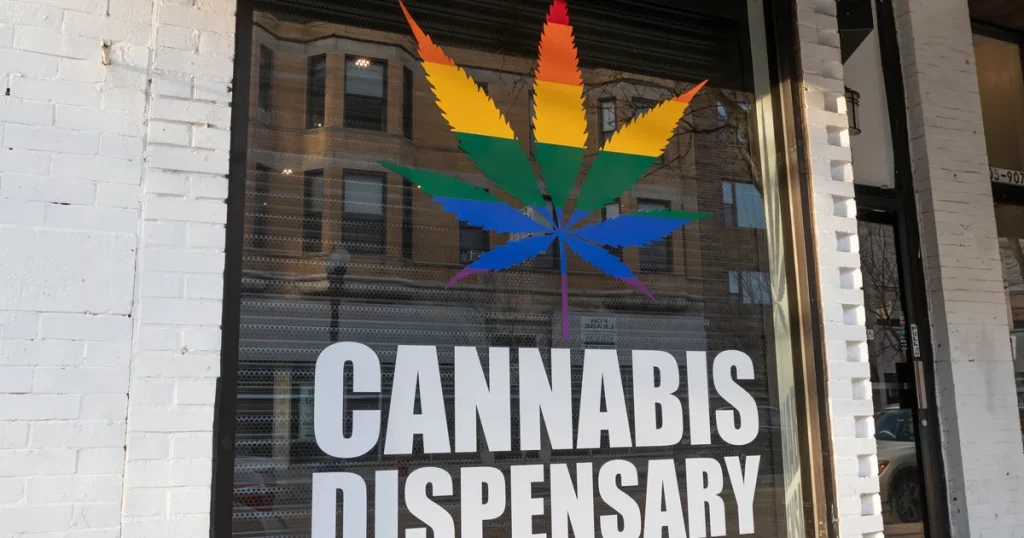
Legal cannabis dispensary in Illinois Photo: Adobe Stock (editorial use only).
What the law says
Legal
- for a person who is 21 years of age or older and a resident of this State, the possession limit is as follows:
- 60 grams of cannabis flower;
- no more than 1000 milligrams of THC contained in cannabis-infused product;
- 10 grams of cannabis concentrate
Not legal
- using cannabis:
- in any motor vehicle;
- in any public place;
- operating, navigating, or being in actual physical control of any motor vehicle, aircraft, watercraft, or snowmobile while using or under the influence of cannabis
Quoted from 410 ILCS 705/10-10.
How old do you have to be to use marijuana in Illinois?
You have to be 21 to buy weed in Illinois for adult use. Licensed dispensaries sell to adults 21 and older. Medical patients under 21 may receive medical cannabis through the medical program, often with a caregiver. Possession or use by anyone under 21 who is not a medical patient remains illegal.
How much marijuana can you have in Illinois?
Illinois residents 21 and older can have up to 60 grams of cannabis flower, 10 grams of concentrate, and 1,000 milligrams of THC in infused products. Those limits are cumulative, so you can have the full amount in each category at once. Nonresidents 21 and older may have half as much: 30 grams, 5 grams and 500 milligrams. At home, extra cannabis from a medical patient's five plants must stay secured at the residence if it is over 60 grams. In a moving car, lawful cannabis must be in a secured, sealed, odor-proof, child-resistant container in its original packaging.
Where can you buy marijuana in Illinois?
You can buy weed in Illinois at state-licensed dispensaries. Adults 21 and older need a valid ID. Medical patients can buy at medical dispensaries, including through a caregiver. Local governments can affect where stores operate, so access varies by location. Buying from unlicensed sellers is not legal.
Can you grow marijuana at home in Illinois?
Only registered qualifying medical cannabis patients may grow at home in Illinois, and then only up to five plants in an enclosed, locked space. Adult-use consumers who are not medical patients cannot legally grow. Medical patients may not give away the cannabis they grow, and seeds may not be given or sold to anyone who is not a qualifying patient.
Where can you use marijuana in Illinois?
You can smoke weed in Illinois mainly on private property. The law bans using cannabis in any public place, in any motor vehicle, in government buildings, on school grounds, in a correctional facility, and knowingly next to anyone under 21 who is not a medical patient. Smoking cannabis is also banned wherever the Smoke Free Illinois Act bans smoking. Some cities may allow licensed consumption lounges.
How do you get a medical marijuana card in Illinois?
To get a medical marijuana card in Illinois, you need a qualifying condition and a certification from a registered health-care professional, then you apply through the state's medical cannabis program. Registered patients may possess medical cannabis and, if they choose, grow up to five plants at home. Patients under 21 typically use a caregiver to purchase.
Can visitors buy or use marijuana in Illinois?
Yes. Out-of-state visitors can buy marijuana in Illinois if they are 21 or older. They may possess only the nonresident limits: 30 grams of flower, 5 grams of concentrate, and 500 milligrams of THC in infused products. They follow the same public-use and vehicle-container rules. Taking cannabis out of Illinois isn't protected by state law and remains illegal under federal law.
What are the rules on driving and marijuana in Illinois?
No, you can't drive high in Illinois. It is illegal to drive under the influence of cannabis. Illinois also treats 5 nanograms of THC in whole blood, or 10 nanograms in another bodily substance, within two hours of driving as a DUI standard. Using cannabis in a motor vehicle is separately illegal, and cannabis in a moving car must be sealed and not easily accessible.
Can an employer in Illinois fire you for using marijuana?
Yes, you can get fired for using marijuana in Illinois, even legally off the job, if your employer has a drug-free workplace or zero-tolerance policy. The Cannabis Regulation and Tax Act lets employers keep reasonable, nondiscriminatory workplace drug policies. Public-safety employers, including for police, corrections and firefighters, have extra authority to restrict on-duty and off-duty use.
What are the penalties for breaking marijuana laws in Illinois?
In Illinois, going over the possession limit, transporting cannabis outside a proper container, or using it in public can bring criminal or ordinance charges. Transporting cannabis in a moving vehicle in the wrong kind of container is a Class A misdemeanor. Selling without a license remains a crime. People under 21 who possess cannabis outside the medical program also face penalties.
Are CBD, hemp and delta-8 products legal in Illinois?
CBD from hemp can be legal in Illinois, but the state has been aligning intoxicating hemp products with cannabis rules. Effective November 12, 2026, products that exceed the new federal total-THC and per-container limits, including many delta-8 and THCA items, are treated as cannabis rather than hemp. Separately, a stricter federal hemp definition, with a total-THC standard that counts THCA and a 0.4 mg-per-container cap, takes effect December 11, 2026.
Does federal law still apply in Illinois?
Yes. Federal law still applies in Illinois. Marijuana remains a Schedule I controlled substance under federal law, with one exception: since April 28, 2026, marijuana covered by a state medical marijuana license and FDA-approved marijuana products are in Schedule III. A broader federal rescheduling proceeding was stayed on September 29, 2026, and has no decision date. State law does not change federal rules on federal land, on carrying marijuana across state lines, or on federally required drug testing, such as for DOT-regulated jobs.
Has the law in Illinois changed recently, or is it about to?
Yes. The biggest 2026 change for consumers is the possession-limit increase. Public Act 104-463 took effect June 12, 2026, and doubled resident limits to 60 grams of flower, 10 grams of concentrate and 1,000 milligrams of THC in infused products, with nonresidents at half those amounts. Home grow is still medical-only. At the federal level, state-licensed medical marijuana moved to Schedule III on April 28, 2026. New federal hemp limits begin November 12 and December 11, 2026.
Legislation
Sources (5)
General information, not legal advice. Laws change often, so check with the state's cannabis agency before relying on this.
← See all states on the map