

Getting started Lifecycle Germination
Photoperiod, autoflower, feminized, regular: which seeds to buy
Photoperiod plants flower when nights get long, so you decide when. Autoflowers flower with age, on their own schedule. Feminized seeds give almost all female plants. For a first grow, feminized photoperiod…
On this page
People often mix up two separate choices: how the plant decides when to flower, and whether the seeds are feminized.
How the plant decides to flower
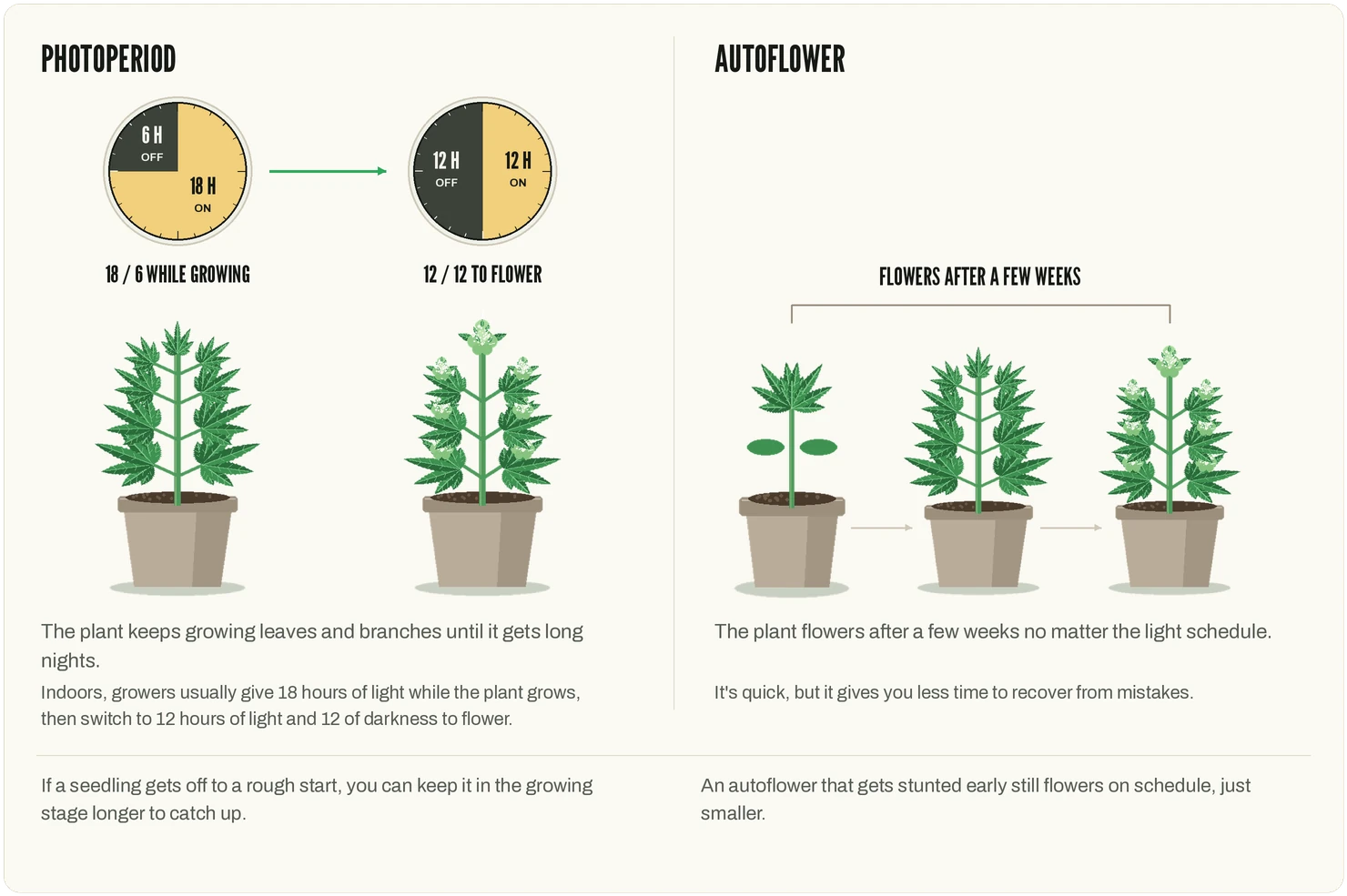
- Photoperiod. The plant keeps growing leaves and branches until it gets long nights. Indoors, growers usually give 18 hours of light while the plant grows, then switch to 12 hours of light and 12 of darkness to flower. A 2021 study found the highest flowering response at 12 and 13.2 hours of light, but in tissue-cultured pieces of one genotype, called 802. That’s not a whole-plant threshold or proof that 12/12 is optimal for every cultivar.
- Autoflower. The plant flowers after a few weeks no matter the light schedule. It’s quick, but it gives you less time to recover from mistakes.
Feminized or regular
- Feminized. Nearly all plants are female, which is what you want for flower.
- Regular. About half are male. They’re useful for breeding. If you want unpollinated flower, leave room to spot and separate the males.
What to buy for a first grow
Feminized photoperiod seeds. If a seedling gets off to a rough start, you can keep it in the growing stage longer to catch up. An autoflower that gets stunted early still flowers on schedule, just smaller.
Autoflowers make sense for short outdoor summers, or if you want a quick, compact plant.
One caveat
Feminized seed lowers the chance of male plants. It doesn’t remove the need to check for them. Genetics and growing conditions can affect sex expression, and no seed lot is an absolute guarantee. See the guide on sexing plants.
Sources (2)
- Moher, M., Jones, M., & Zheng, Y. (2021). Photoperiodic response of in vitro Cannabis sativa plants. HortScience, 56(1), 108–113. https://doi.org/10.21273/HORTSCI15452-20 [Evidence access: ABSTRACT VERIFIED; full text NOT VERIFIED.]
- Livingston, S. J., et al. (2020). Cannabis glandular trichomes alter morphology and metabolite content during flower maturation. The Plant Journal, 101(1), 37–56. https://onlinelibrary.wiley.com/doi/full/10.1111/tpj.14516 [Evidence access: FULL TEXT VERIFIED.]