

Lifecycle Training and technique Seedling Vegetative
How to take and root cannabis clones
One cannabis-cutting study found better rooting with the tested 0.2% IBA gel than with the tested willow-extract gel. Three leaves improved root quality, not rooting success, and trimming leaf tips reduced rooting…
On this page
A clone is a cutting from a healthy plant that grows roots and becomes a copy of its mother.
What research found
Researchers tested four common practices on cannabis cuttings:
- Rooting hormone. The tested 0.2 percent IBA gel gave about 2.1 times the rooting success of the tested willow-extract gel. That compared two formulations. It doesn’t prove the same benefit over every untreated cutting or rooting product.
- Leaf number. Cuttings with three fully expanded leaves had better root quality than those with two, but leaf number didn’t change rooting success.
- Trimming leaf tips. Cutting off leaf tips lowered rooting success, from 71 percent to 53 percent in the study, and didn’t improve root quality.
- Where you cut. Cuttings from top and lower branches rooted about equally.
Step by step
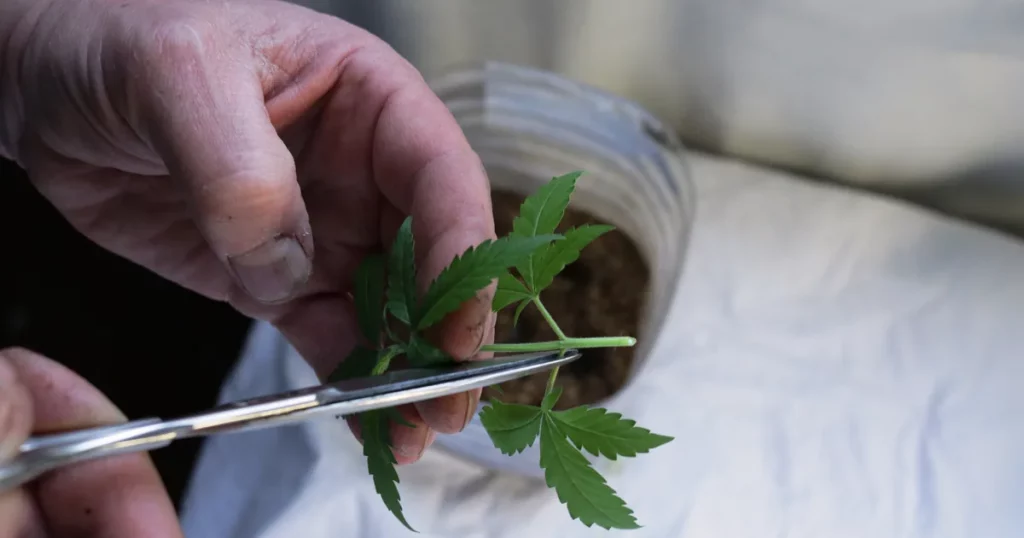
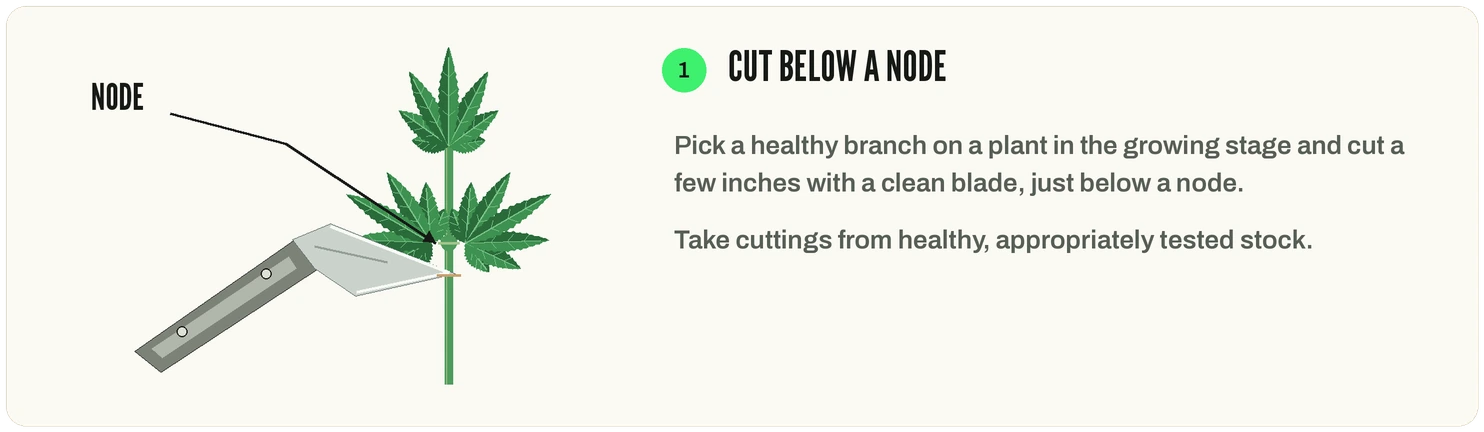
- Pick a healthy branch on a plant in the growing stage and cut a few inches with a clean blade, just below a node.
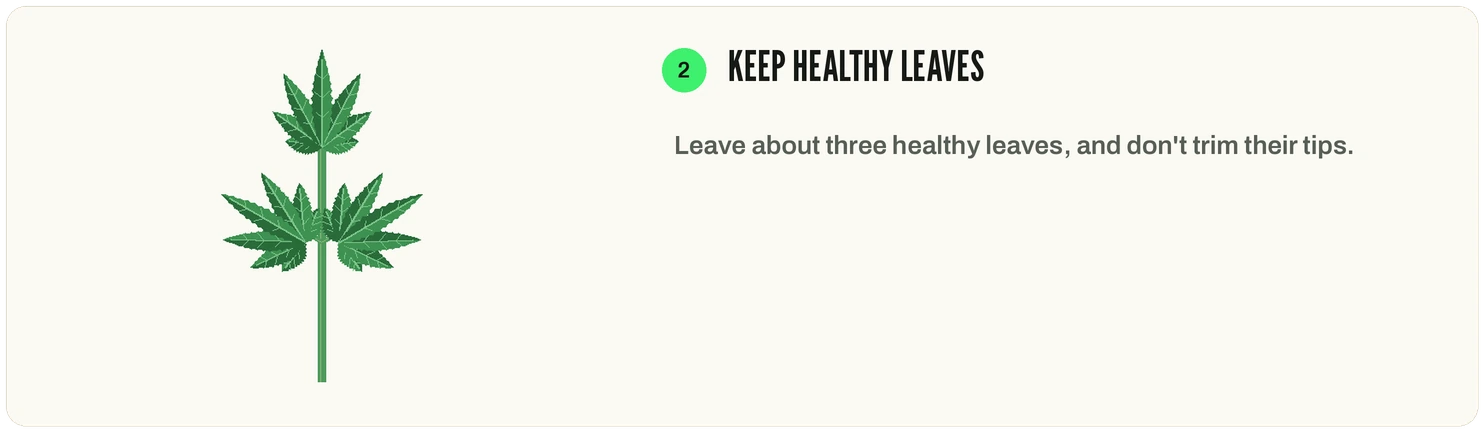
- Leave about three healthy leaves, and don’t trim their tips.
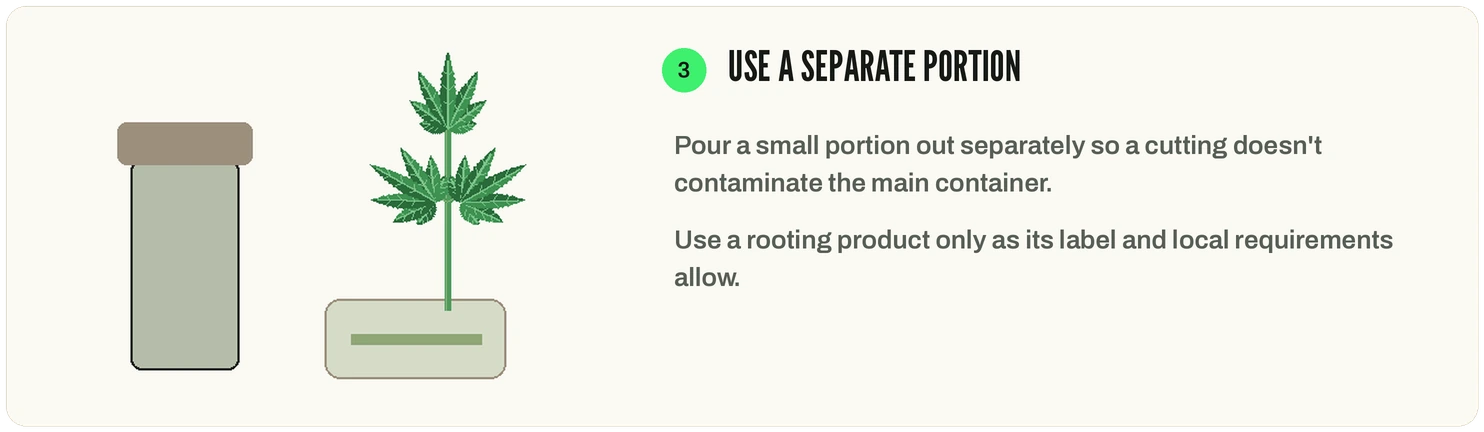
- Use a rooting product only as its label and local requirements allow. Pour a small portion out separately so a cutting doesn’t contaminate the main container.
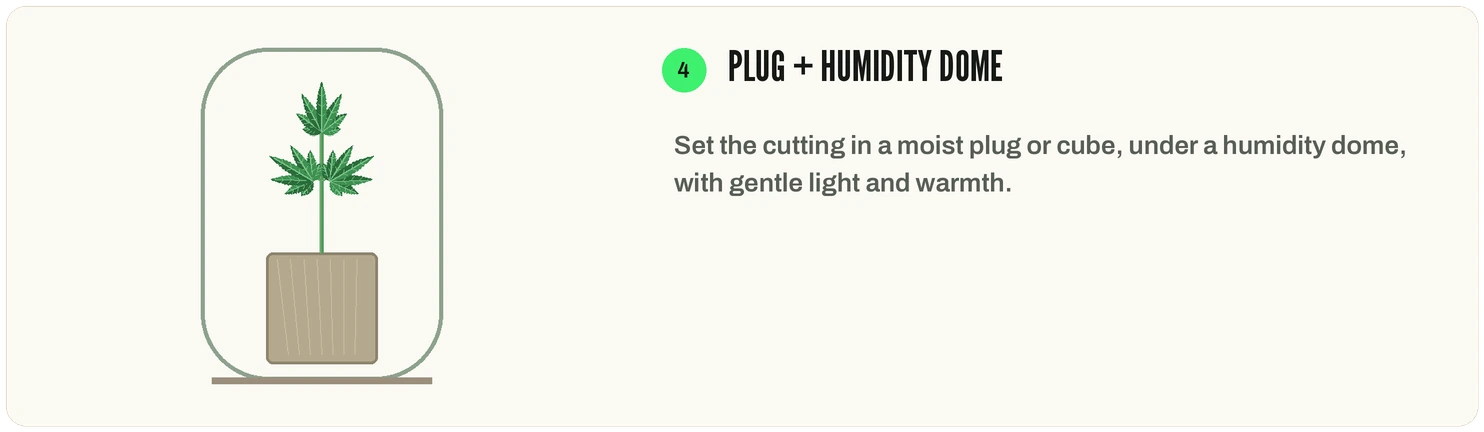
- Set the cutting in a moist plug or cube, under a humidity dome, with gentle light and warmth.
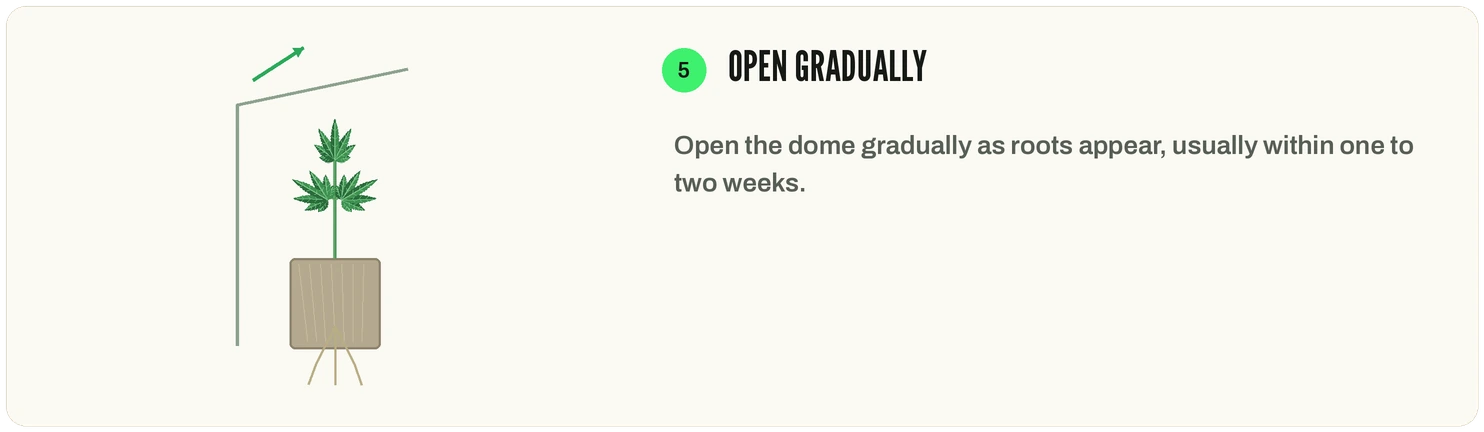
- Open the dome gradually as roots appear, usually within one to two weeks.
Take cuttings from healthy, appropriately tested stock. Keep incoming plants separate and inspect them, but a couple of symptom-free weeks can’t rule out HLVd. Clean tools between plants with an appropriate validated protocol; alcohol alone isn’t reliable against HLVd.
Sources (2)
- Caplan, D., Stemeroff, J., Dixon, M., & Zheng, Y. (2018). Vegetative propagation of cannabis by stem cuttings: effects of leaf number, cutting position, rooting hormone, and leaf tip removal. Canadian Journal of Plant Science, 98(5), 1126–1132. https://doi.org/10.1139/cjps-2018-0038 [Evidence access: FULL AUTHOR MANUSCRIPT VERIFIED.]
- Ocamb, C. M. (2024). Hop latent viroid in hemp. Oregon State University Extension, EM 9570. https://extension.oregonstate.edu/catalog/em-9570-hop-latent-viroid-hemp [Evidence access: EXTENSION TEXT VERIFIED.]