

Lifecycle Training and technique Vegetative
Training basics: topping, FIMing, LST and supercropping
Training shapes the canopy through pruning or bending. Some treatments improved cannabinoid uniformity across different plant sites in a greenhouse study, but that does not mean every training method increases yield. Start…
On this page
Left alone, a cannabis plant grows like a Christmas tree, with one main top and weaker shoots below. Training evens that out.
The main methods
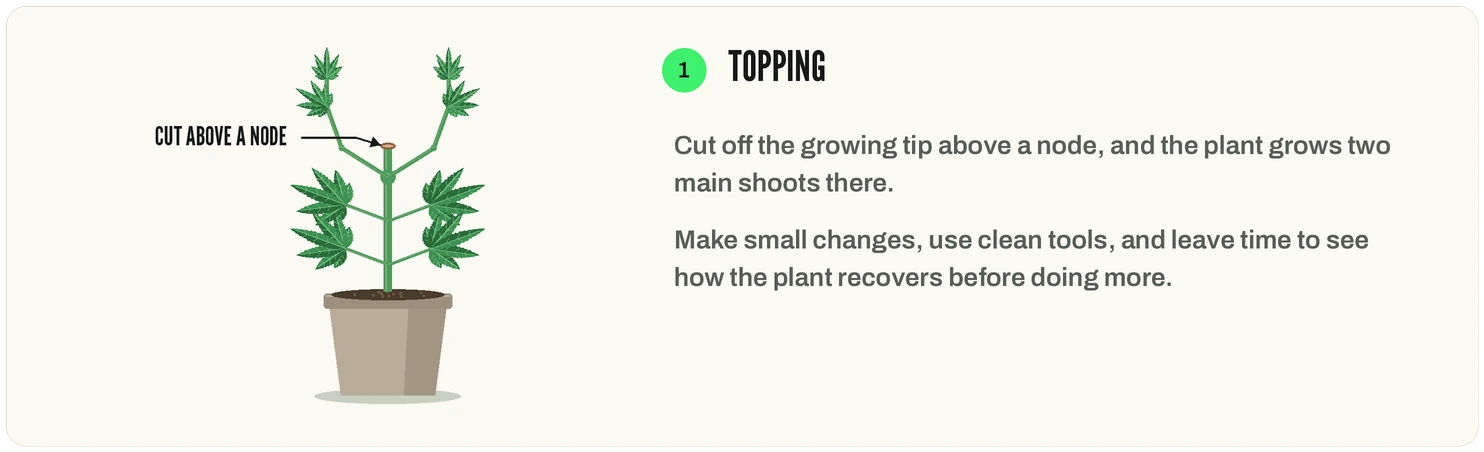
- Topping: cut off the growing tip above a node, and the plant grows two main shoots there. Wait until the plant is healthy and has around five nodes.
- FIMing: pinch off most of the tip, leaving a little. It can give more shoots, but messier ones.
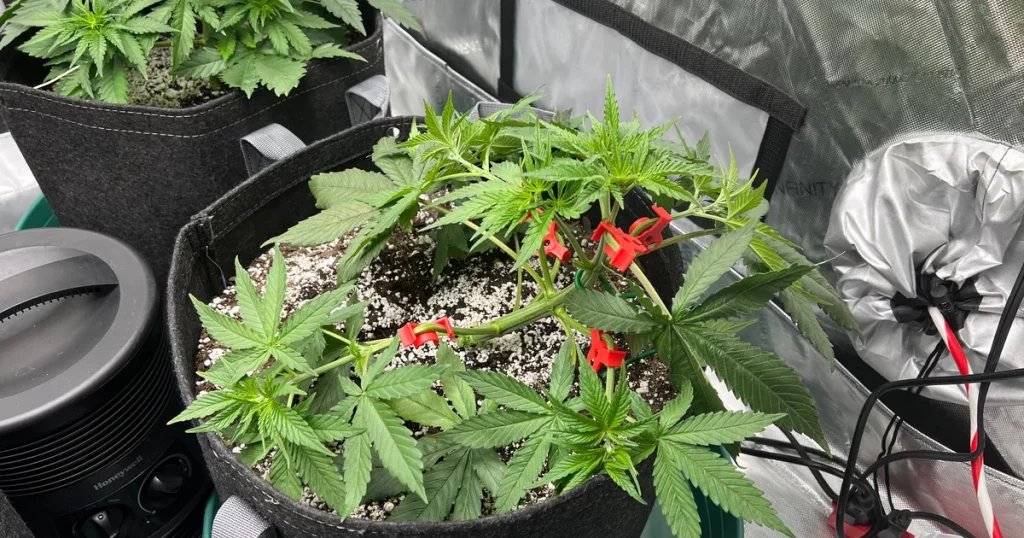
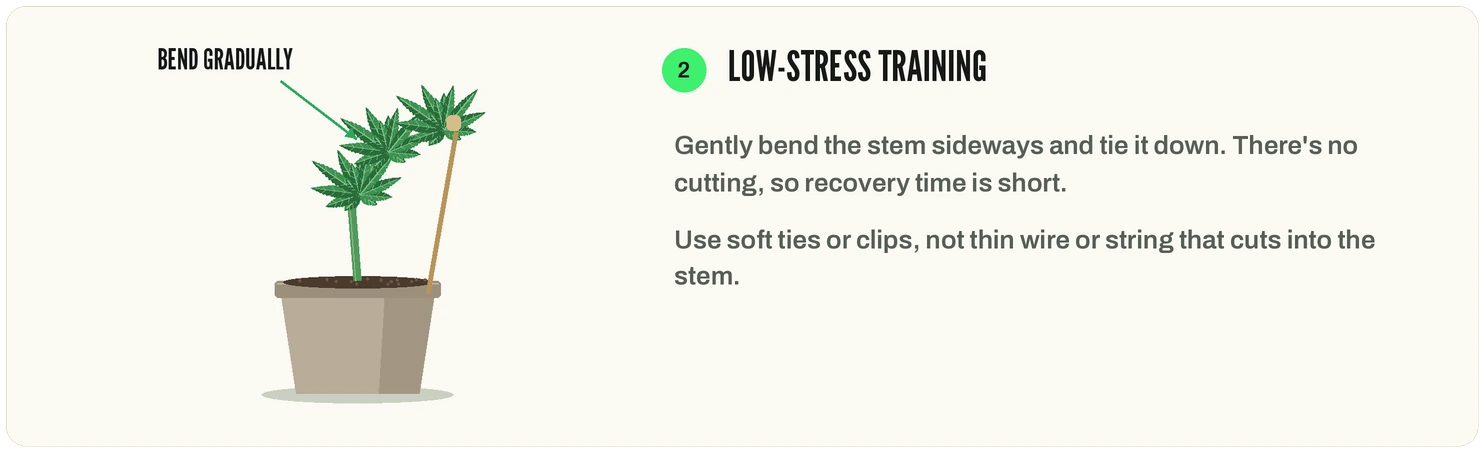
- Low-stress training (LST): gently bend the stem sideways and tie it down. There’s no cutting, so recovery time is short.
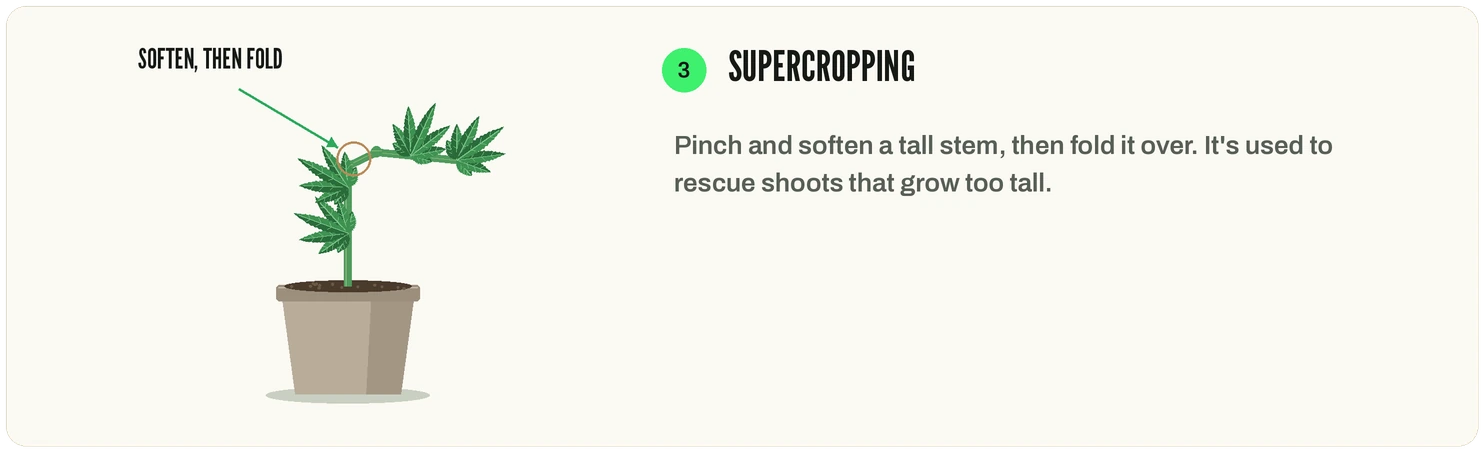
- Supercropping: pinch and soften a tall stem, then fold it over. It’s used to rescue shoots that grow too tall.
- Mainlining: repeated toppings to build a symmetrical structure. It takes extra time to recover.
Safe LST
- Pick a young, flexible shoot on a healthy plant and bend it gradually. Don’t deliberately wilt the plant, force a woody stem or bend until tissue tears.
- Use soft ties or clips, not thin wire or string that cuts into the stem.
- Check ties every few days, since stems thicken.
What research shows
In a greenhouse study of large, CBD-rich Topaz plants, some pruning and defoliation treatments improved cannabinoid uniformity across different sites. Some treatments didn’t raise total yield, and severe branch removal reduced it. This isn’t direct evidence that every method listed here improves yield.
The node count and techniques above are grower starting points, not a tested universal schedule. Make small changes, use clean tools, and leave time to see how the plant recovers before doing more.
Sources (2)
- Danziger, N., & Bernstein, N. (2021). Shape matters: Plant architecture affects chemical uniformity in large-size medical cannabis plants. Plants, 10(9), 1834. https://www.mdpi.com/2223-7747/10/9/1834 [Evidence access: FULL TEXT VERIFIED.]
- Ocamb, C. M. (2024). Hop latent viroid in hemp. Oregon State University Extension, EM 9570. https://extension.oregonstate.edu/catalog/em-9570-hop-latent-viroid-hemp [Evidence access: EXTENSION TEXT VERIFIED.]