

Feeding and water Flowering Seedling Vegetative
Cal-Mag and magnesium: when you need them
You're most likely to need extra calcium and magnesium if you use RO or very soft water, or grow in coco. Calcium problems show up on new growth. Too much Cal-Mag can…
On this page
Calcium and magnesium are needed in decent amounts. Some hard water supplies useful calcium and magnesium, but amounts vary. RO water usually contains much less, though the actual composition depends on the system and source.
When you may need a supplement
- You use RO, distilled or rain water.
- You grow in coco, which tends to hold on to these minerals.
- Your feed doesn’t already include them.
What deficiency looks like
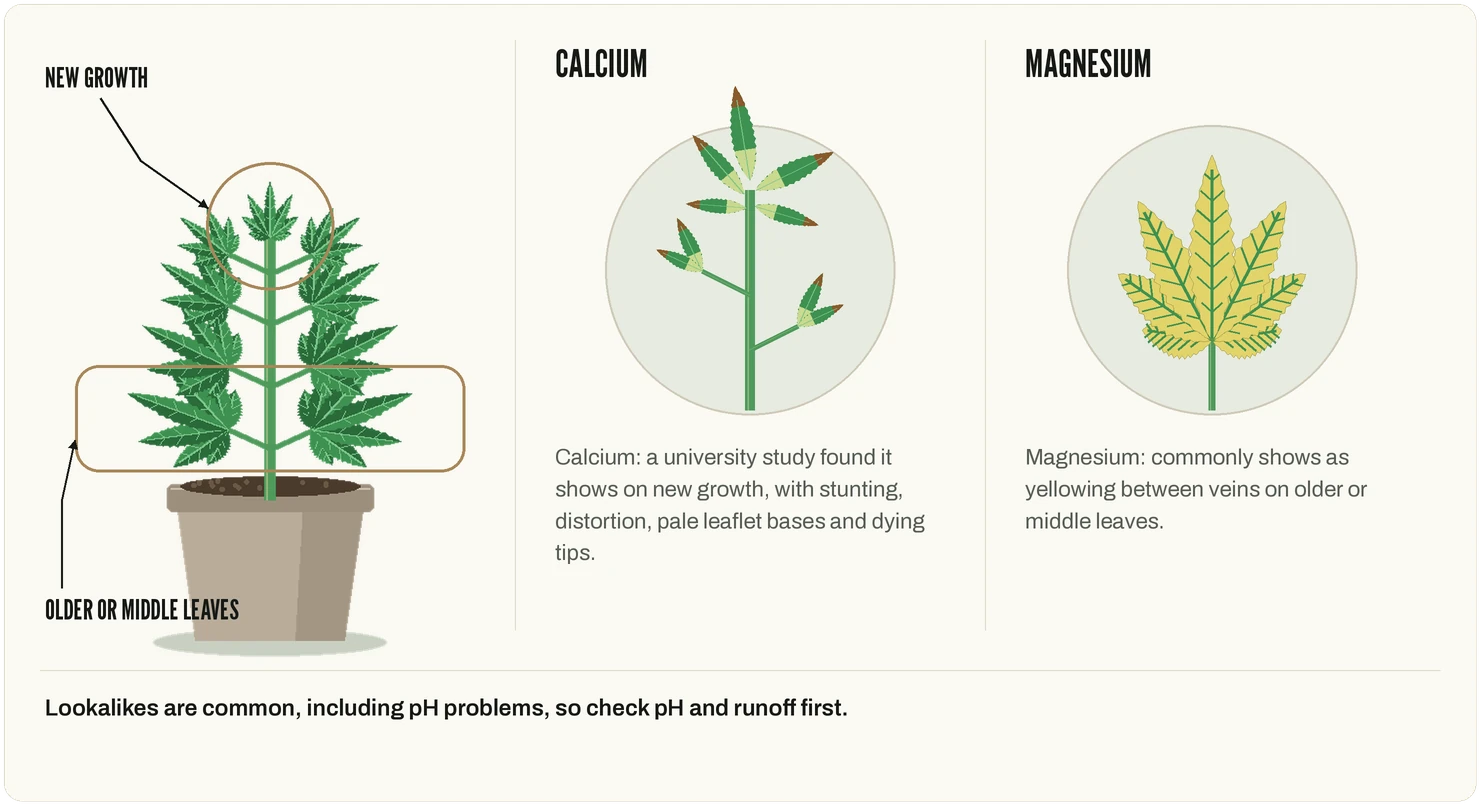
- Calcium: a university study found it shows on new growth, with stunting, distortion, pale leaflet bases and dying tips.
- Magnesium: commonly shows as yellowing between veins on older or middle leaves.
Lookalikes are common, including pH problems, so check pH and runoff first.
Watch the side effects
Check the label: many liquid Cal-Mag products contain nitrate, so they also add some nitrogen. If you only need magnesium, plain Epsom salt (magnesium sulfate) supplies magnesium and sulfur without nitrogen. Use it only for a reason you’ve established from the nutrient program, water analysis and symptoms.
Follow a suitable product’s directions, and measure by mass when you make up a nutrient solution. A spoon dose doesn’t account for what’s already there. Too much of one nutrient can also block uptake of others.
Tips
- Use a water report or analysis for calcium, magnesium, sodium and alkalinity. EC alone can’t tell you which of these your water contains.
- Follow the nutrient manufacturer’s mixing order. Add each component to the water separately, mix thoroughly, and never combine concentrates directly. Adjust pH only after mixing and checking the complete solution.
- Don’t pour more on at the first spot.
Sources (4)
- Cockson, P., Landis, H., Smith, T., Hicks, K., & Whipker, B. E. (2019). Characterization of nutrient disorders of Cannabis sativa. Applied Sciences, 9(20), 4432. https://www.mdpi.com/2076-3417/9/20/4432 [Evidence access: FULL TEXT VERIFIED.]
- UMass Extension. Water quality: pH and alkalinity. https://ag.umass.edu/greenhouse-floriculture/fact-sheets/water-quality-ph-alkalinity [Evidence access: EXTENSION TEXT VERIFIED.]
- University of Minnesota Extension. Small-scale hydroponics. https://extension.umn.edu/how/small-scale-hydroponics [Evidence access: EXTENSION TEXT VERIFIED.]
- Bevan, L., Jones, M., & Zheng, Y. (2021). Optimisation of nitrogen, phosphorus, and potassium for soilless production of Cannabis sativa in the flowering stage using response surface analysis. Frontiers in Plant Science, 12, 764103. https://www.frontiersin.org/journals/plant-science/articles/10.3389/fpls.2021.764103/full [Evidence access: FULL TEXT VERIFIED.]