

Harvest and cure Lifecycle Drying and curing
Curing and storing cannabis
Start curing only after the flower is properly dry, keep an eye on moisture, and store whole flower sealed, cool and dark. A controlled storage study favored 4°C, but prevent condensation if…
On this page
Curing lets moisture even out inside dried flower. Many growers prefer the aroma and handling that result, but a set number of weeks doesn’t guarantee better smoke or microbial safety.
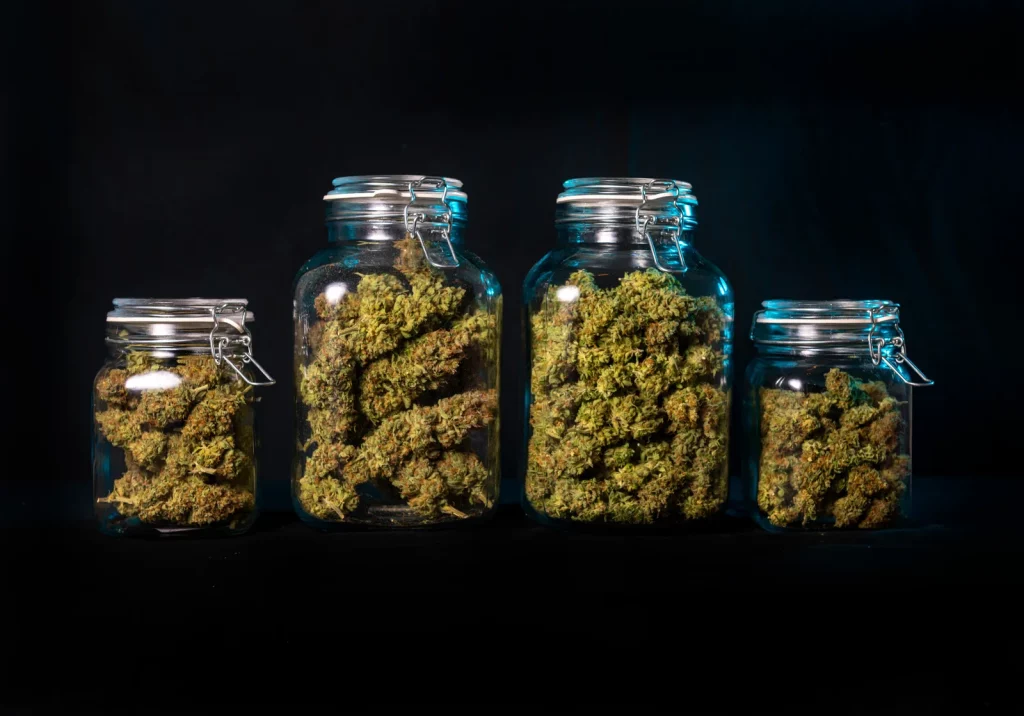
Jar curing
- Fill glass jars about three-quarters full and add a small hygrometer.
- For the first week or two, open each jar for a few minutes a day.
- If the settled jar humidity rises toward or above the mid-60s, the flower may need more drying. Check for spoilage before it goes back into storage. Opening the lid for a few minutes isn’t a dependable way to dry wet flower.
- After a couple of weeks, open the jars less often. Many growers cure for 2 to 4 weeks or more.
Reading the jar
| Jar humidity | What it means |
|---|---|
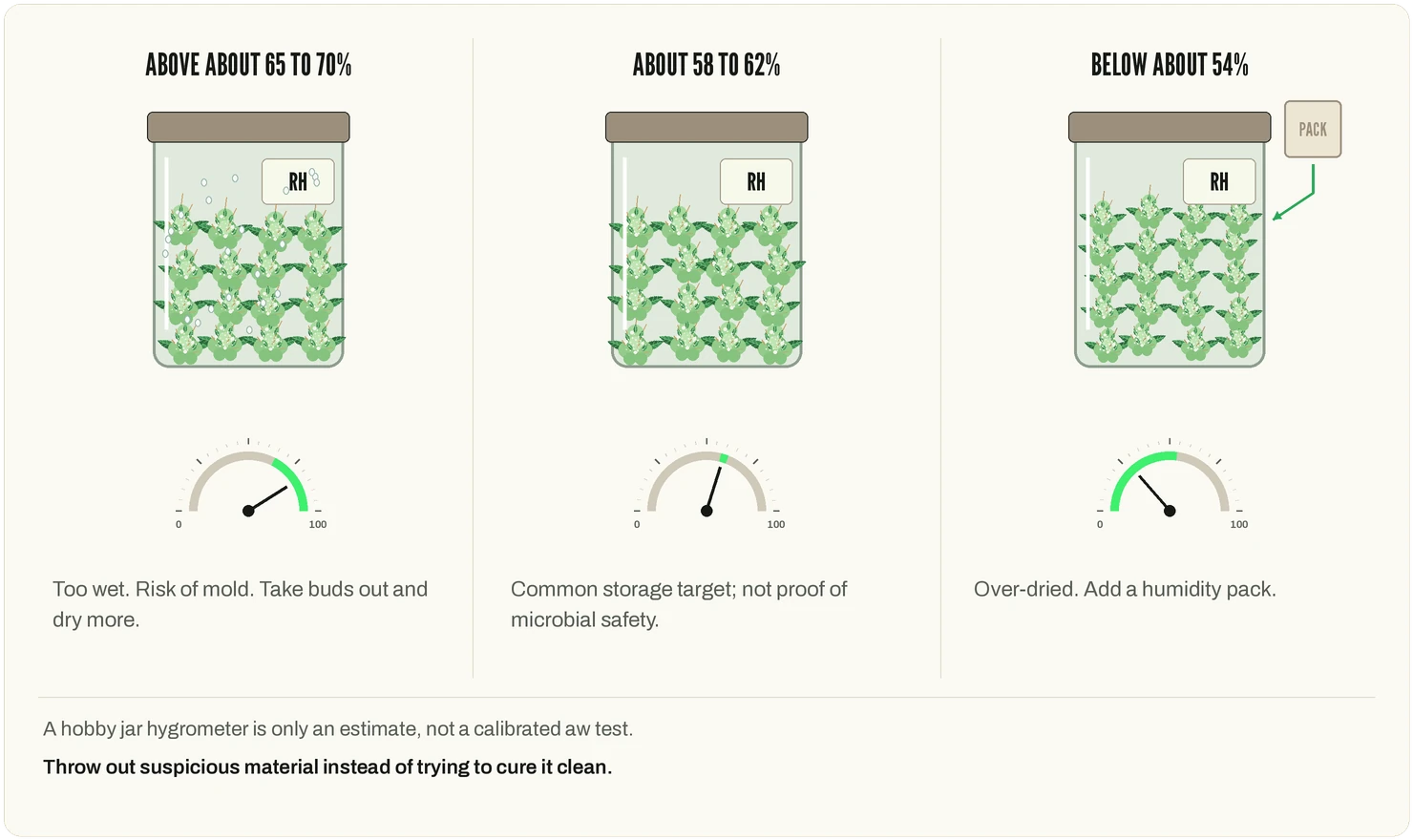
| Above about 65 to 70 percent | Too wet. Risk of mold. Take buds out and dry more. |
| About 58 to 62 percent | Common storage target; not proof of microbial safety. |
| Below about 54 percent | Over-dried. Add a humidity pack. |
Jars or curing bags?
Clean, intact glass jars can be reused, but seals wear out and glass can break. Many growers open jars during early curing to keep an eye on conditions. Curing bags are lower fuss, but they only work if the flower is properly dry first.
Storing
For everyday storage, use clean, airtight containers in a cool, dark, stable place away from children and pets. If you refrigerate, keep the container sealed while it warms back to room temperature before opening, so less condensation forms on the cold flower. Avoid repeated warming and cooling.
In a controlled study, Milay and colleagues compared whole and ground flower of two chemovars in sealed bottles, all kept in darkness, at −80, −30, 4 and 25°C for up to a year. Whole flower at 4°C did best overall under those conditions. Terpenoids declined in every condition, and grinding and the deep-freezing treatments were unfavorable for preserving them. That doesn’t show every household refrigerator, or every freezing method, is better or worse.
At equilibrium and the same temperature, water activity roughly corresponds to headspace relative humidity divided by 100. A hobby jar hygrometer is only an estimate, not a calibrated aw test. ASTM’s 0.55–0.65 range doesn’t make existing mold or contamination disappear. Throw out suspicious material instead of trying to cure it clean.
Sources (3)
- ASTM International (2022). ASTM D8197-22: Standard specification for maintaining acceptable water activity (aw) range (0.55 to 0.65) for dry cannabis flower intended for human/animal use. https://store.astm.org/d8197-22.html [Evidence access: PUBLIC ABSTRACT/SCOPE VERIFIED; paid full standard NOT VERIFIED.]
- Milay, L., Berman, P., Shapira, A., Guberman, O., & Meiri, D. (2020). Metabolic profiling of cannabis secondary metabolites for evaluation of optimal postharvest storage conditions. Frontiers in Plant Science, 11, 583605. https://www.frontiersin.org/journals/plant-science/articles/10.3389/fpls.2020.583605/full [Evidence access: FULL TEXT VERIFIED.]
- Punja, Z. K., Collyer, D., Scott, C., Lung, S., Holmes, J., & Sutton, D. (2019). Pathogens and molds affecting production and quality of Cannabis sativa L. Frontiers in Plant Science, 10, 1120. https://www.frontiersin.org/journals/plant-science/articles/10.3389/fpls.2019.01120/full [Evidence access: FULL TEXT VERIFIED.]