

Environment Feeding and water Lifecycle Flowering Late flower
The flowering stage, week by week
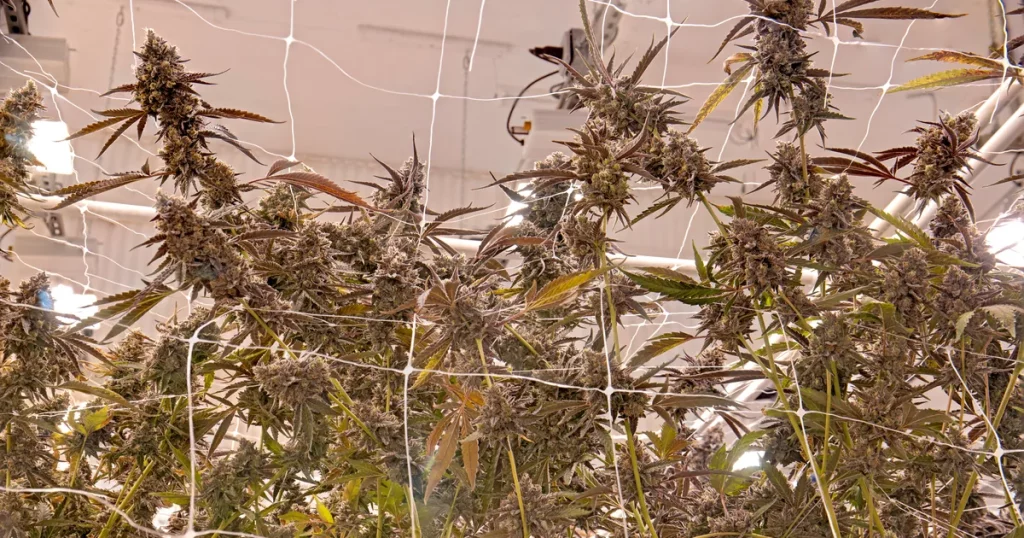
Stretch, bud building and ripening provide a useful map of flowering, but their timing varies by cultivar and conditions. Use the example weeks as a guide, support developing branches and manage moisture…
On this page
The clock starts when you switch photoperiod plants to 12 hours of light and 12 of unbroken darkness. Autoflowers aren’t started by a 12/12 switch. Treat the weeks below as an example sequence, not a schedule every cultivar will follow.
Weeks 1 to 3: the stretch
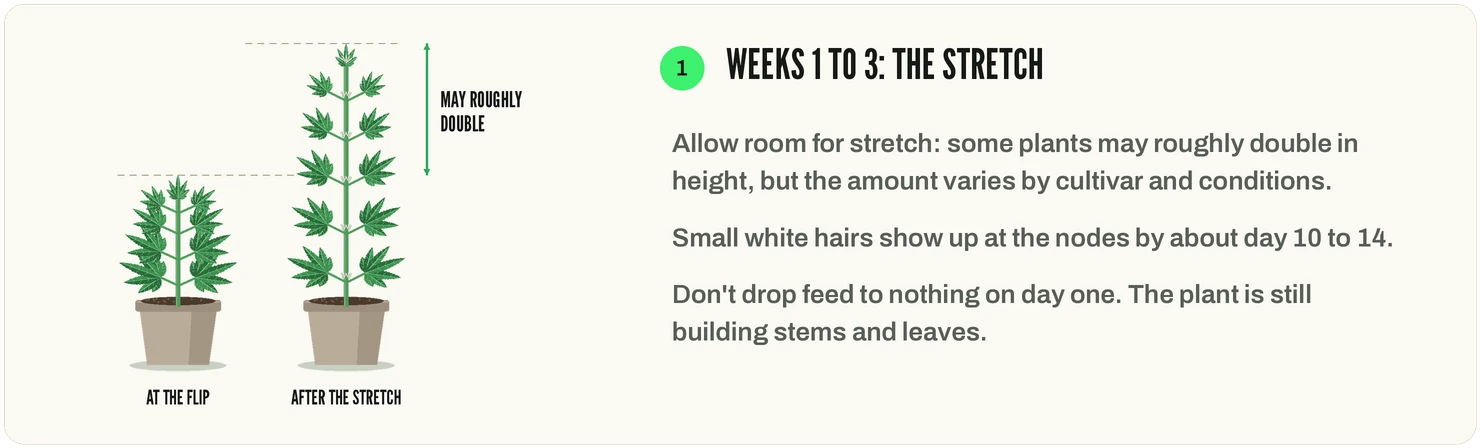
- Allow room for stretch: some plants may roughly double in height, but the amount varies by cultivar and conditions. If using a net, guide flexible shoots gently rather than forcing them.
- Small white hairs show up at the nodes by about day 10 to 14.
- Don’t drop feed to nothing on day one. The plant is still building stems and leaves.
- Keep day and night temperatures fairly close. Growers report this reduces stretch.
Weeks 4 to 6: buds fill out
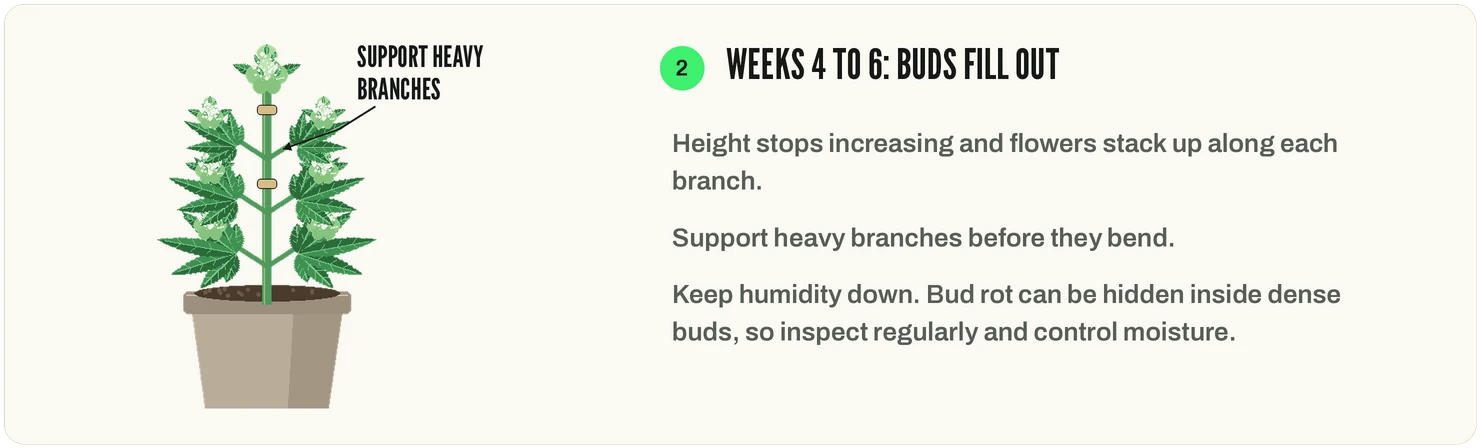
- Height stops increasing and flowers stack up along each branch.
- Support heavy branches before they bend.
- Keep humidity down. Bud rot can be hidden inside dense buds, so inspect regularly and control moisture.
Weeks 7 and beyond: ripening
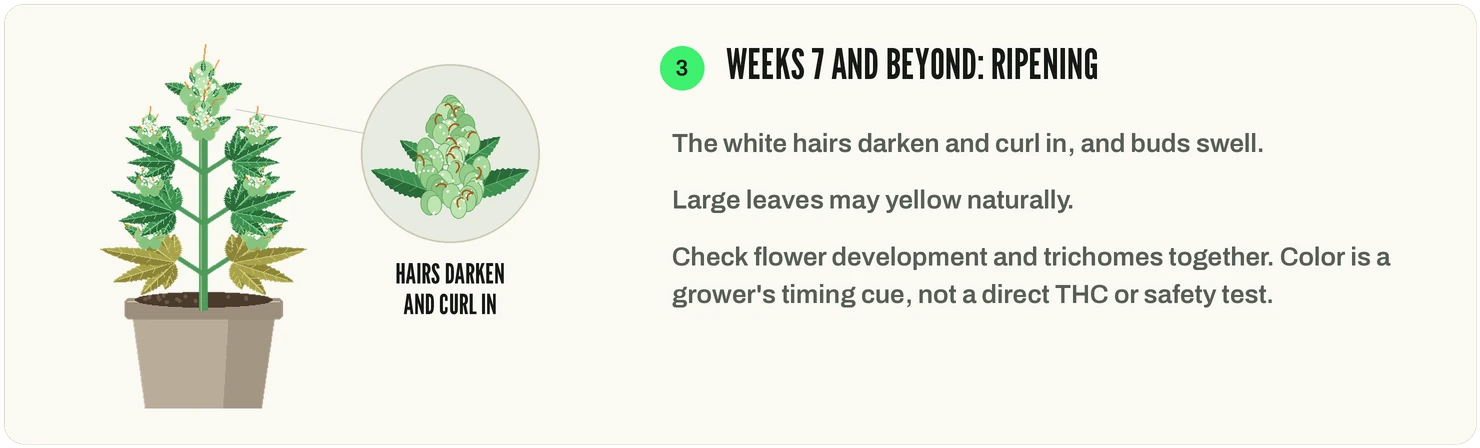
- The white hairs darken and curl in, and buds swell.
- Large leaves may yellow naturally. See the late flower guide.
- Check flower development and trichomes together. Color is a grower’s timing cue, not a direct THC or safety test.
What research says about flowering feed
The research gives no reason to assume extra bloom booster always helps, though the findings below are system-specific, not a universal recipe.
Bevan and colleagues modeled flower yield in one high-THC cultivar, Gelato, in deep-water culture. The model predicted a maximum around 194 mg/L elemental nitrogen and 59 mg/L elemental phosphorus. Potassium didn’t affect yield across 60 to 340 mg/L in that experiment. A separate perlite study in two cultivars found 30 to 90 mg/L phosphorus supported plant function.
Light leaks and re-vegging
Strong enough or repeated light interruptions during the dark period can interfere with flowering in photoperiod cultivars. One sign is leaves growing out of buds that look smooth and single-bladed. Restore a consistent dark period and monitor new growth. Recovery time and the effect on flowering vary; correcting a leak does not guarantee the original schedule will resume.
Pistils turning orange early
This can be normal ripening. If it happens earlier than expected, it can mean touching or brushing, heat or wind, or pollination. Look for developing seeds before you worry.
Sources (5)
- Bevan, L., Jones, M., & Zheng, Y. (2021). Optimisation of nitrogen, phosphorus, and potassium for soilless production of Cannabis sativa in the flowering stage using response surface analysis. Frontiers in Plant Science, 12, 764103. https://www.frontiersin.org/journals/plant-science/articles/10.3389/fpls.2021.764103/full [Evidence access: FULL TEXT VERIFIED.]
- Shiponi, S., & Bernstein, N. (2021). The highs and lows of P supply in medical cannabis: Effects on cannabinoids, the ionome, and morpho-physiology. Frontiers in Plant Science, 12, 657323. https://www.frontiersin.org/journals/plant-science/articles/10.3389/fpls.2021.657323/full [Evidence access: FULL TEXT VERIFIED.]
- Moher, M., Jones, M., & Zheng, Y. (2021). Photoperiodic response of in vitro Cannabis sativa plants. HortScience, 56(1), 108–113. https://doi.org/10.21273/HORTSCI15452-20 [Evidence access: ABSTRACT VERIFIED; full text NOT VERIFIED.]
- Punja, Z. K., Collyer, D., Scott, C., Lung, S., Holmes, J., & Sutton, D. (2019). Pathogens and molds affecting production and quality of Cannabis sativa L. Frontiers in Plant Science, 10, 1120. https://www.frontiersin.org/journals/plant-science/articles/10.3389/fpls.2019.01120/full [Evidence access: FULL TEXT VERIFIED.]
- Livingston, S. J., et al. (2020). Cannabis glandular trichomes alter morphology and metabolite content during flower maturation. The Plant Journal, 101(1), 37–56. https://onlinelibrary.wiley.com/doi/full/10.1111/tpj.14516 [Evidence access: FULL TEXT VERIFIED.]