

Harvest and cure Lifecycle Harvest
When to harvest: reading trichomes and hairs
Use flower development, cultivar timing and trichome appearance together. Mostly cloudy heads with some amber is a common grower cue, not a universal THC peak or a reliable prediction of effects.
On this page
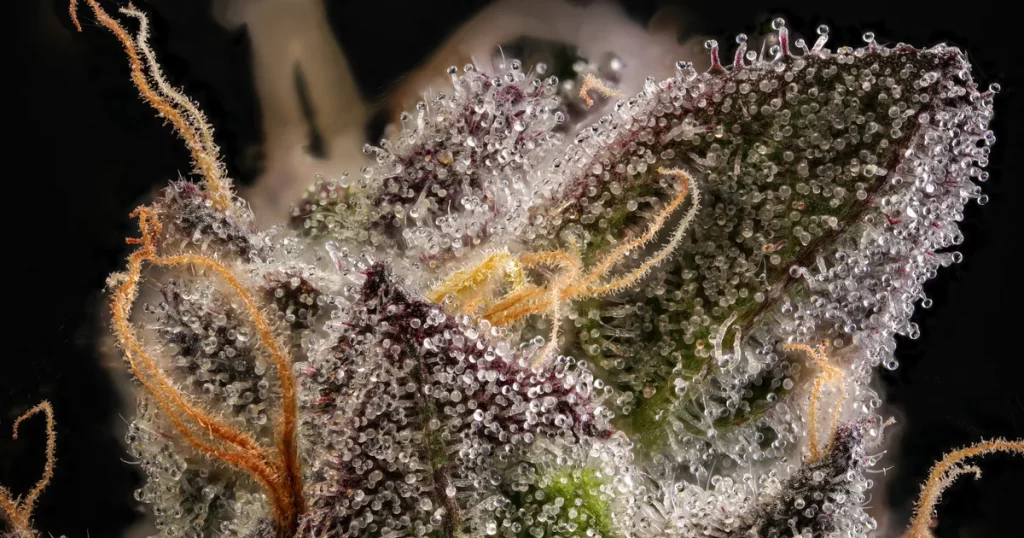
Trichomes are the tiny resin glands on buds, and they change as flowers mature. Read them together with flower development and your cultivar’s timing.
What growers look for
- Clear: still developing. Lots of clear heads can be a cue to keep watching flower development, but they don’t measure cannabinoid concentration.
- Cloudy or milky: a commonly used harvest cue, not a proven universal THC peak.
- Amber: the color has changed with maturation, aging or damage. Amber percentage isn’t a validated way to predict sedation or a specific cannabinoid profile.
The clear, cloudy and amber system is grower practice, not a tested scale, though research does confirm that trichomes change as flowers mature.
How to check
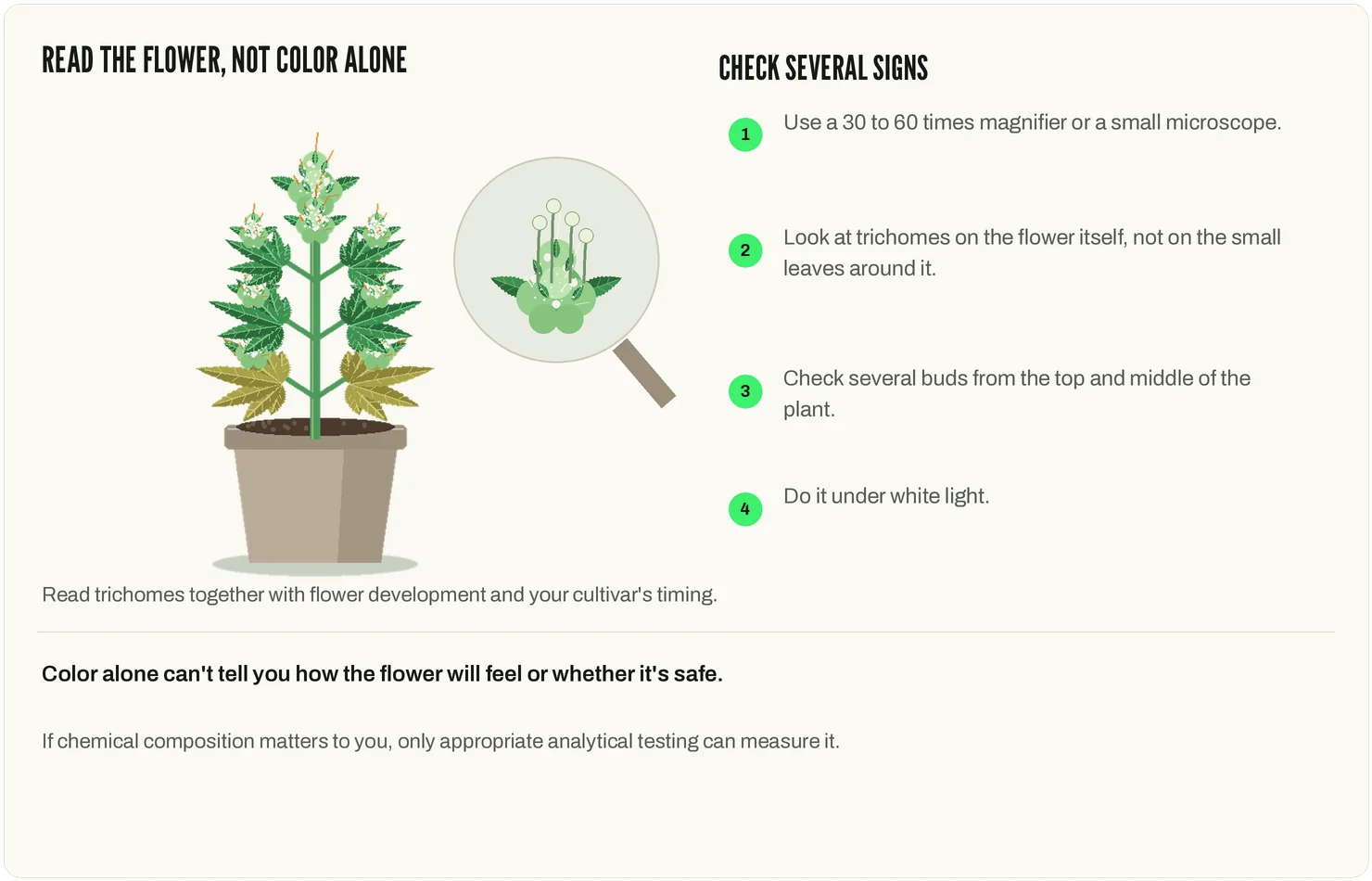
- Use a 30 to 60 times magnifier or a small microscope.
- Look at trichomes on the flower itself, not on the small leaves around it. Leaf and floral trichomes differ, so don’t treat their appearance as interchangeable.
- Check several buds from the top and middle of the plant.
- Do it under white light.
Hairs, swell and day counts
Most pistils darkening and curling in is a good sign, but it isn’t reliable on its own. Day counts from seed packs are estimates.
Too early or too late?
- Too early: flowers may still be gaining biomass and changing chemically. How much timing matters depends on cultivar and conditions.
- Waiting longer: watch plant health and the weather as well as maturity. Color alone can’t tell you how the flower will feel or whether it’s safe.
You can harvest the top buds first and give shaded lower ones extra time.
Livingston and colleagues studied trichome development and chemistry, mainly in Finola hemp with some drug-type comparisons. They didn’t validate a cloudy-to-amber ratio for peak THC or a chosen effect. If chemical composition matters to you, only appropriate analytical testing can measure it.
Sources (1)
- Livingston, S. J., et al. (2020). Cannabis glandular trichomes alter morphology and metabolite content during flower maturation. The Plant Journal, 101(1), 37–56. https://onlinelibrary.wiley.com/doi/full/10.1111/tpj.14516 [Evidence access: FULL TEXT VERIFIED.]