

Pest
Caterpillars in buds: corn earworm and what follows
Tunnels, droppings and wilting tips in flowering buds usually mean caterpillars, often corn earworm outdoors. Check buds by hand from the start of flowering, because the holes they leave can let rot…
On this page
What it looks like
- Tunnels into buds and developing seeds
- Droppings, called frass, in or on the buds
- Wilting leaves and dying bud tissue near the damage
- Some chewed leaves, especially when there aren’t flowers to eat
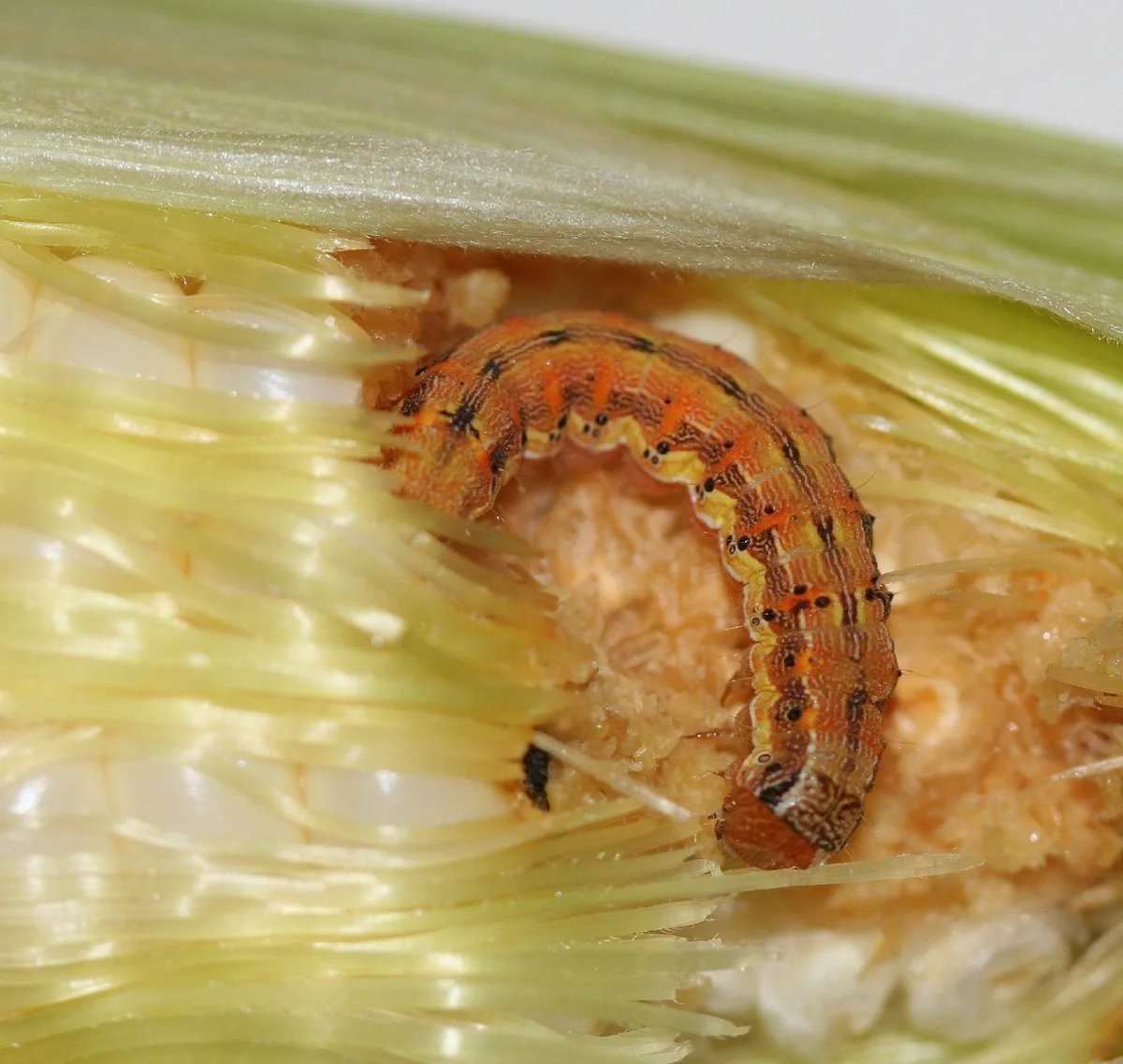
Young caterpillars are small and dark with black bristles. Older ones reach about 1 inch and can be green, brown, pink or yellow, with dark and light stripes running lengthwise and a brown or black head. The adult is a white or tan moth about 1 inch long that’s active at night (Colorado State).
Other caterpillars can feed on cannabis too. The checks and first steps here are the same, but treatment results may not be.
Why it happens
Corn earworm moths are attracted to plants once they flower, usually late in the summer (Cranshaw et al. 2019). They lay eggs singly on young leaves and buds. Some overwinter in the soil and some migrate in from warmer areas, so a clean garden doesn’t fully protect you (Colorado State).
Most of what’s known comes from outdoor crops, where big buds are hit hardest (Cranshaw et al. 2019). It’s been a major problem on CBD hemp in Colorado and Virginia. In Virginia, caterpillars in fields were linked to more bud rot (Virginia Tech). Colorado State adds that feeding wounds let disease in, and that Fusarium is a particular problem (Colorado State).
How to confirm it
- Inspect buds by hand once flowering starts. Open up any that are wilting or have frass on them.
- Look for the caterpillar itself. It’s often inside the bud.
- Check rot carefully. A bud that’s brown or mushy inside might have started with a caterpillar, or it might be rot alone. Either way, look for tunnels and frass.
What to do
- Pick them off. Hand removal works but takes time (Colorado State). On a few plants, it’s the obvious first step.
- Cut out damaged buds. This is our advice rather than a tested finding: open tunnels and frass are where rot can start, so we’d rather lose that bud than risk the ones around it.
- Keep checking. Moths keep laying, so a clean plant one week isn’t clean the next (Colorado State).
- Clear weeds around the garden to reduce food for caterpillars (Colorado State).
- If you use a Bt product, spray early and often. Caterpillars have to eat it, so coverage matters. Virginia Tech advises applying every 2 to 3 days in early morning or late evening during peak pressure, and dead caterpillars may not show up for about 48 hours (Virginia Tech).
Results vary by product. In a Virginia Tech field trial, only spinosad gave effective control. Spinosad couldn’t legally be used on hemp in Virginia at the time. In their lab test, the Bt strain aizawai (sold as XenTari) gave significant control and did better than the other non-spinosad products (Virginia Tech). Check what’s allowed in your state before you buy anything.
Keep sprays off buds you plan to smoke. One study of contaminated flower found residues of four synthetic chemicals carried over into smoke, as much as 69.5% depending on the chemical and the device (Sullivan et al. 2013). We found no similar study for soaps, oils or biological products, so we can’t tell you those are safe to smoke. Few products are registered for cannabis at all (Lemay et al. 2022), and which ones are allowed differs by state, so check the label and your state’s rules first.
How much to trust this
Most of this comes from outdoor industrial hemp, largely CBD crops, and the Virginia results are from small plots and a lab test in one year. No treatment thresholds exist for hemp (Colorado State). Little of this was tested on smokable cannabis, and indoor caterpillar problems aren’t covered.
The bud rot connection is an association seen in fields, along with the reasonable idea that wounds let disease in. It doesn’t show that every rotten bud started with a caterpillar.
Photos
1 photo of caterpillars in buds: corn earworm and what follows
It could also be
These share symptoms with this one. Open each to see what tells them apart.
-
 Pest
Aphids: clusters and sticky leaves
Clusters of small soft insects on stems and under leaves, often with sticky or shiny residue, mean aphids. They can…
Sticky or shiny residue · Stunted growth · Visible bugs · Wilting or drooping
-
 Temperature
Heat stress: when the tent is running too hot
Wilting or curling on a plant with moist roots, in a tent that runs hot, may be heat stress. Measure…
Browning / necrosis · Curling or clawing · Wilting or drooping · Buds
-
 Nutrient toxicity
Nutrient burn: brown tips and edges from too much feed
Brown, crispy tips or edges after a stronger feed may be nutrient burn, but other problems look the same. Test…
Browning / necrosis · Curling or clawing · Wilting or drooping · Yellowing
-
 Watering
Underwatering: a light pot and a limp plant
A limp plant in a pot that feels very light probably just needs water. Water it slowly until the whole…
Browning / necrosis · Stunted growth · Wilting or drooping · Yellowing
-
 Pest
Spider mites: pale speckles, then webbing
Fine pale speckles on the leaves, with tiny moving dots or webbing underneath, point to spider mites. Check the underside…
Pale speckling · Visible bugs · Webbing · Yellowing
-
Pest
Hemp russet mites: the pest you can’t see
Upward-curling leaf edges and a dull, bronzed look, with no webbing and no bugs you can find, may mean russet…
Browning / necrosis · Curling or clawing · Other discolouration · Pale speckling
Sources (5)
- Cranshaw, W., Schreiner, M., Britt, K., Kuhar, T.P., McPartland, J., & Grant, J. (2019). Developing insect pest management systems for hemp in the United States: a work in progress. Journal of Integrated Pest Management, 10(1), 26. https://doi.org/10.1093/jipm/pmz023
- Colorado State University, Agricultural Biology. Corn earworm, Helicoverpa zea. https://agsci.colostate.edu/agbio/ipm-pests/corn-earworm/
- Kuhar, T., Britt, K., & Doughty, H. (2019). Corn earworm pest problems on hemp and results of recent insecticide tests. Virginia Ag Pest and Crop Advisory. https://ag-pest-advisory.vaes.vt.edu/corn-earworm-pest-problems-on-hemp-and-results-of-recent-insecticide-tests/
- Lemay, J., Zheng, Y., & Scott-Dupree, C. (2022). Factors influencing the efficacy of biological control agents used to manage insect pests in indoor cannabis (Cannabis sativa) cultivation. Frontiers in Agronomy, 4, 795989. https://doi.org/10.3389/fagro.2022.795989
- Sullivan, N., Elzinga, S., & Raber, J.C. (2013). Determination of pesticide residues in cannabis smoke. Journal of Toxicology, 2013, 378168. https://doi.org/10.1155/2013/378168 [Evidence access: ABSTRACT VERIFIED; full text NOT VERIFIED.]