

Pest
Spider mites: pale speckles, then webbing
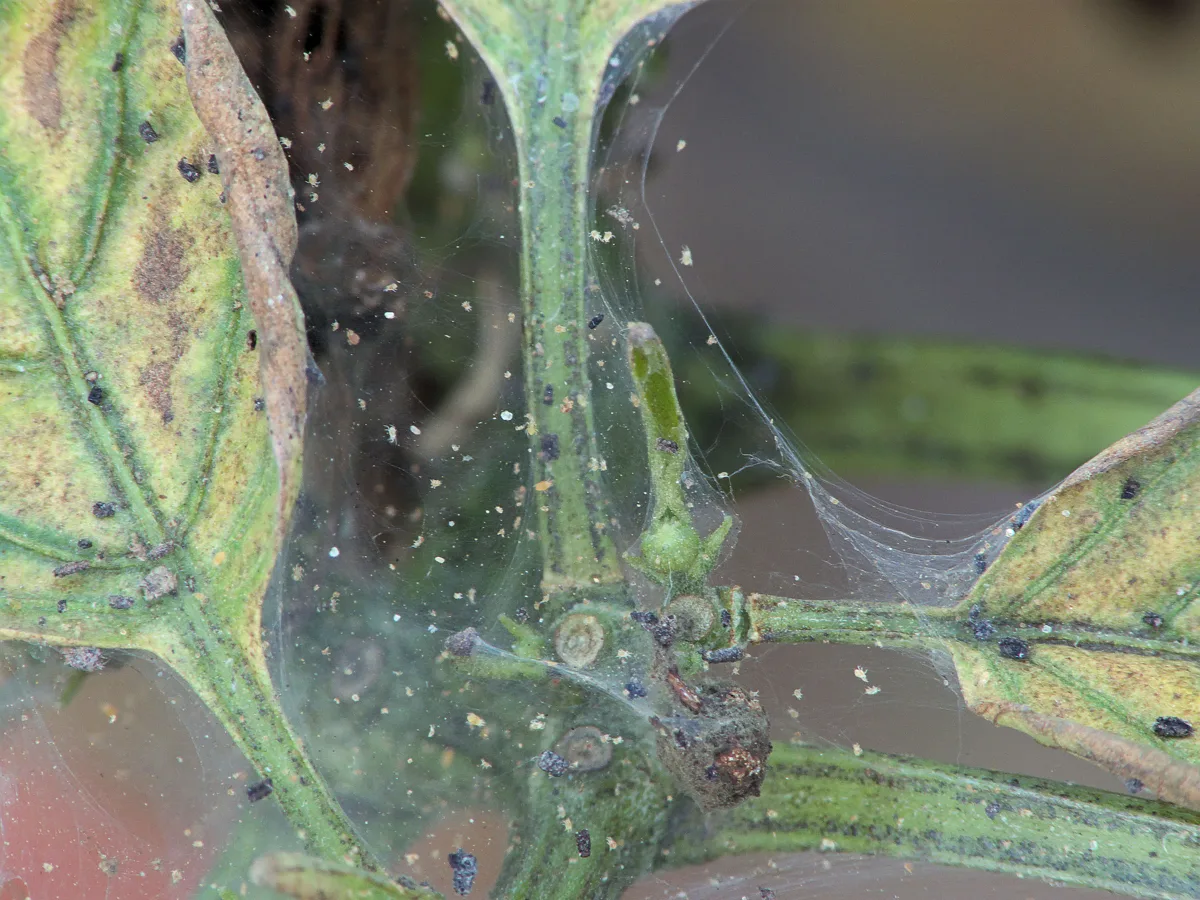
Fine pale speckles on the leaves, with tiny moving dots or webbing underneath, point to spider mites. Check the underside of a leaf with a lens before you treat anything.

On this page
Damage can outlast the mites that caused it, so confirm they’re still there before you spray.
What it looks like
The twospotted spider mite feeds on the undersides of leaves. Each feeding spot leaves a white mark like a pin prick, and many together look like fine pale speckling. You may also see black specks, which are mite droppings (Pacific Northwest handbook).
As numbers climb, leaves dry out, turn yellow or bronze, and can drop early. Webbing means the infestation is already severe, and it can cover whole plants, which then look dirty or rusty (Colorado State).
Webbing on buds is a problem of its own, and mites can keep spinning it on buds after harvest while they dry (Purdue Extension).
Why it happens
Mites usually arrive on plants or cuttings brought in from elsewhere, and they can travel on people who have handled infested plants. Mother plants and the clones taken from them can carry serious infestations (Cranshaw et al. 2019).
They’re mainly an indoor problem. Under lights they stay active all year, while outdoors natural enemies usually keep them down (Colorado State). Damage is usually worst in hot, dusty conditions and on water-stressed plants (UC IPM).
They also breed quickly. In controlled environments a generation takes about 12 to 15 days, and as few as 5 to 10 in ideal conditions (Purdue Extension). That’s why a few speckles can become webbing so fast.
How to confirm it
- Look under a leaf with a 10x to 15x lens. You’re looking for slow-moving oval mites about 0.4 mm long, round eggs and fine silk (Purdue Extension).
- Shake a stem over white paper. Specks that walk away are mites.
- Make sure mites are still there. They’re sometimes gone by the time you notice the damage, and plants often recover on their own (UC IPM).
What else it could be: thrips also leave pale marks and black specks, but the marks tend to look silvery and you’ll find slender insects rather than round mites. Hemp russet mites cause speckling too, but they make no webbing and you can’t see them with an ordinary lens.
What to do
- Separate the plant. Move infested plants away from clean ones. Mites can also travel on people who have handled them (Purdue Extension).
- Knock numbers down early. Sprays of water, insecticidal soaps and oils are the first options (UC IPM). Soaps and oils only kill what they touch, so cover the undersides of leaves and expect to repeat. Don’t use them on water-stressed plants or above 90°F, and test a small area first.
- Consider predatory mites. Phytoseiulus persimilis is sold commercially and eats only web-spinning mites (Purdue Extension). A common guideline is one predator for every 10 spider mites, so reduce heavy infestations first (UC IPM). It needs prey to survive, so it isn’t a preventive.
- Don’t reach for broad-spectrum insecticides. They frequently cause mite outbreaks by killing what eats mites (UC IPM), and misuse of miticides breeds resistance (Colorado State).
- Don’t mix sulfur and oil. Leave at least 30 days between an oil spray and sulfur, and skip sulfur above 90°F (UC IPM).
- Clean up afterward. Remove plant debris and clean the space between harvests, and check drying buds (Purdue Extension).
Keep sprays off buds you plan to smoke. One study of contaminated flower found residues of four synthetic chemicals carried over into smoke, as much as 69.5% depending on the chemical and the device (Sullivan et al. 2013). We found no similar study for soaps, oils or biological products, so we can’t tell you those are safe to smoke. Few products are registered for cannabis at all (Lemay et al. 2022), and which ones are allowed differs by state, so check the label and your state’s rules first.
How much to trust this
Most of what’s here comes from extension guides for hemp and from general spider mite biology. We didn’t find a controlled trial of these treatments on smokable cannabis in a home grow.
Results may also fall short of what suppliers describe. A 2022 review reports that many biological controls work less well on cannabis than on other crops, and research on managing pests in indoor cannabis is limited (Lemay et al. 2022). Trichomes may be part of the reason, but that’s still being worked out. Treat predatory mites as a tool that may need repeating.
Photos
1 photo of spider mites: pale speckles, then webbing
It could also be
These share symptoms with this one. Open each to see what tells them apart.
-
 Pest
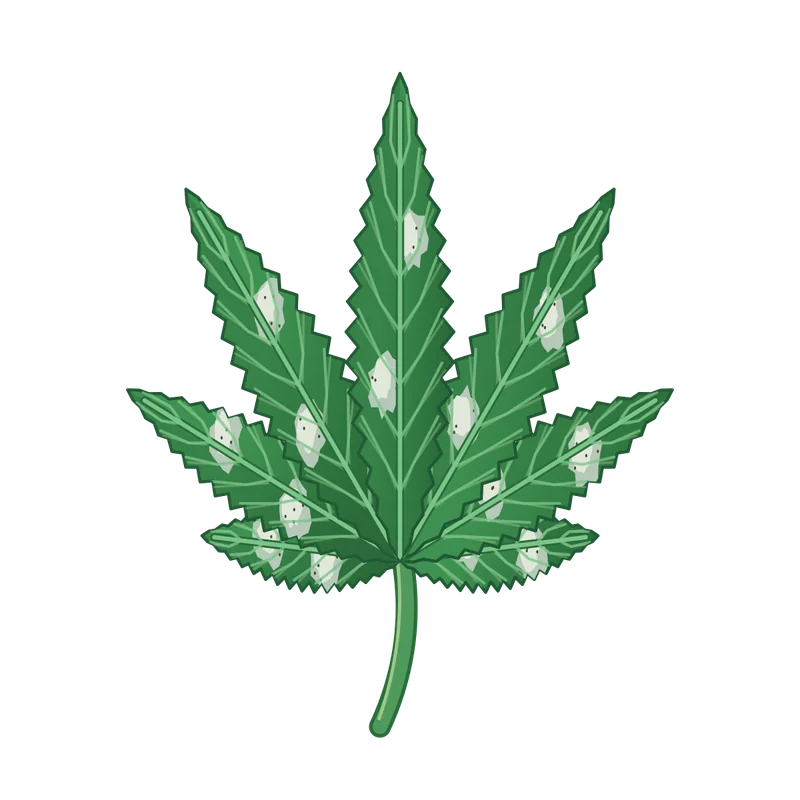
Thrips: silvery scrapes and black specks
Silvery or pale scraped patches with tiny black specks point to thrips. Look for the slender insects themselves before you…
Pale speckling · Silvery patches · Visible bugs · Buds
-
 Pest
Aphids: clusters and sticky leaves
Clusters of small soft insects on stems and under leaves, often with sticky or shiny residue, mean aphids. They can…
Sticky or shiny residue · Stunted growth · Visible bugs · Wilting or drooping
-
 Pest
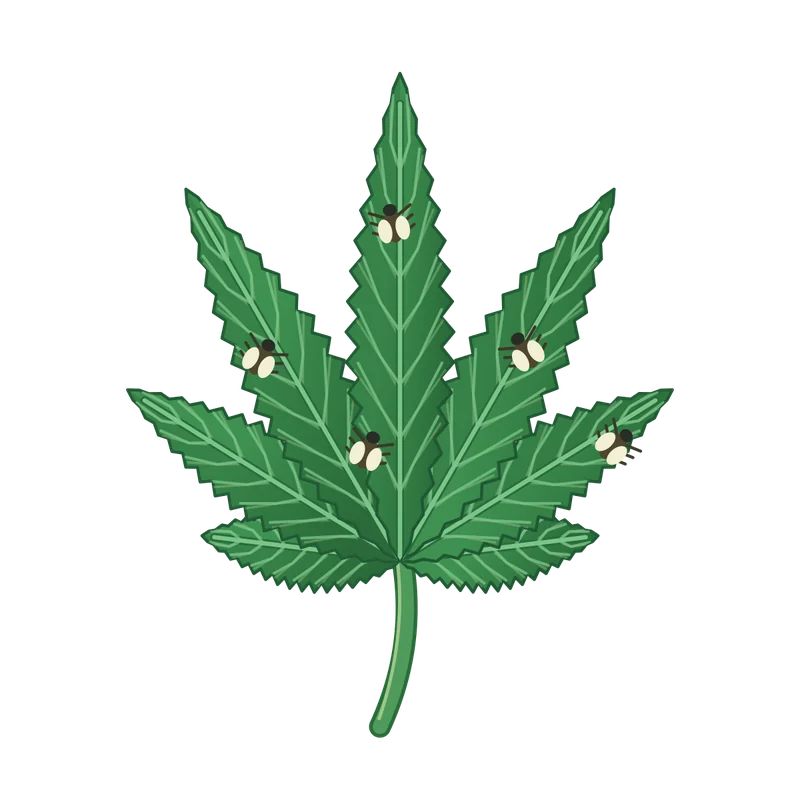
Whiteflies: a white cloud when you shake the plant
Tiny white insects that fly up when you water or brush the plant are whiteflies. Keep a yellow sticky card…
Sticky or shiny residue · Visible bugs · Wilting or drooping · Yellowing
-
 Pest
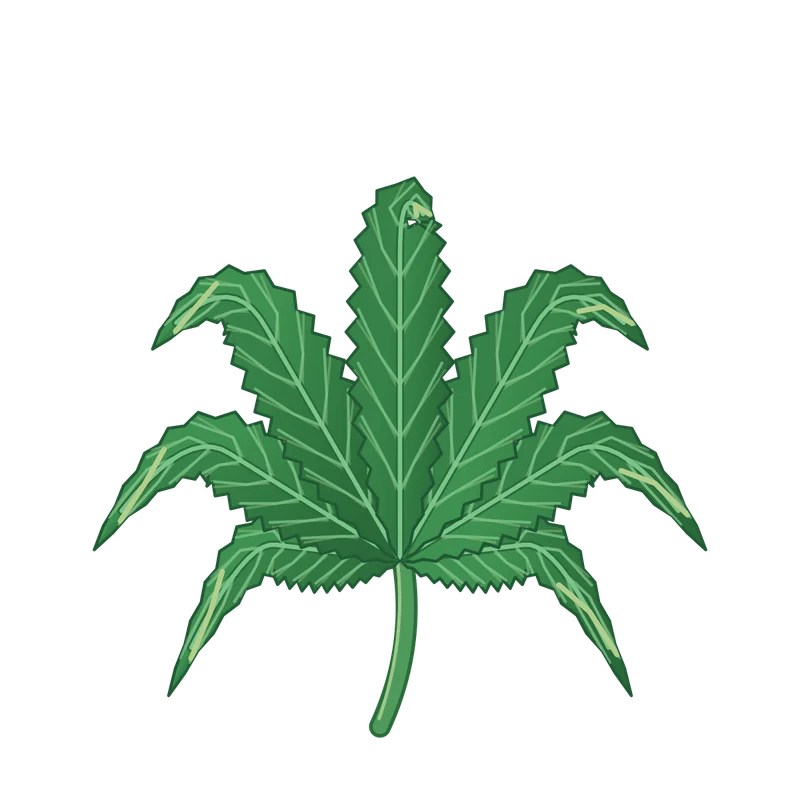
Hemp russet mites: the pest you can’t see
Upward-curling leaf edges and a dull, bronzed look, with no webbing and no bugs you can find, may mean russet…
Browning / necrosis · Curling or clawing · Other discolouration · Pale speckling
-
 Watering
Underwatering: a light pot and a limp plant
A limp plant in a pot that feels very light probably just needs water. Water it slowly until the whole…
Browning / necrosis · Stunted growth · Wilting or drooping · Yellowing
-
 Nutrient toxicity
Nutrient burn: brown tips and edges from too much feed
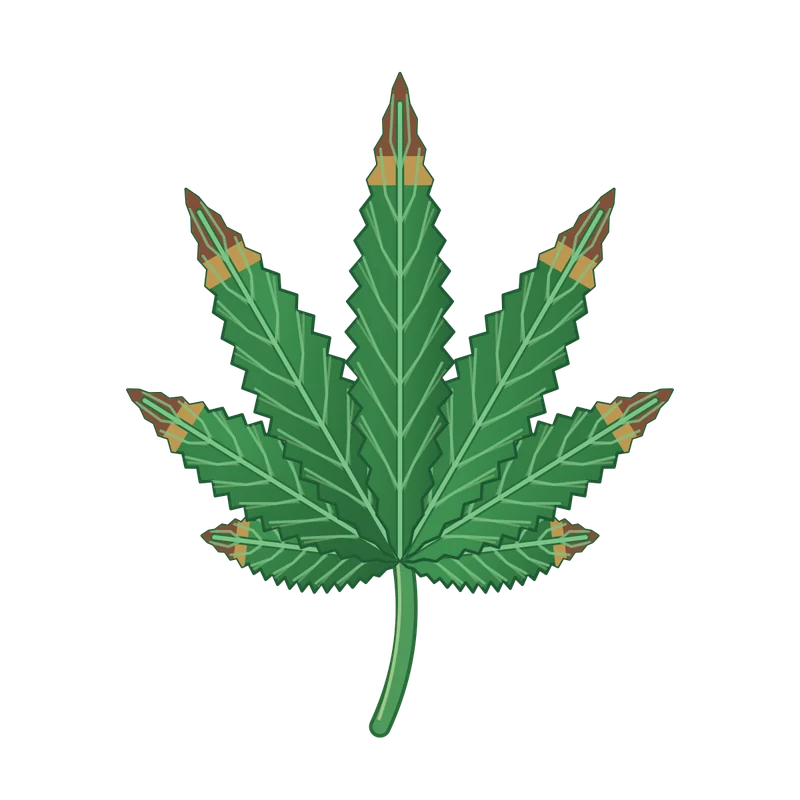
Brown, crispy tips or edges after a stronger feed may be nutrient burn, but other problems look the same. Test…
Browning / necrosis · Curling or clawing · Wilting or drooping · Yellowing
Sources (7)
- Serber, Z., & Long, E.Y. (2021). Management strategies for common arthropod pests of greenhouse hemp in Indiana. Purdue Extension, E-275-W. https://www.extension.entm.purdue.edu/publications/E-275/E-275.pdf
- Pacific Northwest Insect Management Handbook. Two-spotted spider mite (Tetranychus urticae) on hemp. Oregon State University, Washington State University, University of Idaho. https://pnwhandbooks.org/node/25851
- Colorado State University, Agricultural Biology. Twospotted spider mite, Tetranychus urticae. https://agsci.colostate.edu/agbio/ipm-pests/twospotted-spider-mite/
- Godfrey, L.D. (2011). Pest Notes: Spider Mites. UC ANR Publication 7405. https://ipm.ucanr.edu/PMG/PESTNOTES/pn7405.html
- Cranshaw, W., Schreiner, M., Britt, K., Kuhar, T.P., McPartland, J., & Grant, J. (2019). Developing insect pest management systems for hemp in the United States: a work in progress. Journal of Integrated Pest Management, 10(1), 26. https://doi.org/10.1093/jipm/pmz023
- Lemay, J., Zheng, Y., & Scott-Dupree, C. (2022). Factors influencing the efficacy of biological control agents used to manage insect pests in indoor cannabis (Cannabis sativa) cultivation. Frontiers in Agronomy, 4, 795989. https://doi.org/10.3389/fagro.2022.795989
- Sullivan, N., Elzinga, S., & Raber, J.C. (2013). Determination of pesticide residues in cannabis smoke. Journal of Toxicology, 2013, 378168. https://doi.org/10.1155/2013/378168 [Evidence access: ABSTRACT VERIFIED; full text NOT VERIFIED.]