

Pest
Fungus gnats: small flies around wet soil
Small dark flies around the pot usually mean the soil is staying too wet. The adults are a nuisance. Their larvae can hurt seedlings, but they're a less common cause of a…
On this page
Start by letting the top of the soil dry out. That one change deals with the conditions they need.
What it looks like
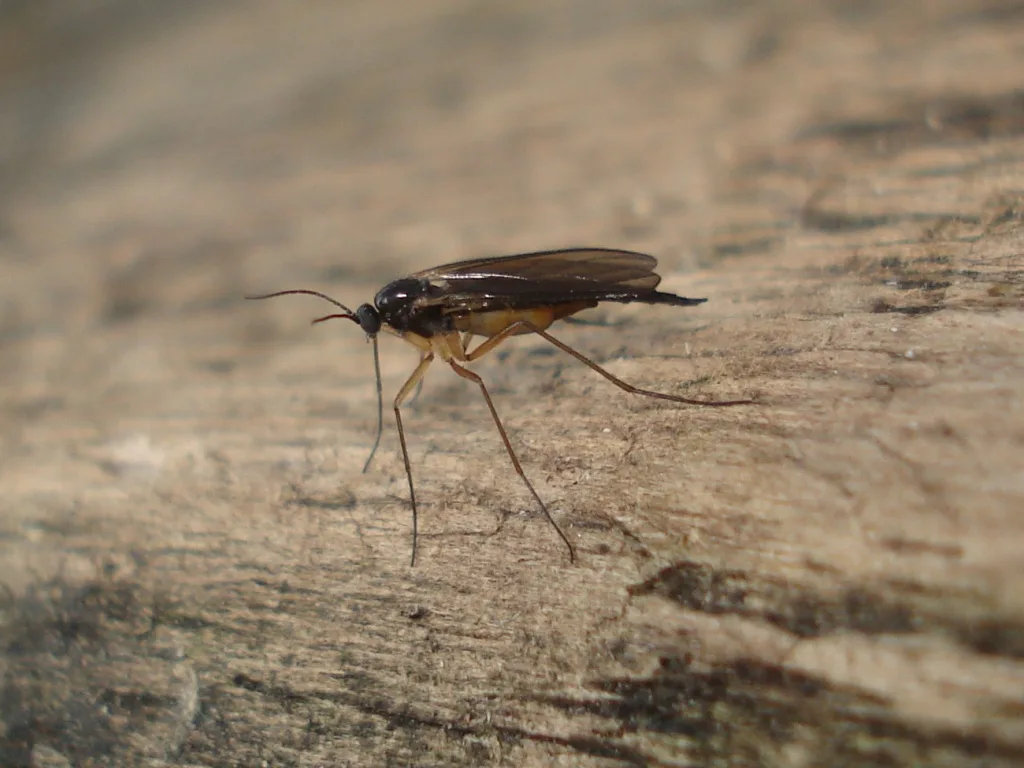
Adults are dark, delicate flies, a bit like tiny mosquitoes, with long antennae. They’re drawn to light, so you may first notice them flying around a window or lamp.
The larvae live in the growing mix. They have a shiny black head and a clear to whitish legless body. In very wet, heavily infested mix, they can leave shiny slime trails on the surface.
In large numbers, larvae can damage roots and stunt growth, mostly in seedlings and young plants (UC IPM).
Why it happens
Larvae feed on fungi, decaying organic matter and root hairs, so damp mix rich in organic material suits them well. Overwatering, poor drainage, leaks and standing water all help.
At 75°F, eggs hatch in about 3 days, larvae pupate after about 10 days, and adults emerge about 4 days after that. That’s about 17 days for a generation, and it goes faster when it’s warmer (UC IPM). Generations overlap, so you won’t clear them with a single treatment.
How to confirm it
- Hang a yellow sticky trap near the pot to catch adults.
- Put a chunk of raw potato on the soil, cut side down. Check underneath after a few days for larvae, then replace it (UC IPM).
- Check the antennae if you can. Shore flies also gather around wet mix, but they’re stouter, with short bristle-like antennae. They’re associated with algae and rotting organic matter.
If your plant is wilting, don’t blame the gnats yet. Larvae can cause it, but unhealthy roots from other causes are more common (UC IPM). Too much or too little water and root rot can look the same. Gnats often appear because the mix is wet, so they may be a sign of the real problem rather than the cause of it.
What to do
- Let the surface dry between waterings. This is the main fix. Also improve drainage, clean up standing water and fix any leaks.
- Remove what they’re feeding on, such as fallen leaves, debris and excess organic material on the soil.
- Use Bti if you need more. Bacillus thuringiensis subspecies israelensis is sold in garden centers and only affects certain fly larvae. It gives temporary control, so expect to reapply.
- Or try nematodes. Steinernema feltiae works between 60°F and 90°F in moist mix, and it’s applied as a soil drench. Nematodes are perishable and usually bought by mail.
- Use pasteurized potting mix in your next round.
Insecticide sprays are rarely needed for gnats, and pyrethrins or pyrethroids only give temporary control (UC IPM). Sticky traps catch adults, but they won’t deal with the larvae in the soil.
How much to trust this
Everything here comes from general guidance for houseplants, greenhouses and container plants. We didn’t find a controlled study of fungus gnats on cannabis, or of how much damage they do to it. The advice is low-risk and the biology is general to these flies, but we can’t tell you how serious they are for cannabis specifically.
Photos
1 photo of fungus gnats: small flies around wet soil
It could also be
These share symptoms with this one. Open each to see what tells them apart.
-
 Pest
Aphids: clusters and sticky leaves
Clusters of small soft insects on stems and under leaves, often with sticky or shiny residue, mean aphids. They can…
Sticky or shiny residue · Stunted growth · Visible bugs · Wilting or drooping
-
 Watering
Overwatering: wet roots that can’t get air
Drooping or yellowing leaves on a pot that still feels heavy usually mean the roots are too wet. Don't water…
Curling or clawing · Stunted growth · Wilting or drooping · Yellowing
-
 Disease
Root rot: brown roots and a plant that keeps declining
Wilting or stunting that watering and feeding don't fix, with brown or decaying roots, points to root rot. Check the…
Browning / necrosis · Stunted growth · Wilting or drooping · Yellowing
-
Watering
Underwatering: a light pot and a limp plant
A limp plant in a pot that feels very light probably just needs water. Water it slowly until the whole…
Browning / necrosis · Stunted growth · Wilting or drooping · Yellowing
-
 Pest
Spider mites: pale speckles, then webbing
Fine pale speckles on the leaves, with tiny moving dots or webbing underneath, point to spider mites. Check the underside…
Pale speckling · Visible bugs · Webbing · Yellowing
-
 Pest
Thrips: silvery scrapes and black specks
Silvery or pale scraped patches with tiny black specks point to thrips. Look for the slender insects themselves before you…
Pale speckling · Silvery patches · Visible bugs · Buds
Sources (1)
- Bethke, J.A., & Dreistadt, S.H. (2013). Pest Notes: Fungus Gnats. UC ANR Publication 7448. https://ipm.ucanr.edu/PMG/PESTNOTES/pn7448.html