

Environment Setup and equipment
Exhaust fans, carbon filters and airflow in a grow tent
Exhaust removes heat and moisture, and a carbon filter reduces odor. Size the system for its real duct and filter resistance, use gentle airflow at the canopy, and manage the room around…
On this page
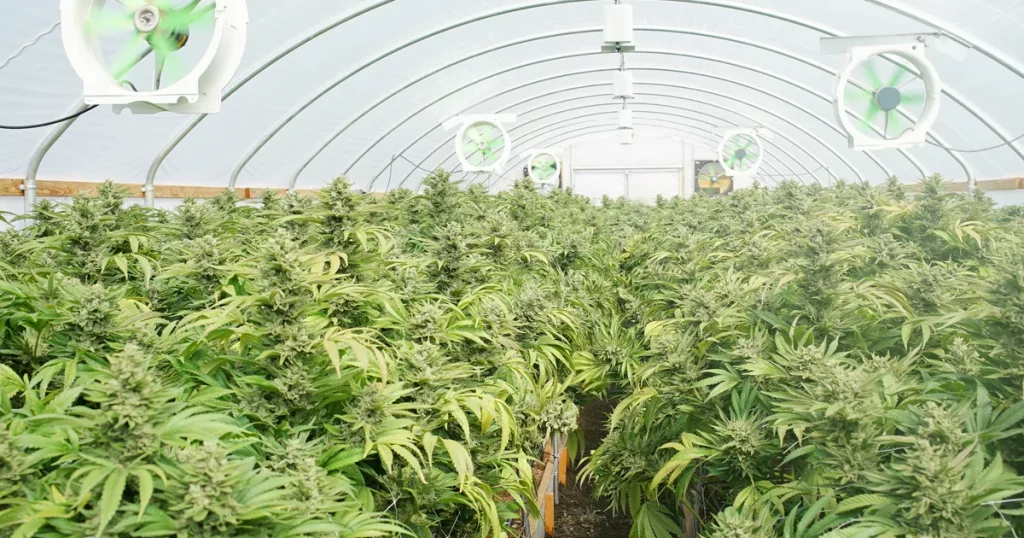
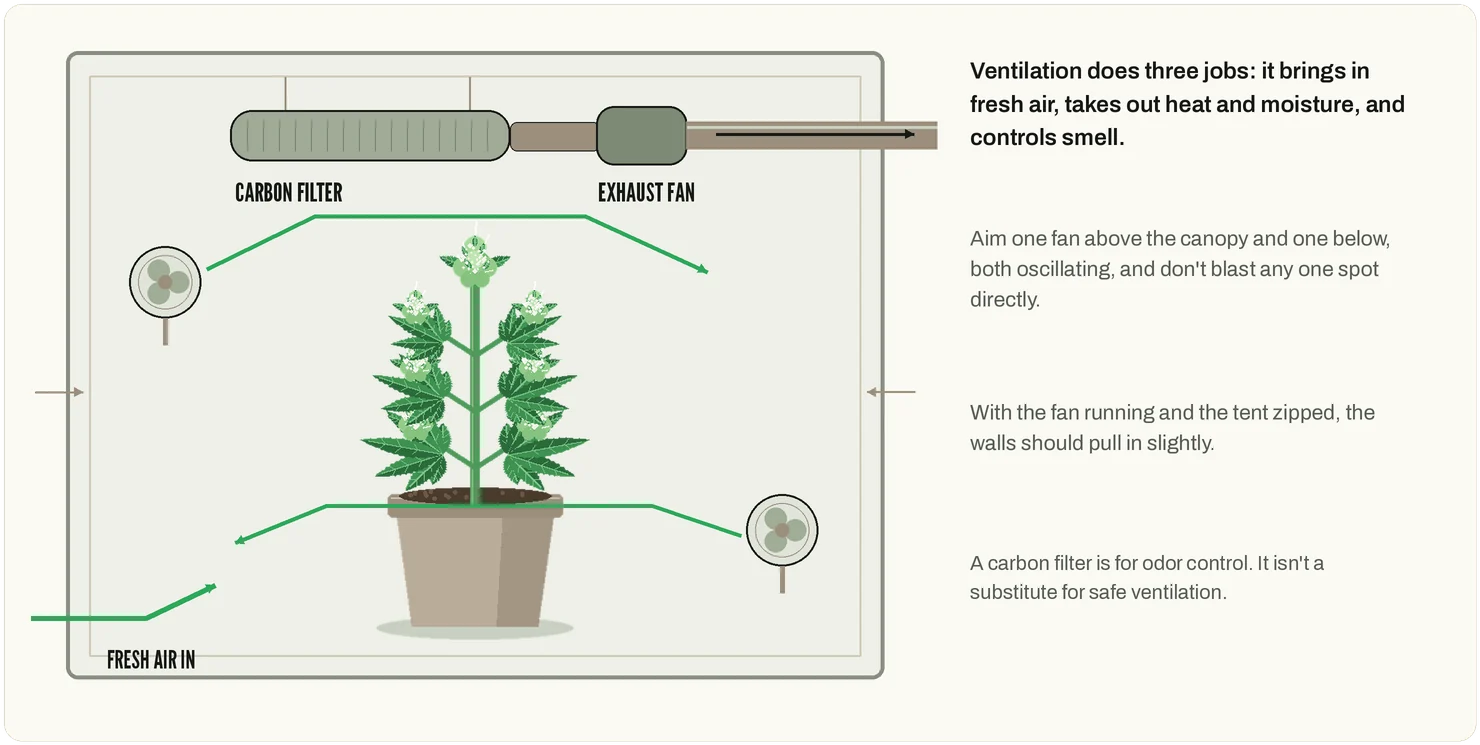
Ventilation does three jobs: it brings in fresh air, takes out heat and moisture, and controls smell.
Sizing the fan
- Multiply tent length x width x height in feet to get cubic feet.
- Choose a fan rated at about twice that number in CFM. A fan delivers less than its rating once you attach a carbon filter and duct bends, and you can slow a bigger fan with a controller to keep it quiet.
This is a common rule of thumb, not a tested formula. Size for your real heat and moisture loads and for how the fan performs with your filter and ducting. If the room is hotter or wetter than your target, you may need cooling or dehumidification, not just a bigger fan.
Keep the tent under slight negative pressure
With the fan running and the tent zipped, the walls should pull in slightly. If they bulge out, air and smell are leaking from the seams.
Why you also need clip fans
Aim one fan above the canopy and one below, both oscillating, and don’t blast any one spot directly. Moist air gets trapped between leaves and inside thick buds. Botrytis can damage flowers, and early rot may be hidden inside a dense bud. Gentle air movement and moisture control help lower the risk but can’t guarantee prevention.
If you can still smell it
- Check whether the tent has lost negative pressure.
- Very humid air is commonly reported to make carbon filters work less well, so keep humidity under control.
- Make sure duct joints are sealed, ideally with foil tape.
- Carbon filters wear out at rates that depend on airflow, humidity, contaminants and use. Follow the service guidance and check for breakthrough instead of counting on a fixed replacement year.
A carbon filter is for odor control. It isn’t a substitute for safe ventilation or a guarantee that the exhaust is free of hazardous gases or spores. Route moist exhaust so it doesn’t cause condensation or mold in the building.
Sources (3)
- Punja, Z. K., Collyer, D., Scott, C., Lung, S., Holmes, J., & Sutton, D. (2019). Pathogens and molds affecting production and quality of Cannabis sativa L. Frontiers in Plant Science, 10, 1120. https://www.frontiersin.org/journals/plant-science/articles/10.3389/fpls.2019.01120/full [Evidence access: FULL TEXT VERIFIED.]
- Punja, Z. K., & Ni, L. (2021). The bud rot pathogens infecting cannabis (Cannabis sativa L., marijuana) inflorescences: symptomology, species identification, pathogenicity and biological control. Canadian Journal of Plant Pathology. https://doi.org/10.1080/07060661.2021.1936650 [Evidence access: ABSTRACT VERIFIED; full text NOT VERIFIED.]
- University of Minnesota Extension. Small-scale hydroponics. https://extension.umn.edu/how/small-scale-hydroponics [Evidence access: EXTENSION TEXT VERIFIED.]