

Environment Lifecycle Setup and equipment Flowering Seedling Vegetative
How high to hang your grow light at each stage
Start from your light's manufacturer chart, keep the light gentle for seedlings, raise intensity as plants grow, and use the dimmer instead of constantly changing the height. Watch the plant for signs…
On this page
Start from your own light’s PPFD chart. No single height works for every light, and a 150 watt light and a 650 watt light behave very differently.
A simple method
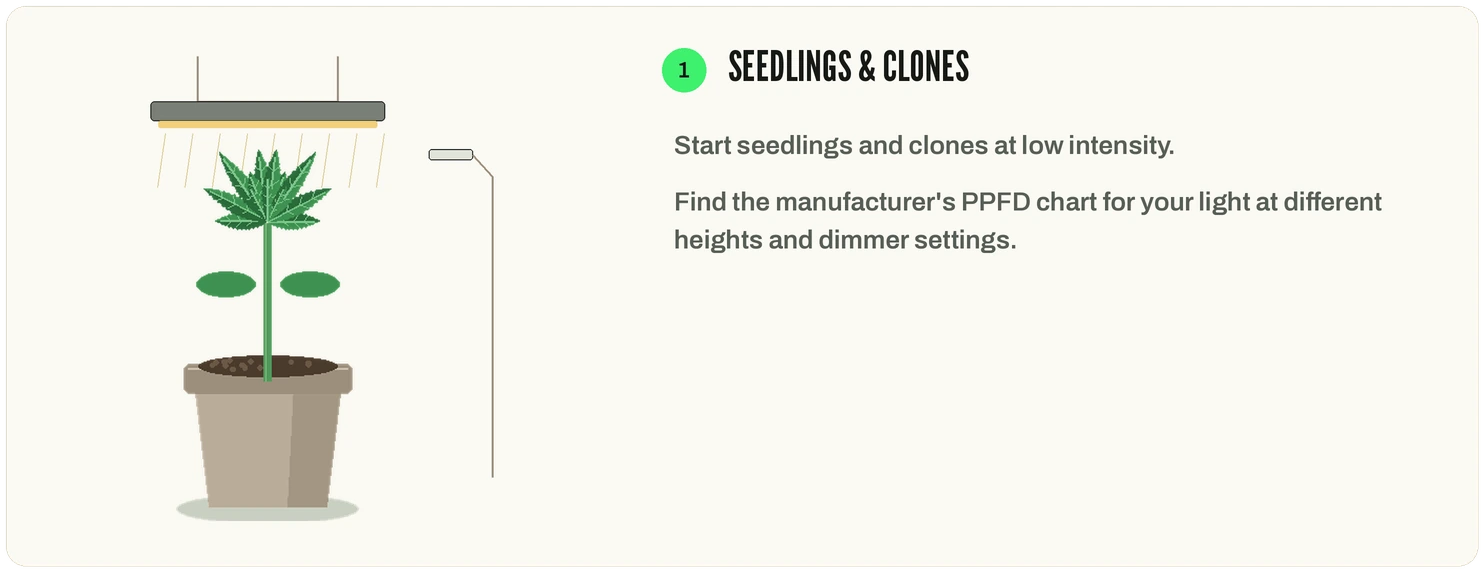
- Find the manufacturer’s PPFD chart for your light at different heights and dimmer settings.
- Start seedlings and clones at low intensity, with the light dimmed or raised up.
- Raise intensity gradually as the plant gets bigger.
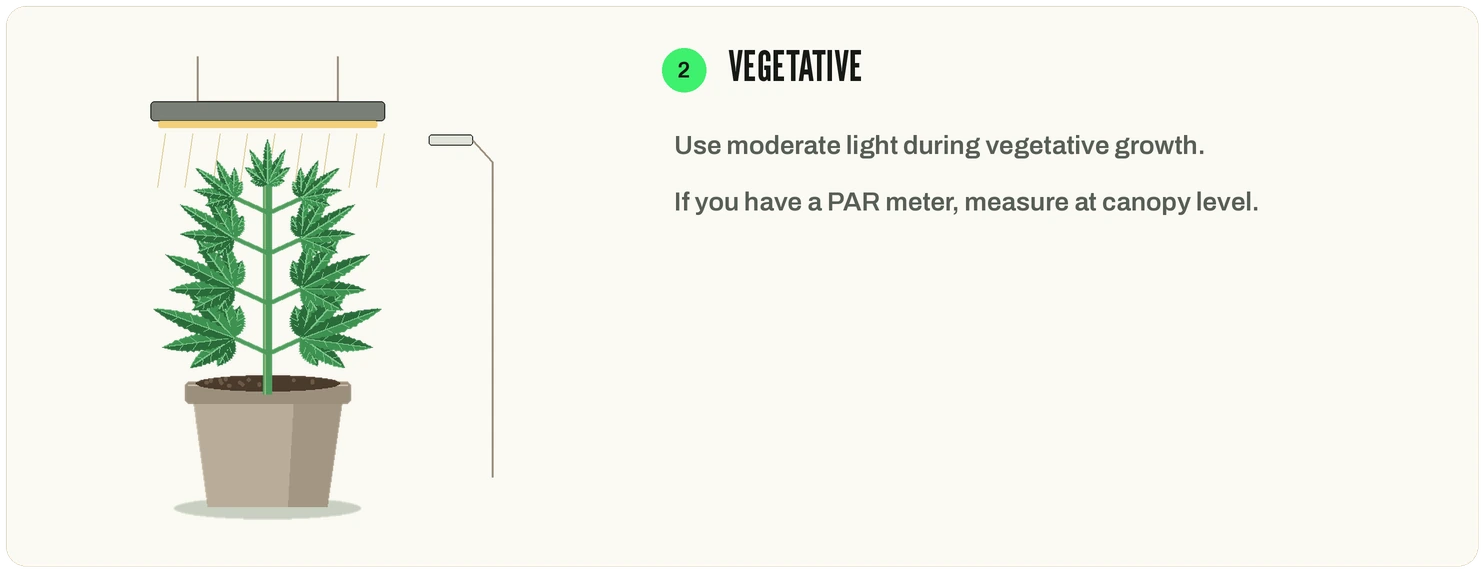
- If you have a PAR meter, measure at canopy level. If not, use the chart and watch your plants.
Typical starting ranges
These are common grower starting points, not hard rules. The ranges are in µmol/m²/s. Controlled research tested flowering canopies at 600 to 1,000 µmol/m²/s and found more light gave more flower.
- Seedlings and clones: gentle light, a few hundred at most.
- Vegetative: moderate, roughly the low to middle hundreds.
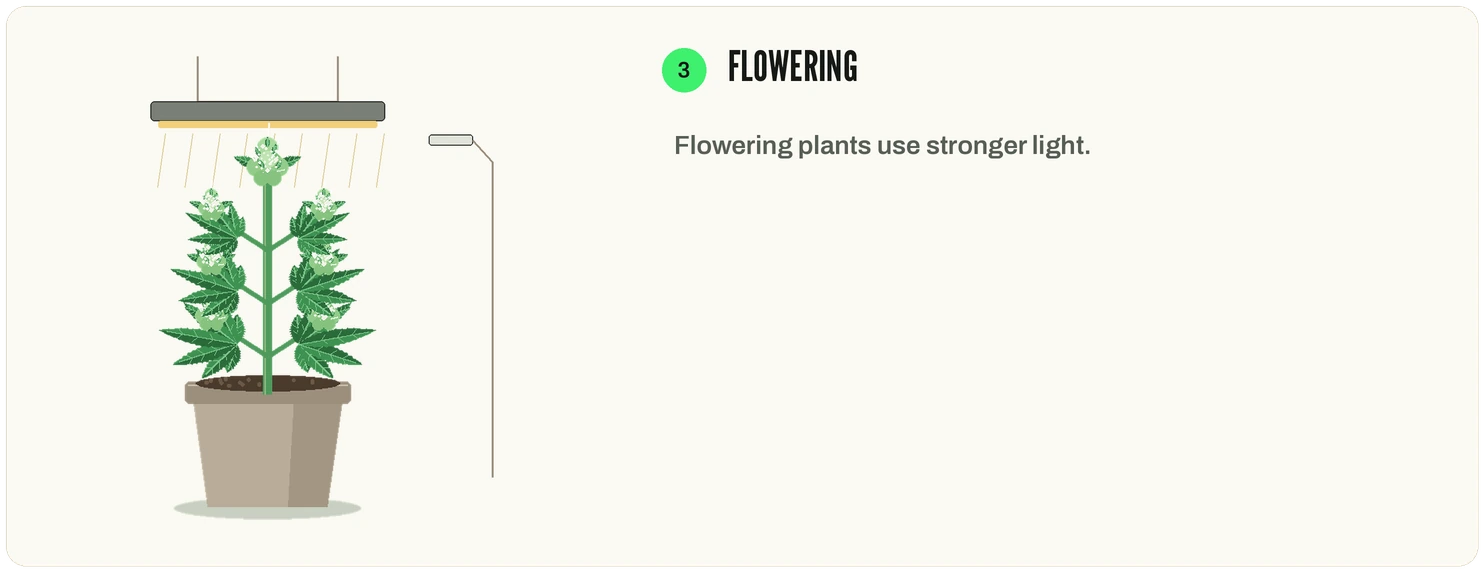
- Flowering: stronger, often 600 and above if the plant is healthy and cool enough.
Signs the light is too strong
- Leaves bleached or pale at the very top.
- Leaf edges curling up toward the light.
- Crisping on the leaves closest to the light.
If these show up mainly at the top, check intensity, leaf temperature, watering and nutrient status before changing anything. Dimming or raising the light may help. Paleness alone doesn’t prove a plant needs more light. Stay within the manufacturer’s clearance and hanging limits.
Remember the flip
When you switch to 12 hours of light, plants get less total light per day. Some growers raise intensity at that point, but work out the daily total and increase gradually instead of assuming you need a sudden jump.
Daily light integral is PPFD × light hours × 0.0036, in mol/m²/day. Under a long vegetative day, a plant can get a substantial daily dose even at a lower PPFD.
Sources (2)
- Llewellyn, D., Golem, S., Foley, E., Dinka, S., Jones, A. M. P., & Zheng, Y. (2022). Indoor grown cannabis yield increased proportionally with light intensity, but ultraviolet radiation did not affect yield or cannabinoid content. Frontiers in Plant Science, 13, 974018. https://www.frontiersin.org/journals/plant-science/articles/10.3389/fpls.2022.974018/full [Evidence access: FULL TEXT VERIFIED.]
- Rodriguez-Morrison, V., Llewellyn, D., & Zheng, Y. (2021). Cannabis yield, potency, and leaf photosynthesis respond differently to increasing light levels in an indoor environment. Frontiers in Plant Science, 12, 646020. https://www.frontiersin.org/journals/plant-science/articles/10.3389/fpls.2021.646020/full [Evidence access: FULL TEXT VERIFIED.]