

Environment Harvest and cure Flowering Late flower Vegetative
Powdery mildew, bud rot and root rot
Learn to spot powdery mildew, flower molds and root disease early. Clean starting material, moisture management and airflow reduce risk but don't guarantee prevention. Don't use moldy flower.
On this page
A survey of cannabis grows found several fungal problems again and again. All of them are easier to prevent than cure.
Problems to recognize
| Problem | Looks like | Prevention and response |
|---|---|---|
| Powdery mildew | White dusty patches on leaves | Airflow, avoid crowding, stop it early; remove badly affected leaves and keep humidity down |
| Botrytis (gray mold, bud rot) | Can be hidden within buds; browning, dying small leaves or gray mold may be clues | Reduce moisture and crowding; isolate affected plants and bag/discard diseased flowers without shaking spores around |
| Penicillium and other bud molds | Blue-green or other mold on buds | Keep humidity down, handle trimmed buds carefully, dry fully |
| Root rot (Pythium and Fusarium) | Browning roots, wilting, stunting despite moist soil | Don’t overwater, use clean media and equipment, keep hydro water cool and oxygenated |
The risky moment
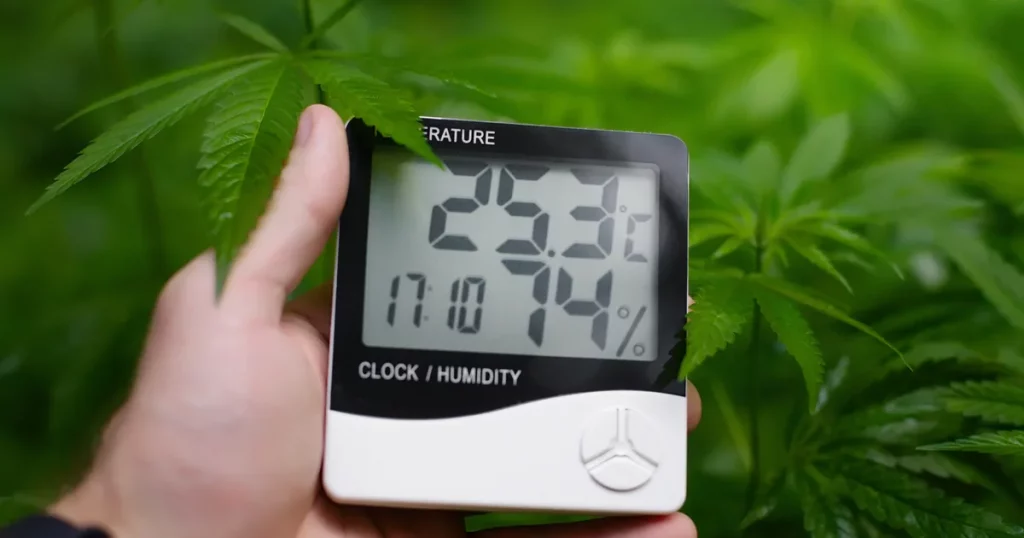
The hour after lights-off is when the air cools and humidity jumps. Keep fans running around the clock, and use a dehumidifier if needed.
Don’t use moldy flower
Don’t smoke, vape, eat or process moldy or suspicious flower. Isolate and discard affected material, and inspect the rest of the crop. Mold may extend beyond the spots you can see, so cutting off a margin, washing, curing, freezing or extraction doesn’t establish safety. Clean equipment and follow an appropriate disinfectant label or validated sanitation procedure. Never mix cleaning chemicals.
Starting clean
- Use pasteurized or fresh media where possible. Unpasteurized coco fiber was identified as a possible source of mold.
- If a plant dies of vascular wilt or root rot, throw out the plant and medium, and clean the pot.
Pythium is an oomycete (water mold), while Fusarium is a fungus, and they can cause overlapping symptoms. Brown roots alone don’t identify the pathogen. Get diagnostic help for persistent wilt or spreading disease. Humidity control helps, but powdery mildew can occur without free water on leaves, so a low room reading isn’t a cure.
Sources (3)
- Punja, Z. K., Collyer, D., Scott, C., Lung, S., Holmes, J., & Sutton, D. (2019). Pathogens and molds affecting production and quality of Cannabis sativa L. Frontiers in Plant Science, 10, 1120. https://www.frontiersin.org/journals/plant-science/articles/10.3389/fpls.2019.01120/full [Evidence access: FULL TEXT VERIFIED.]
- Punja, Z. K., & Ni, L. (2021). The bud rot pathogens infecting cannabis (Cannabis sativa L., marijuana) inflorescences: symptomology, species identification, pathogenicity and biological control. Canadian Journal of Plant Pathology. https://doi.org/10.1080/07060661.2021.1936650 [Evidence access: ABSTRACT VERIFIED; full text NOT VERIFIED.]
- Ocamb, C. M. (2024). Hop latent viroid in hemp. Oregon State University Extension, EM 9570. https://extension.oregonstate.edu/catalog/em-9570-hop-latent-viroid-hemp [Evidence access: EXTENSION TEXT VERIFIED.]