

Environment Getting started Lifecycle Flowering Harvest Seedling Vegetative
Outdoor growing calendar: when to plant, what to watch for, when to harvest
Plant after your last frost once days are long, expect photoperiod plants to start flowering as days shorten in late summer, protect buds from caterpillars and from autumn rain, and choose genetics…
On this page
Outdoors, the sun runs the calendar. Dates below are approximate for the northern United States, so check your local frost dates.
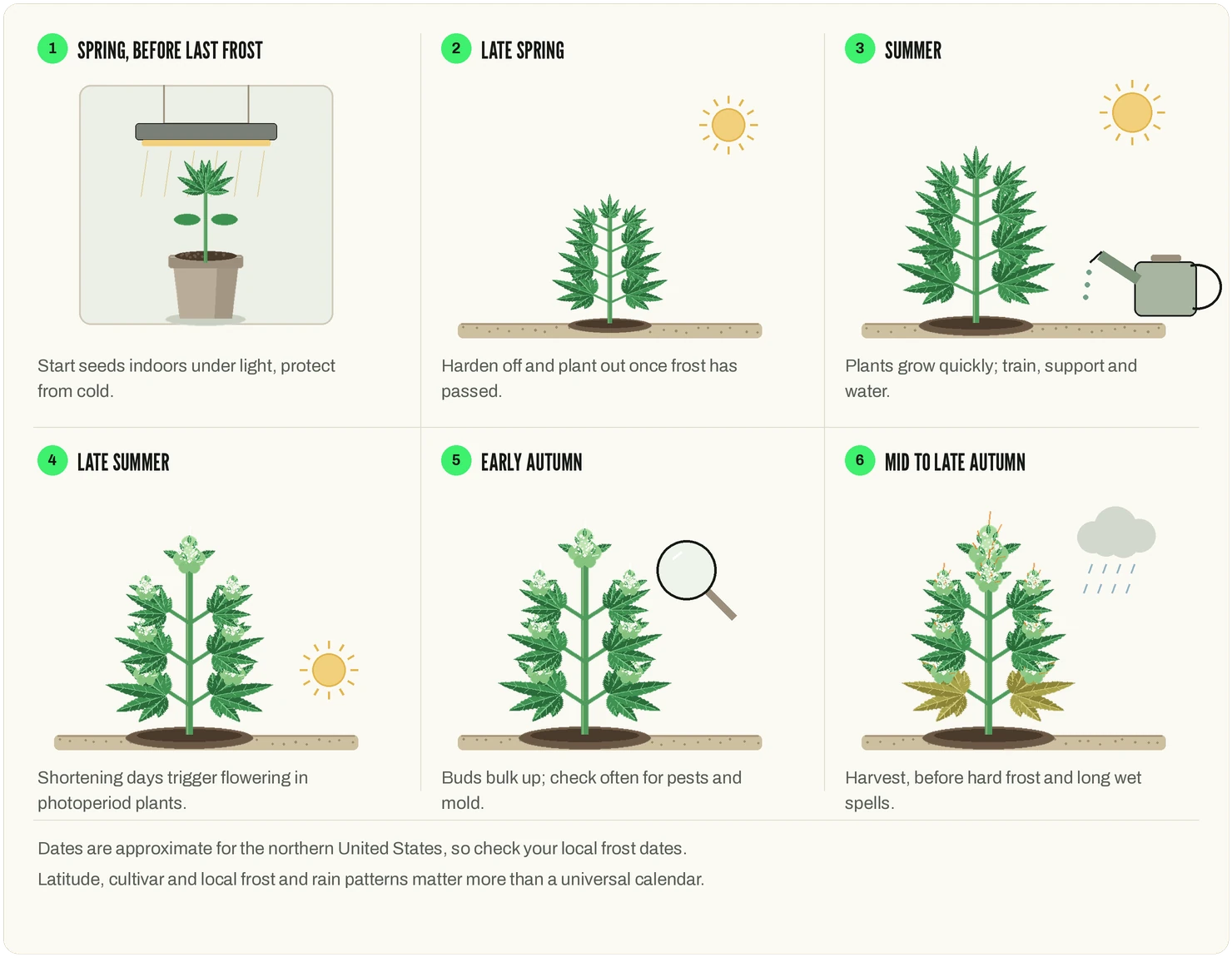
Rough timeline (northern hemisphere)
| When | What happens |
|---|---|
| Spring (before last frost) | Start seeds indoors under light, protect from cold |
| Late spring | Harden off and plant out once frost has passed |
| Summer | Plants grow quickly; train, support and water |
| Late summer | Shortening days trigger flowering in photoperiod plants |
| Early autumn | Buds bulk up; check often for pests and mold |
| Mid to late autumn | Harvest, before hard frost and long wet spells |
Photoperiod plants flower when nights get long enough, but don’t apply a single dark-hour threshold to every outdoor cultivar. The cited Moher experiment used tissue-cultured pieces of one genotype, not field-grown plants. Night lighting can interfere with photoperiod responses depending on its intensity, timing and duration, so choose a site away from avoidable night lighting.
Caterpillars
Check buds regularly. Corn earworm was identified in a review of hemp pests as having the most potential to ruin buds. Some Bacillus thuringiensis products target caterpillars, but strains and permitted uses differ. Only use one if the exact label and current local regulator allow it for the crop, pest, site and timing. A hemp label isn’t automatically a marijuana authorization. Observe all preharvest restrictions, and don’t improvise sprays on flower.
Rain and mold
Bud rot begins inside dense flowers and is worst when buds stay wet. Choose genetics that finish before your wet season, thin the center of the plant for airflow, and make sure any rain shelter has adequate airflow and safe support. A tightly wrapped cover can trap humidity and make things worse.
Short seasons
If your summer is short, autoflowers or early-finishing photoperiods give the best chance of a clean harvest.
Latitude, cultivar and local frost and rain patterns matter more than a universal calendar. Hardening off means gradually adapting plants to outdoor sun, wind and temperature. Check current home-cultivation, visibility, security and plant-count requirements before planting.
Sources (6)
- Cranshaw, W., Schreiner, M., Britt, K., Kuhar, T. P., McPartland, J., & Grant, J. (2019). Developing insect pest management systems for hemp in the United States: A work in progress. Journal of Integrated Pest Management, 10(1), 26. https://webdoc.agsci.colostate.edu/hempinsects/PDFs/JIPM_2019.pdf [Evidence access: FULL TEXT VERIFIED.]
- Punja, Z. K., Collyer, D., Scott, C., Lung, S., Holmes, J., & Sutton, D. (2019). Pathogens and molds affecting production and quality of Cannabis sativa L. Frontiers in Plant Science, 10, 1120. https://www.frontiersin.org/journals/plant-science/articles/10.3389/fpls.2019.01120/full [Evidence access: FULL TEXT VERIFIED.]
- Punja, Z. K., & Ni, L. (2021). The bud rot pathogens infecting cannabis (Cannabis sativa L., marijuana) inflorescences: symptomology, species identification, pathogenicity and biological control. Canadian Journal of Plant Pathology. https://doi.org/10.1080/07060661.2021.1936650 [Evidence access: ABSTRACT VERIFIED; full text NOT VERIFIED.]
- Moher, M., Jones, M., & Zheng, Y. (2021). Photoperiodic response of in vitro Cannabis sativa plants. HortScience, 56(1), 108–113. https://doi.org/10.21273/HORTSCI15452-20 [Evidence access: ABSTRACT VERIFIED; full text NOT VERIFIED.]
- Rutgers SARE. Pesticide products registered for use on hemp. https://sare.rutgers.edu/hemp_pesticide.html [Evidence access: EXTENSION TEXT VERIFIED; product list HISTORICAL.]
- University of Minnesota Extension. Starting seeds indoors. https://extension.umn.edu/planting-and-growing-guides/starting-seeds-indoors [Evidence access: EXTENSION TEXT VERIFIED.]