

Pest
Hemp russet mites: the pest you can’t see
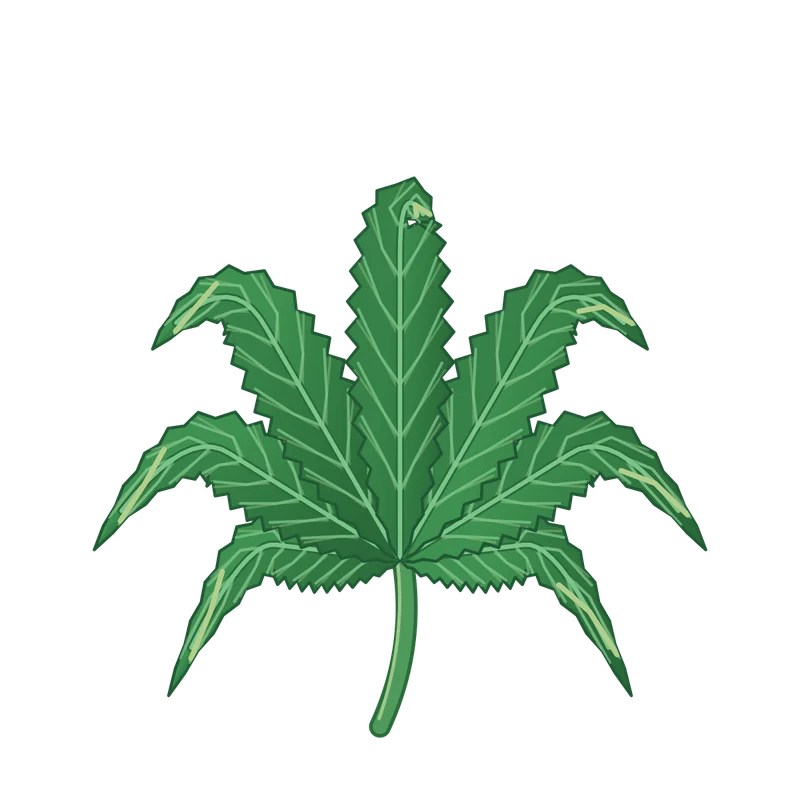
Upward-curling leaf edges and a dull, bronzed look, with no webbing and no bugs you can find, may mean russet mites. They're too small for an ordinary lens, so you need a…
On this page
Don’t rule them out because you can’t see anything. That’s normal with this mite.
What it looks like
At low numbers there may be nothing to see at all (Purdue Extension). Heavy infestations cause:
- Leaf edges curling upward
- Dull, rusty or bronzed leaf tissue, called russeting
- Brown or powdery-looking leaf edges, and a slight bronze or gold tint on the leaf stems (Pacific Northwest handbook)
- Fine spotting, smaller leaves and brittle foliage (Utah State)
- Smaller buds with less resin when flowers are infested (Cranshaw et al. 2019)
Indoors, mites can cover parts of a leaf so densely that they look like fine powder (Cranshaw et al. 2019).
Sources differ on where to look first. One study says the mites feed mainly on new growth (Szczepaniec et al. 2024), while Utah State says to watch for bronzing on lower leaves and stems. Check both.
Why it happens
These mites are only known to feed on cannabis (Pacific Northwest handbook), so they usually come in on infested plants. Clones and cuttings are the main thing to watch (Purdue Extension), and repeated cloning can keep a population going (Cranshaw et al. 2019). They reproduce year-round indoors, with a life cycle of about 8 to 15 days (Purdue Extension), though that figure is partly borrowed from related mites.
Young plants are the most at risk. Clones and seedlings are highly susceptible, and plants can die during indoor propagation (Szczepaniec et al. 2024).
How to confirm it
This is the hard part. The mites are about 0.16 to 0.21 mm long, cigar-shaped and pale, with only two pairs of legs. The usual trick of shaking a plant over white paper doesn’t work (Purdue Extension), and Utah State says a magnifying lens won’t reliably show them either.
- Put a damaged leaf and a nearby healthy-looking leaf under a dissecting microscope (Utah State).
- If you don’t have one, ask a plant diagnostic lab or your county extension office. Rules on sending them cannabis vary, so call first.
- Don’t diagnose from the leaf alone. The symptoms can look like disease or other stress (Pacific Northwest handbook), spider mites or thrips (Utah State).
What else it could be: webbing or mites you can see moving point to spider mites instead. If you’re considering a feeding problem, check pH and watering before you change anything.
What to do
- Isolate suspect plants right away, and be careful moving them, because that can spread mites (Pacific Northwest handbook).
- Consider removing badly infested plants. Remove and destroy infested plants and debris, and clean your tools (Utah State). Our view: with a clone you can replace, that’s often more realistic than trying to rescue it.
- Start the next round clean. Use mite-free seed or starts (Utah State), and be wary of cuttings from a plant that had mites.
- Know what’s been tested. In a greenhouse trial on industrial hemp, abamectin, etoxazole, fenpyroximate, rosemary oil and mineral oil all reduced mites. In the field, after one application, only fenpyroximate, rosemary oil and sulfur did (Szczepaniec et al. 2024). Those are results from a trial, not a recommendation: check what’s legal in your state and what the label allows.
- Don’t count on predators yet. Amblyseius swirskii may have potential, based on its control of a related mite on tomatoes, but research doesn’t yet show that any biological control works (Pacific Northwest handbook).
Keep sprays off buds you plan to smoke. One study of contaminated flower found residues of four synthetic chemicals carried over into smoke, as much as 69.5% depending on the chemical and the device (Sullivan et al. 2013). We found no similar study for soaps, oils or biological products, so we can’t tell you those are safe to smoke. Few products are registered for cannabis at all (Lemay et al. 2022), and which ones are allowed differs by state, so check the label and your state’s rules first.
How much to trust this
Less than you’d want. The mite’s life history is poorly known (Cranshaw et al. 2019), no treatment thresholds exist (Pacific Northwest handbook), and the one controlled treatment study we cite was on industrial hemp, not smokable cannabis, with a single application in the field. Field results also didn’t match greenhouse results for several products.
The symptoms overlap with other problems, too, so a diagnosis from a photo, including from this page, is only a starting point.
It could also be
These share symptoms with this one. Open each to see what tells them apart.
-
 Nutrient toxicity
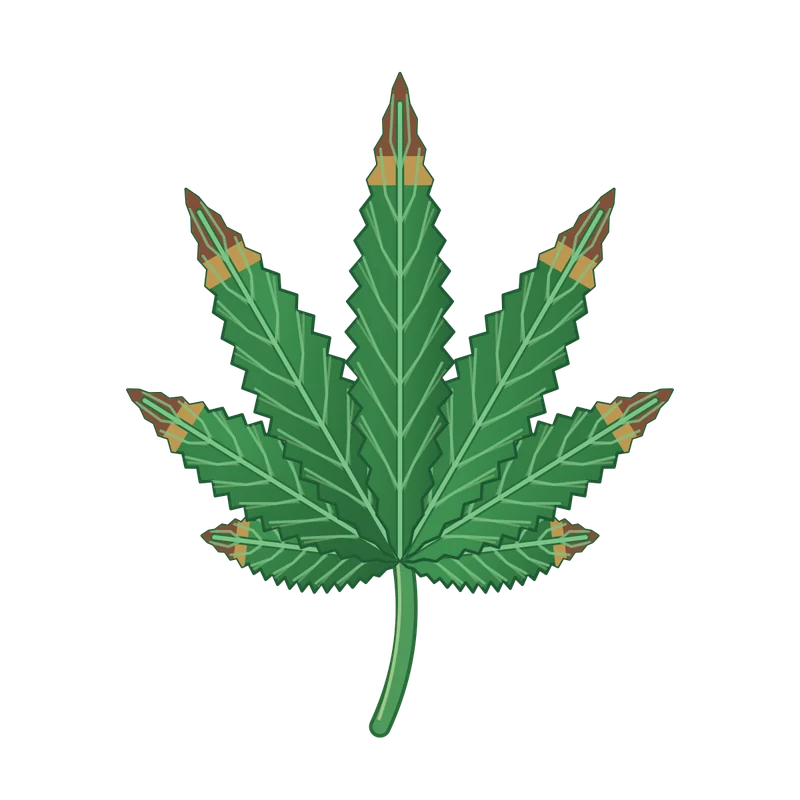
Nutrient burn: brown tips and edges from too much feed
Brown, crispy tips or edges after a stronger feed may be nutrient burn, but other problems look the same. Test…
Browning / necrosis · Curling or clawing · Wilting or drooping · Yellowing
-
 Light
Light burn: bleached leaves closest to the lamp
Pale or bleached leaves at the very top of the plant, closest to the light, may mean too much light…
Browning / necrosis · Curling or clawing · Other discolouration · Yellowing
-
 Pest
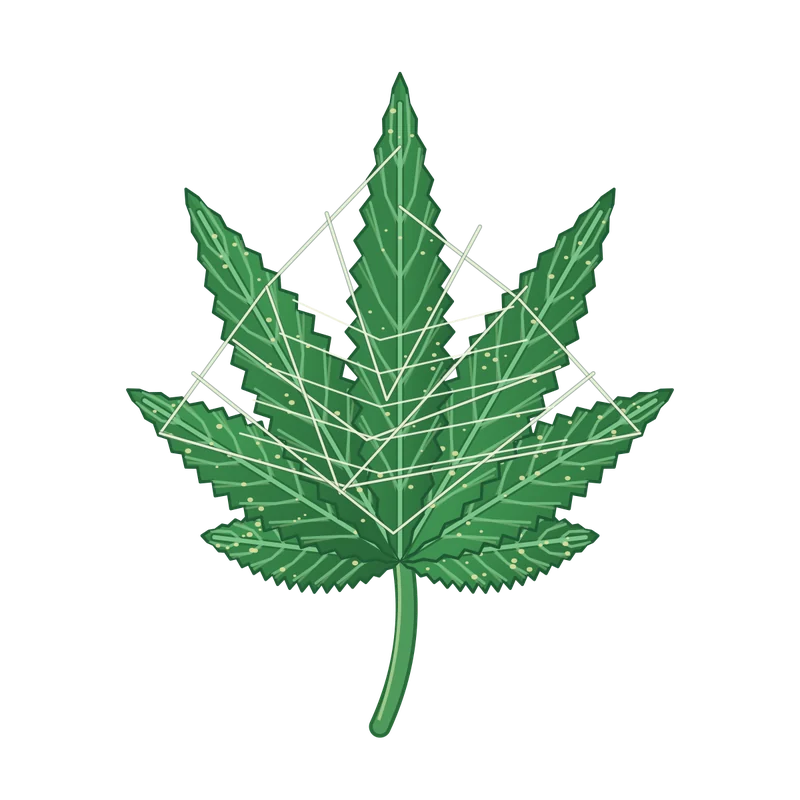
Spider mites: pale speckles, then webbing
Fine pale speckles on the leaves, with tiny moving dots or webbing underneath, point to spider mites. Check the underside…
Pale speckling · Visible bugs · Webbing · Yellowing
-
 Pest
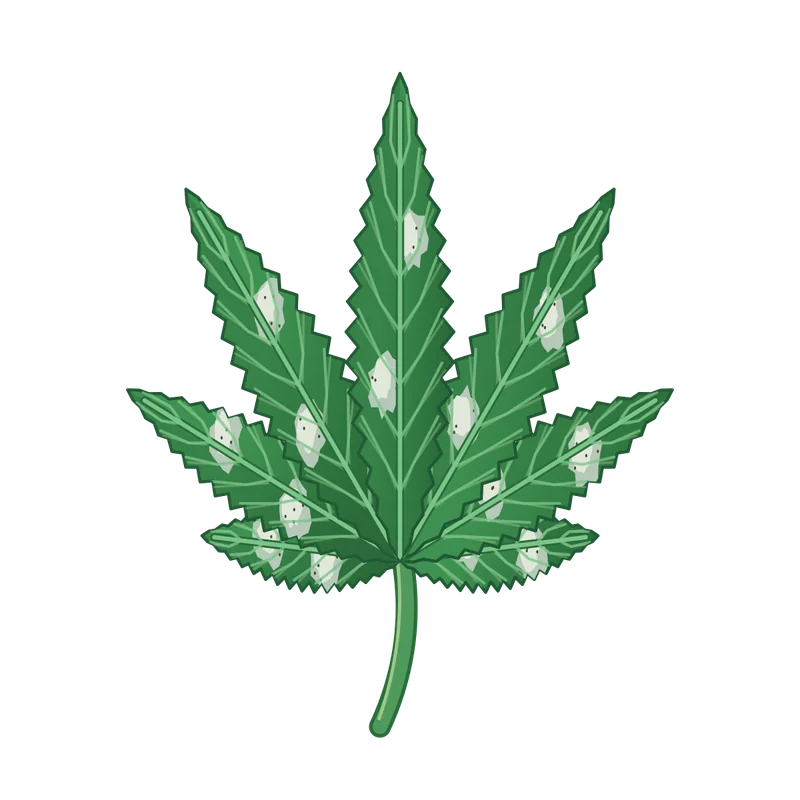
Thrips: silvery scrapes and black specks
Silvery or pale scraped patches with tiny black specks point to thrips. Look for the slender insects themselves before you…
Pale speckling · Silvery patches · Visible bugs · Buds
-
 Pest
Aphids: clusters and sticky leaves
Clusters of small soft insects on stems and under leaves, often with sticky or shiny residue, mean aphids. They can…
Sticky or shiny residue · Stunted growth · Visible bugs · Wilting or drooping
-
 Disease
Powdery mildew: white dusty patches on leaves
White, flour-like spots on the top of leaves are usually powdery mildew. Remove affected leaves early, because new spores can…
Spots · Surface coating or powder · Buds · Lower fan leaves
Sources (7)
- Szczepaniec, A., Lathrop-Melting, A., Janecek, T., Nachappa, P., Cranshaw, W., Alnajjar, G., & Axtell, A. (2024). Suppression of hemp russet mite, Aculops cannabicola (Acari: Eriophyidae), in industrial hemp in greenhouse and field. Environmental Entomology, 53(1), 18-25. https://doi.org/10.1093/ee/nvad052
- Pacific Northwest Insect Management Handbook. Hemp russet mite (Aculops cannabicola). Oregon State University, Washington State University, University of Idaho. https://pnwhandbooks.org/node/25846
- Serber, Z., & Long, E.Y. (2021). Management strategies for common arthropod pests of greenhouse hemp in Indiana. Purdue Extension, E-275-W. https://www.extension.entm.purdue.edu/publications/E-275/E-275.pdf
- Utah State University Extension. Hemp russet mite. https://extension.usu.edu/pests/ipm/notes_ag/hemp-hemp-russet-mite-
- Cranshaw, W., Schreiner, M., Britt, K., Kuhar, T.P., McPartland, J., & Grant, J. (2019). Developing insect pest management systems for hemp in the United States: a work in progress. Journal of Integrated Pest Management, 10(1), 26. https://doi.org/10.1093/jipm/pmz023
- Lemay, J., Zheng, Y., & Scott-Dupree, C. (2022). Factors influencing the efficacy of biological control agents used to manage insect pests in indoor cannabis (Cannabis sativa) cultivation. Frontiers in Agronomy, 4, 795989. https://doi.org/10.3389/fagro.2022.795989
- Sullivan, N., Elzinga, S., & Raber, J.C. (2013). Determination of pesticide residues in cannabis smoke. Journal of Toxicology, 2013, 378168. https://doi.org/10.1155/2013/378168 [Evidence access: ABSTRACT VERIFIED; full text NOT VERIFIED.]