

Disease
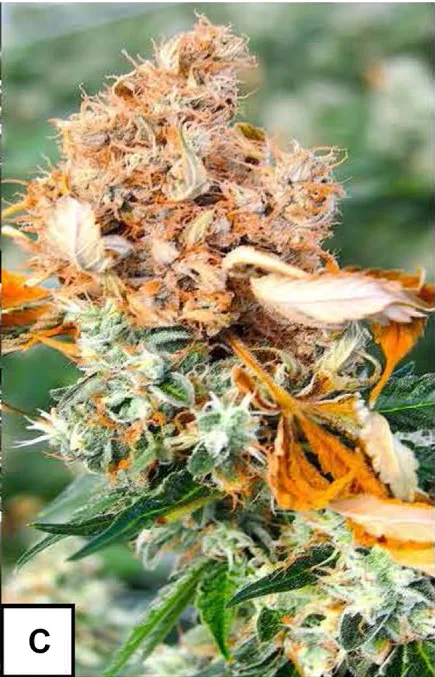
Bud rot: brown, dying buds and gray fuzz
A browning, dying section of bud, sometimes with gray fuzz, usually means bud rot. It can't be cured and it often starts deep inside, so remove it right away and check the…
On this page
Prevention is what counts here, because humidity and tight buds set this up before you can see anything.
What it looks like
- Brown, water-soaked spots on buds that die back and turn brown (Pacific Northwest handbook)
- A gray or gray-brown mat of mold and spores in and around the flower clusters, especially when it’s humid (Utah State, Punja et al. 2019)
- Browning, dying small leaves sticking out of an otherwise healthy-looking bud, which can be the first clue, since rot can be hidden inside (see our mold and root rot guide)
- Yellowed areas on stems that can lead to splitting or breakage, with small black structures sometimes forming inside (Pacific Northwest handbook)
Why it happens
The main cause is Botrytis cinerea. In a survey of cannabis and hemp sites, 162 of 178 fungal isolates from bud rot and stem cankers were this one fungus (Punja & Ni 2021). It’s common nearly everywhere and takes advantage of weak, damaged or dying tissue, especially wounds (Pacific Northwest handbook). Its spores travel on air and splashing water (NC State).
Three things favor it:
- Cool temperatures. Utah State and NC State give 65 to 75°F. The Pacific Northwest handbook gives a wider 50 to 80°F, with 68°F as optimal.
- High humidity, especially when it lasts a week or longer (Utah State).
- Wet plant surfaces, especially rain as buds mature (Pacific Northwest handbook).
Dense, heavy canopies make it worse (Pacific Northwest handbook), and insect wounds give it a way in (NC State).
How to confirm it
- Gently open any bud with brown or dying sections. Look for gray fuzz and rot at the center.
- Look for tunnels and droppings. Caterpillar damage can look similar, and it can come first (Utah State).
- Don’t try to name the mold by eye. Other fungi cause bud rot too, including Penicillium and Fusarium (Punja et al. 2019). Separating them can take a microscope (Utah State). Blue-green mold usually points away from Botrytis, but the response is the same.
What to do
- Remove infected material immediately. Infections can’t be cured (Utah State). Cut well below the visible damage, and bag it where it is so you don’t shake spores around. Do it when conditions are dry if you can (NC State).
- Protect yourself. Wear a mask, because the spores can cause an allergic reaction (Utah State).
- Check every other bud. Start with the plants next to it and the densest buds.
- Clean your tools, and use a labeled disinfectant or validated sanitation procedure. Never mix cleaning chemicals.
- Dry out the environment. Extension guides for greenhouses advise keeping relative humidity below 50%, along with spacing and airflow (Utah State, NC State, Pacific Northwest handbook). Those guides don’t cover home tents, so treat it as a target to work toward.
- Keep plants dry. Avoid anything that keeps them wet for 12 hours or longer. Water at the base, and in the morning if possible (Pacific Northwest handbook).
- Don’t overfeed nitrogen, and avoid wounding plants (Pacific Northwest handbook, NC State).
- Watch the drying room. Make sure air moves around the buds as they dry (Utah State), and don’t pack them together. Infection during growth can cause serious losses in storage (Punja et al. 2019).
Are there sprays for it?
Not one you can rely on. Extension sources disagree, probably because rules differ by state: Utah State says no fungicides are available, NC State says there are no effective legal options for industrial hemp, and the Pacific Northwest handbook lists a few products for hemp. In one lab test, biocontrol agents sprayed 48 hours before infection reduced disease on detached flowers (Punja & Ni 2021). That’s prevention under lab conditions, not a rescue, and you’d need to weigh it against spraying buds you plan to smoke.
Can you still use the flower?
Don’t smoke, vape, eat or process moldy flower. Mold can reach further than the spots you can see, so cutting around it, washing, curing or freezing doesn’t make it safe. That’s the same advice as our mold and root rot guide.
The risk isn’t precisely measured. Some molds found on buds can produce toxins, but it isn’t known how much they make in harvested buds (Punja et al. 2019). The clearest warnings are case reports: in a 2001 case report, a man with leukemia developed a serious lung infection, and the authors linked it to smoking a contaminated tobacco and marijuana mix. If your immune system is weakened, ask your doctor before using cannabis flower at all.
How much to trust this
The identification is on firm ground: there’s cannabis-specific work on which fungi cause bud rot. We read that 2021 paper’s abstract, not the full text. The temperature and humidity advice comes from extension guides for hemp and greenhouses and from Botrytis in general, and we didn’t find a controlled study of what humidity prevents bud rot in a home grow. We also didn’t find a clear answer on exactly how the fungus gets into cannabis flowers.
Photos
1 photo of bud rot: brown, dying buds and gray fuzz
It could also be
These share symptoms with this one. Open each to see what tells them apart.
-
 Temperature
Heat stress: when the tent is running too hot
Wilting or curling on a plant with moist roots, in a tent that runs hot, may be heat stress. Measure…
Browning / necrosis · Curling or clawing · Wilting or drooping · Buds
-
 Pest
Aphids: clusters and sticky leaves
Clusters of small soft insects on stems and under leaves, often with sticky or shiny residue, mean aphids. They can…
Sticky or shiny residue · Stunted growth · Visible bugs · Wilting or drooping
-
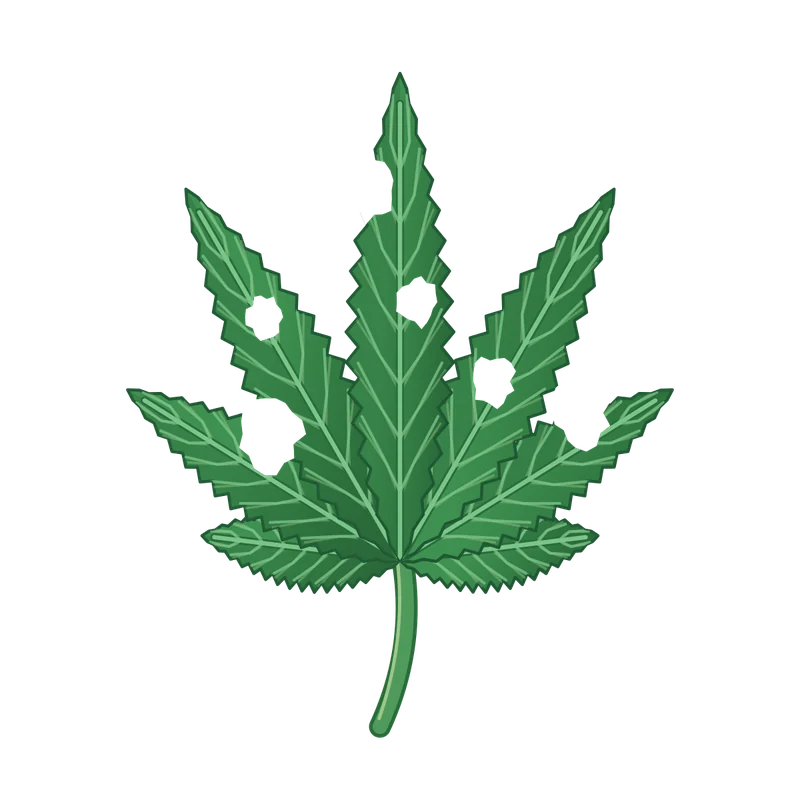 Pest
Caterpillars in buds: corn earworm and what follows
Tunnels, droppings and wilting tips in flowering buds usually mean caterpillars, often corn earworm outdoors. Check buds by hand from…
Browning / necrosis · Chewed or tunnelled · Visible bugs · Wilting or drooping
-
Pest
Hemp russet mites: the pest you can’t see
Upward-curling leaf edges and a dull, bronzed look, with no webbing and no bugs you can find, may mean russet…
Browning / necrosis · Curling or clawing · Other discolouration · Pale speckling
-
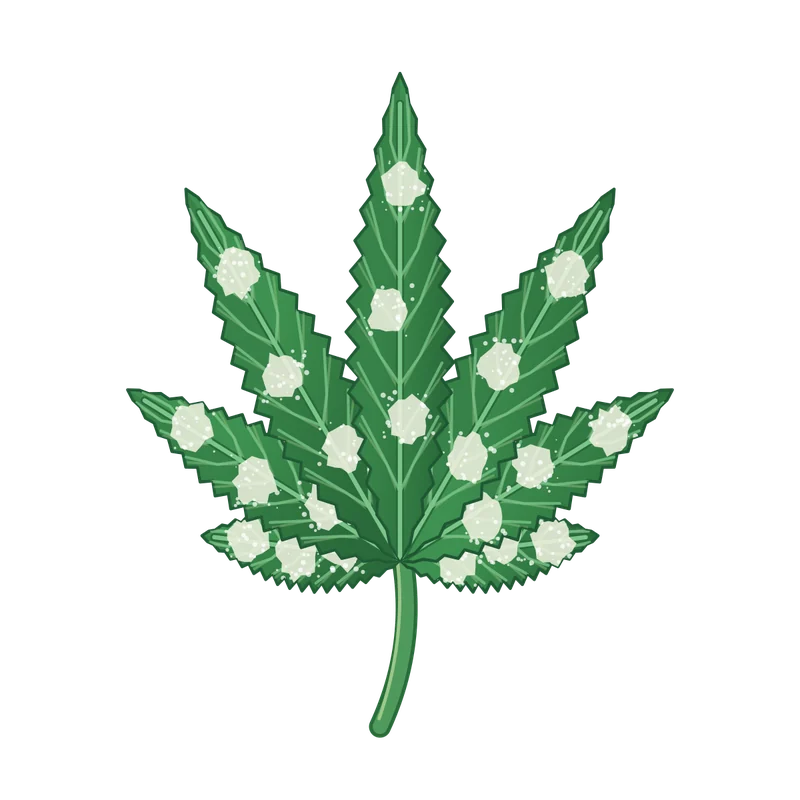 Disease
Powdery mildew: white dusty patches on leaves
White, flour-like spots on the top of leaves are usually powdery mildew. Remove affected leaves early, because new spores can…
Spots · Surface coating or powder · Buds · Lower fan leaves
-
 Disease
Root rot: brown roots and a plant that keeps declining
Wilting or stunting that watering and feeding don't fix, with brown or decaying roots, points to root rot. Check the…
Browning / necrosis · Stunted growth · Wilting or drooping · Yellowing
Sources (6)
- Punja, Z.K., & Ni, L. (2021). The bud rot pathogens infecting cannabis (Cannabis sativa L., marijuana) inflorescences: symptomology, species identification, pathogenicity and biological control. Canadian Journal of Plant Pathology. https://doi.org/10.1080/07060661.2021.1936650 [Evidence access: ABSTRACT VERIFIED; full text NOT VERIFIED.]
- Punja, Z.K., Collyer, D., Scott, C., Lung, S., Holmes, J., & Sutton, D. (2019). Pathogens and molds affecting production and quality of Cannabis sativa L. Frontiers in Plant Science, 10, 1120. https://doi.org/10.3389/fpls.2019.01120 [Evidence access: FULL TEXT VERIFIED.]
- Ocamb, C.M., & Osterbauer, N. Hemp (Cannabis sativa): Gray Mold (Botrytis Bud Blight and Stem Canker). Pacific Northwest Plant Disease Management Handbook. https://pnwhandbooks.org/node/12921 [Evidence access: EXTENSION TEXT VERIFIED.]
- Utah State University Extension. Hemp bud rot. https://extension.usu.edu/planthealth/ipm/notes_ag/hemp-bud-rot [Evidence access: EXTENSION TEXT VERIFIED.]
- NC State Extension. Gray mold of industrial hemp. https://content.ces.ncsu.edu/gray-mold-of-industrial-hemp [Evidence access: EXTENSION TEXT VERIFIED.]
- Szyper-Kravitz, M., Lang, R., Manor, Y., & Lahav, M. (2001). Early invasive pulmonary aspergillosis in a leukemia patient linked to aspergillus contaminated marijuana smoking. PubMed record. https://pubmed.ncbi.nlm.nih.gov/11911432/ [Evidence access: ABSTRACT VERIFIED; full text NOT VERIFIED.]