

Normal, not a problem
Purple stems and petioles: the phosphorus myth
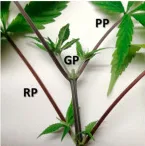
Purple stems are not a reliable sign of phosphorus deficiency.

This is normal. Nothing here needs fixing, and feeding the plant to correct it will make things worse.
On this page
Purple stems are not a reliable sign of phosphorus deficiency. Two controlled studies have characterized phosphorus deficiency in Cannabis sativa. One reports that purpling was minimal. In the other, the words “purple” and “anthocyanin” do not appear anywhere in the paper — not in the phosphorus section, not in any section.
If your plant is otherwise healthy and growing well, purple stems are most likely genetics or temperature, and there is nothing to fix.
This is one of the most repeated claims in cannabis growing, and the evidence doesn’t support it.
What the research actually found for phosphorus deficiency
Cockson et al. (2019) — vegetative, ‘T1’, sand culture
Phosphorus deficiency symptoms took seven weeks to develop. What appeared:
“The plants first displayed slight stunting when compared to the control. Initially, the plants developed olive-green spots in an irregular spotting pattern along the leaflets on the lower and older leaves. As symptoms progressed, the olive-green spots developed into larger olive-green spots that appeared sunken and almost wet in appearance.”
Olive-green, sunken, wet-looking spots. On lower and older leaves. We searched the full text: purple, purpling and anthocyanin appear zero times in a paper whose entire purpose was cataloguing deficiency and toxicity symptoms across every essential nutrient.
Llewellyn et al. (2023) — flowering, ‘Gelato 29’, hydroponic
Independently, in a different cultivar, a different system and a different growth stage:
- Tiny chlorotic spots at week 3, enlarging into necrotic lesions by weeks 4–5
- Necrosis spreading along leaf margins, leaflets curling upward by week 6
- All fan leaves dead by week 7
- “Purpling was minimal.”
The authors note the necrotic spotting pattern “had not been described in indoor cannabis before” — meaning the symptom that does characterize phosphorus deficiency is one most growers have never been told to look for, while the symptom they’re all watching for isn’t it.
These two studies disagree about several other nutrients. On phosphorus, they agree: the symptom is spotting, not purpling.
So what does cause purple?
Anthocyanins — the same pigment family that colors red cabbage and blueberries. In cannabis the predominant one reported is cyanidin-3-rutinoside.
The best evidence is a 2025 controlled study: Kim, Basnet, Kovaleski & Ellison, Journal of Cannabis Research. They grew a purple-capable inbred line at constant temperatures from 0.5 °C to 22 °C.
| Temperature | Total monomeric anthocyanins | Visual pigment score |
|---|---|---|
| 0.5 °C | lowest | 19 |
| 8 °C | 68 mg/L (highest) | 534 |
| 15 °C | 58 mg/L | 533 |
| 22 °C | lowest | — |
The relationship is nonlinear and peaks in the middle. Colder is not always more purple — at 0.5 °C the plants were nearly as green as at 22 °C.
They also ran fluctuating regimes (22 °C for 5 h / 4 °C for 19 h, and 22 °C for 15 h / 4 °C for 9 h). Those produced anthocyanin levels similar to the constant 4 °C and 22 °C treatments, which the authors read as evidence that temperature stimuli rather than accumulated heat drive the response.
And genetics gates all of it. The study used Early Harvest 118 S3, a line self-pollinated for three generations specifically for uniform purple pigmentation — it holds colour even at 25–30 °C. The plants showed no purple before treatment, so within a purple-capable genotype, temperature set how much appeared. A cultivar without the pigment pathway stays green no matter how cold you run it.
The honest limit on all of this
That study did not score stems. Visual ratings covered leaf and floral tissue and whole-plant coverage; for the chemical assay, stems were removed from the inflorescence before grinding.
So it establishes that temperature drives anthocyanin accumulation in cannabis leaves and flowers. It does not directly establish what makes a stem or petiole purple.
It’s also one genotype, grown in chambers, in two replicate experiments — the authors say generalizing to field conditions needs caution. And they flag that visual scores may be inflated relative to the chemical measurements, even though the two correlated well (r = 0.7 and 0.8).
Purple stems specifically are under-researched. Every confident explanation you’ll find online — including specific night-temperature targets and day/night differentials presented as fact — traces back to grower blogs, not to published work. We looked. If you find a primary source on stem-specific anthocyanin expression in cannabis, tell us and this page gets updated.
Where the myth probably comes from
Phosphorus deficiency does cause purpling in some other crops — maize is the classic textbook case, where phosphorus-deficient seedlings turn reddish-purple. That’s real, it’s well documented, and it’s in every general agronomy text.
The leap was assuming it transfers to cannabis. When somebody finally tested it in cannabis, twice, it didn’t.
This is a good reminder that most cannabis growing advice predates any cannabis research. Prohibition meant the plant went unstudied for decades, so the knowledge base was assembled from other crops plus grower observation. Much of it holds. This piece doesn’t.
What to actually do
- Is the plant otherwise healthy? Normal growth rate, good colour in the leaves, no spotting? Then purple stems are almost certainly genetics or temperature. Do nothing.
- Check your night temperatures. If they’ve dropped into the 8–15 °C range, you’ve found your explanation — that’s the anthocyanin peak.
- Check the genetics. Many cultivars express purple stems from seedling stage regardless of conditions. If it’s been purple since week one and the plant is thriving, that’s what it is.
- Do not dose phosphorus based on stem colour. If the plant isn’t phosphorus deficient, you’re pushing EC up for nothing — and high phosphorus interferes with other uptake.
- If you want to find real phosphorus deficiency, look at the leaves. Irregular spotting on lower, older leaves — olive-green and sunken in the vegetative study, chlorotic progressing to necrotic in the flowering one. Spots, not colour.
- If there are other symptoms, diagnose those. The stem colour is a distraction. Work the differential on the real signs.
Photos
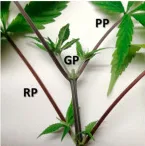
1 photo of purple stems and petioles: the phosphorus myth
It could also be
These share symptoms with this one. Open each to see what tells them apart.
-
 Pest
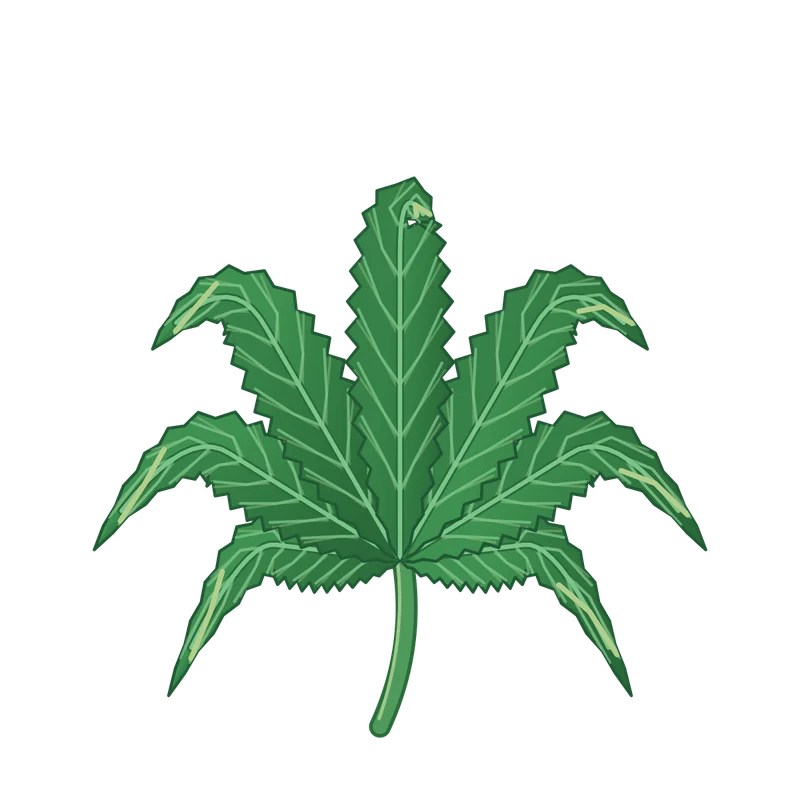
Hemp russet mites: the pest you can’t see
Upward-curling leaf edges and a dull, bronzed look, with no webbing and no bugs you can find, may mean russet…
Browning / necrosis · Curling or clawing · Other discolouration · Pale speckling
-
 Light
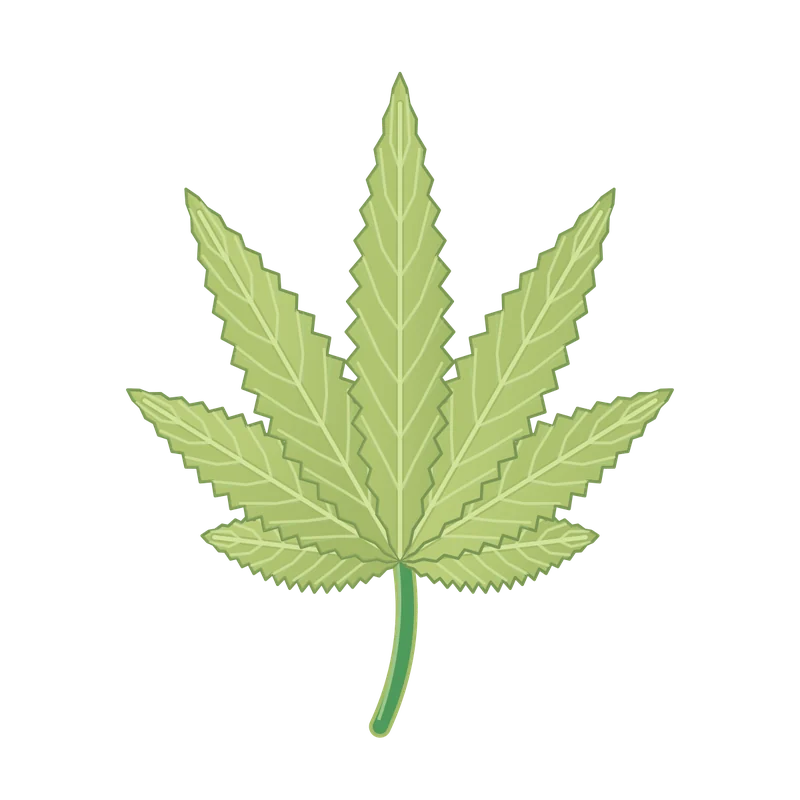
Light burn: bleached leaves closest to the lamp
Pale or bleached leaves at the very top of the plant, closest to the light, may mean too much light…
Browning / necrosis · Curling or clawing · Other discolouration · Yellowing
-
 Pest
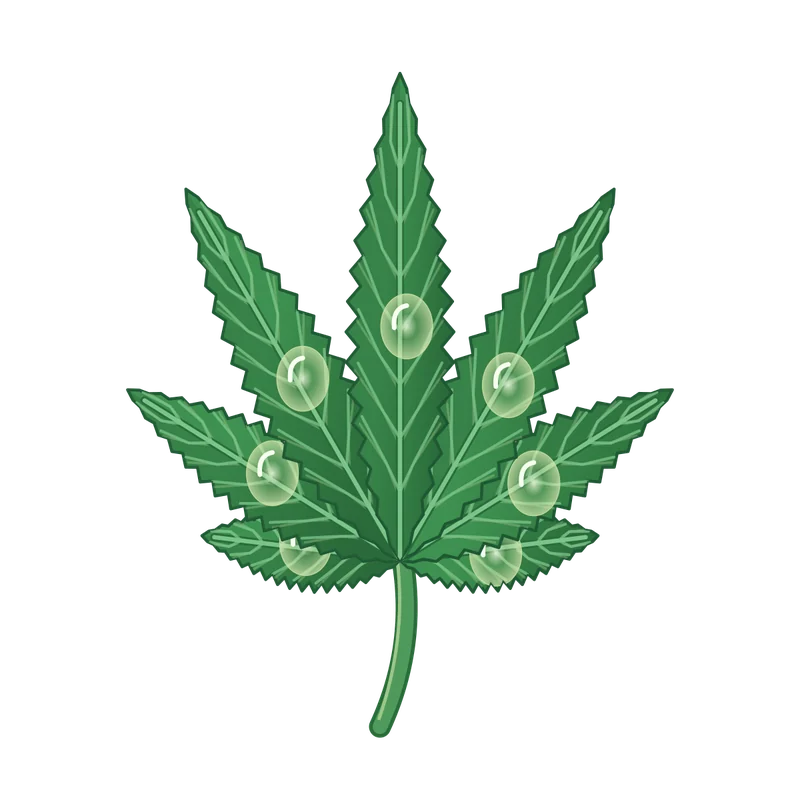
Aphids: clusters and sticky leaves
Clusters of small soft insects on stems and under leaves, often with sticky or shiny residue, mean aphids. They can…
Sticky or shiny residue · Stunted growth · Visible bugs · Wilting or drooping
-
 Disease
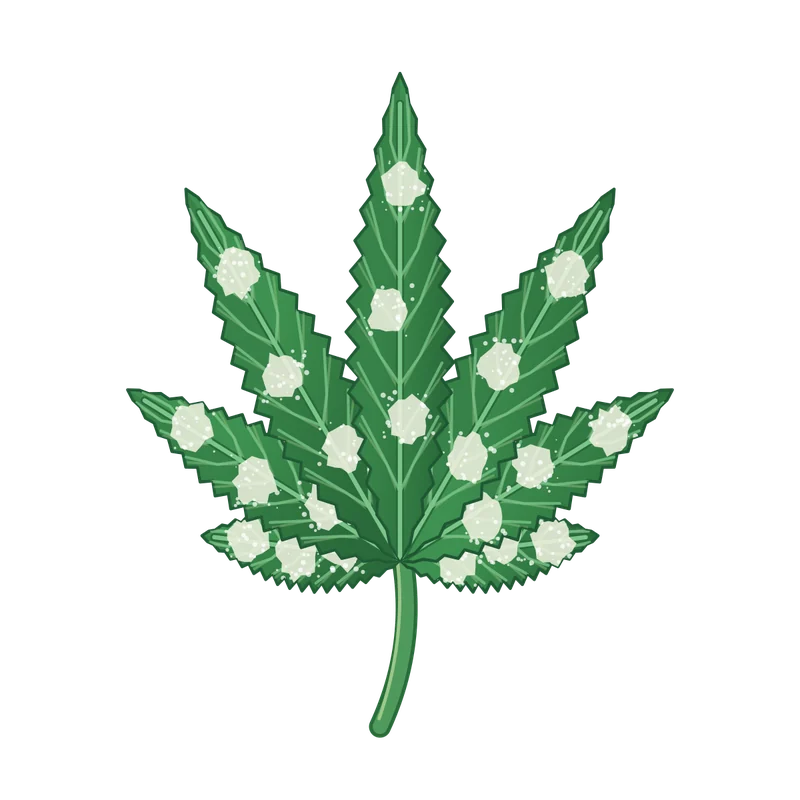
Powdery mildew: white dusty patches on leaves
White, flour-like spots on the top of leaves are usually powdery mildew. Remove affected leaves early, because new spores can…
Spots · Surface coating or powder · Buds · Lower fan leaves
-
 Disease
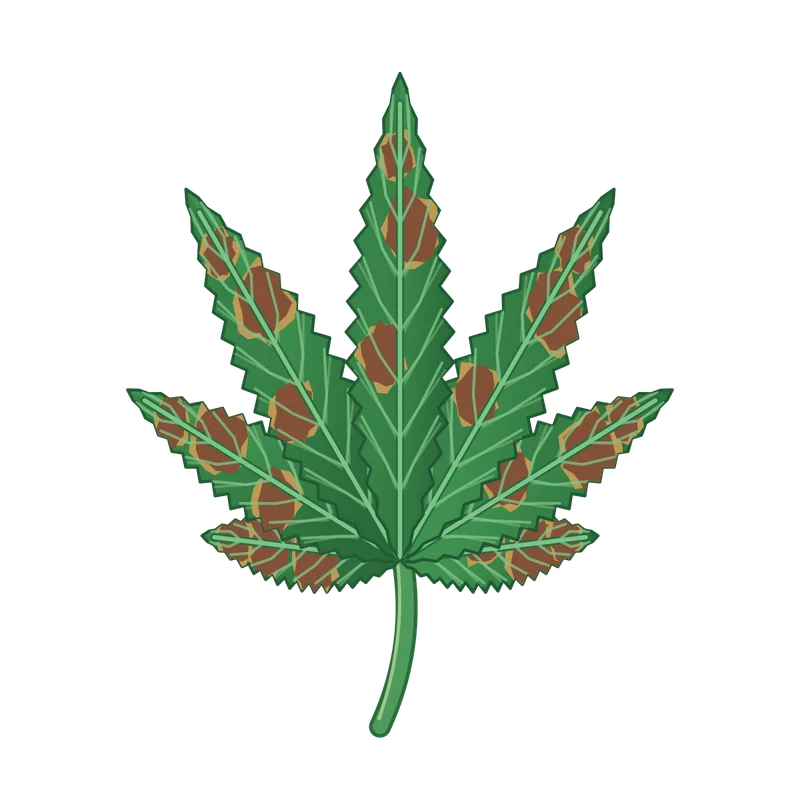
Bud rot: brown, dying buds and gray fuzz
A browning, dying section of bud, sometimes with gray fuzz, usually means bud rot. It can't be cured and it…
Browning / necrosis · Surface coating or powder · Wilting or drooping · Buds
-
 Disease
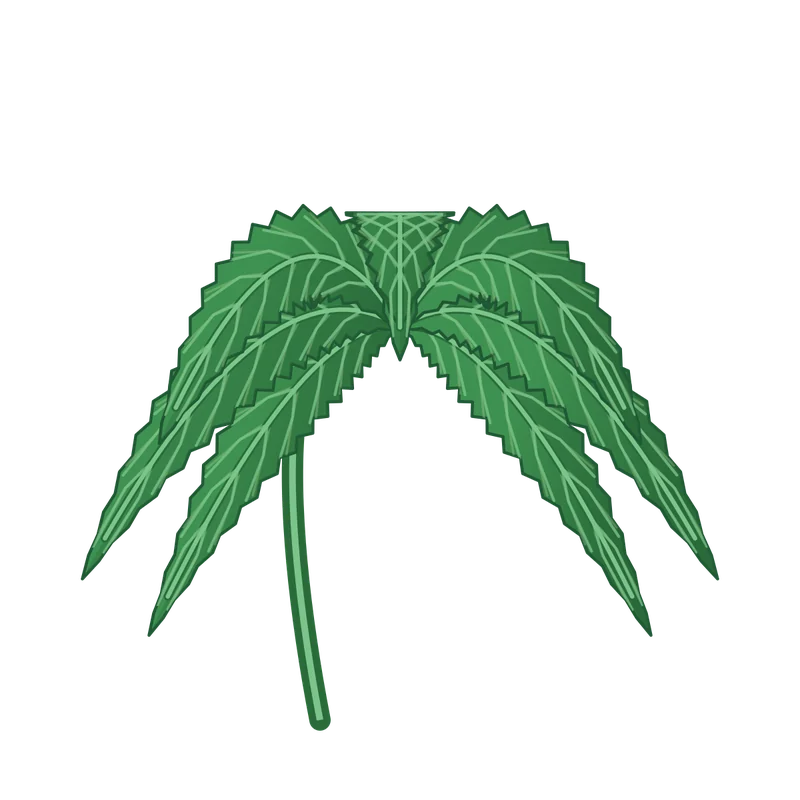
Root rot: brown roots and a plant that keeps declining
Wilting or stunting that watering and feeding don't fix, with brown or decaying roots, points to root rot. Check the…
Browning / necrosis · Stunted growth · Wilting or drooping · Yellowing
Sources (3)
- Cockson, P., Landis, H., Smith, T., Hicks, K., & Whipker, B.E. (2019). Characterization of nutrient disorders of Cannabis sativa. Applied Sciences, 9(20), 4432. https://doi.org/10.3390/app9204432 — open access. Phosphorus description quoted directly; full-text search confirms no mention of purpling or anthocyanins.
- Llewellyn, D., Golem, S., Jones, A.M.P., & Zheng, Y. (2023). Foliar symptomology, nutrient content, yield, and secondary metabolite variability of cannabis grown hydroponically with different single-element nutrient deficiencies. Plants, 12(3), 422. https://doi.org/10.3390/plants12030422 — open access. Source for "purpling was minimal."
- Kim, Basnet, Kovaleski & Ellison (2025). Anthocyanin accumulation, inflorescence dry weight and total cannabidiol content have different temperature optima in Cannabis sativa. Journal of Cannabis Research. https://pmc.ncbi.nlm.nih.gov/articles/PMC12309197/ — open access. Source for all temperature and pigment figures. Stems were not scored in this study.