

Normal, not a problem
Natural senescence: when yellowing leaves are supposed to happen
Late in flower, your plant starts dismantling its own fan leaves on purpose.
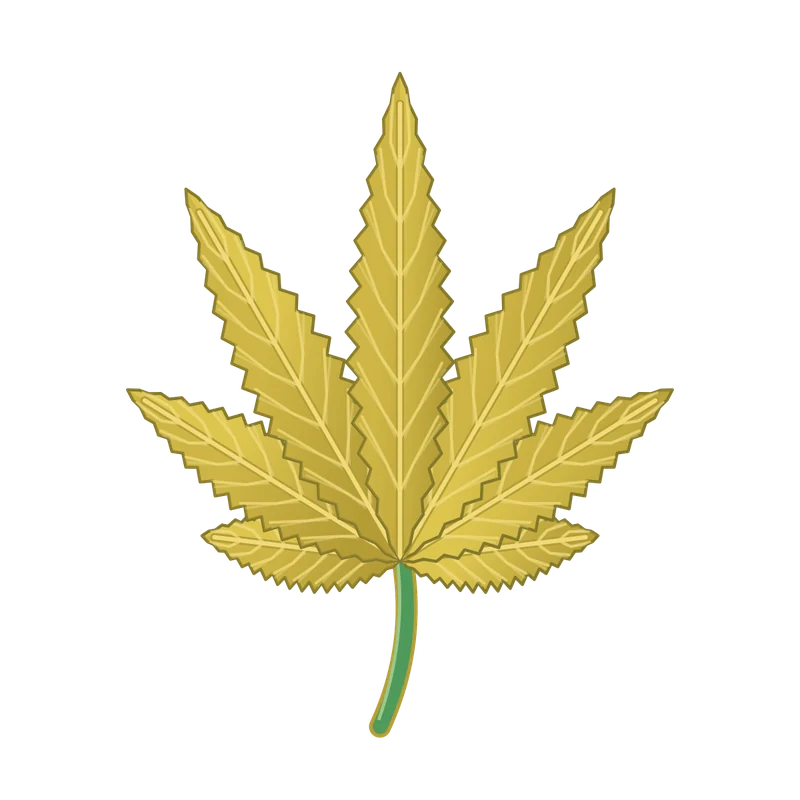
This is normal. Nothing here needs fixing, and feeding the plant to correct it will make things worse.
On this page
Late in flower, your plant starts dismantling its own fan leaves on purpose. It pulls the nitrogen, phosphorus and magnesium out of old leaves and moves them into the flowers. The leaves yellow, then die. This is the plant working correctly.
In a 2023 controlled study, the control plants — receiving complete nutrition, with nothing withheld — began senescing around week 6 of flower. The researchers note this made late-stage deficiency symptoms harder to read in their own experiment. If people running the study had trouble telling senescence from deficiency, you’re not being careless by finding it confusing.
Why it looks exactly like nitrogen deficiency
Because it is, mechanically, the same process.
Senescence is a controlled shift in a leaf from building nutrients to exporting them — described in the plant science literature as a “functional transition from nutrient assimilation to nutrient remobilization.” Chloroplasts are broken down wholesale, which is what releases the nitrogen; their destruction is why the green goes. The freed amino acids are loaded into the phloem and shipped to wherever the plant is investing.
Cannabis is monocarpic — it flowers once and dies. In monocarpic plants, after the switch to reproductive growth, leaves are progressively converted into source organs feeding the developing flowers and seeds.
And here’s the part that explains the confusion: under nitrogen shortage, the plant runs this same remobilization program — stripping older leaves to supply new growth. That’s what produces the classic yellowing of lower leaves in nitrogen deficiency.
So senescence and nitrogen deficiency aren’t two different-looking things you’re failing to tell apart. They’re one mechanism with two triggers. One is developmental and on schedule; the other is scarcity, early.
How to tell them apart
| Natural senescence | Nitrogen deficiency | |
|---|---|---|
| Timing | Week 6+ of flower | Any time; often much earlier |
| Progression | Slow, stays in the oldest growth | Climbs the plant, reaching upper fan then sugar leaves |
| Rest of the plant | Healthy, flowers filling | Overall growth stunted |
| Petioles | Usually unremarkable | Turn red-brown in the flowering study |
| Pace | Gradual over weeks | Can move fast |
The single most useful signal is whether it climbs. Senescence works bottom-up and stays near the bottom while the plant finishes. Nitrogen deficiency keeps going — in the study, it progressed from lower fan leaves to most fan leaves to the sugar leaves, with the plant losing all fan leaves by the end.
The second most useful is red-brown petioles, which the flowering study reported for nitrogen deficiency and which aren’t a feature of ordinary senescence.
What to do about it
Nothing. That’s the whole answer.
Specifically, do not:
- Feed more nitrogen to “fix” it. Late-flower nitrogen is the opposite of what you want; the plant is deliberately divesting. You’d be fighting its own program.
- Strip the yellowing leaves early. They’re still being emptied. Removing a leaf mid-remobilization throws away the nutrients it was in the middle of handing back.
- Panic-diagnose. Reach for the differential only if it’s climbing the plant or it’s well before week 6.
Leaves that have fully yellowed and gone crisp are finished and can come off. There’s no rush.
The flushing question, honestly
Pre-harvest flushing — withholding nutrients for the last stretch — is near-universal practice and it interacts with this directly.
The flowering study’s authors note that flushing “may amplify deficiency appearance or speed senescence.” So if you flush and then watch the plant yellow dramatically, you’ve likely caused or accelerated the thing you’re now looking at.
Whether that’s good, bad or neutral for the final product is not settled by any research we could find. The claims in both directions — that flushing improves smoothness, that it costs yield — trace to grower consensus, not published work. We’re not going to pretend otherwise.
What is defensible: judge a plant’s health before a flush, not during one. Once you’ve deliberately cut nutrition, the plant’s appearance stops being diagnostic.
What isn’t known
This is worth stating plainly, because confident timing claims are everywhere.
There is no peer-reviewed research on senescence specifically in cannabis. We looked. The mechanism above is established plant science drawn from Arabidopsis, poplar, grapevine and general reviews — it is well-supported and there’s no particular reason cannabis would differ, but it has not been measured in this plant.
The one hard cannabis-specific data point is the control-group observation in Llewellyn et al.: senescence beginning around week 6 in fully-fed plants of one cultivar, grown hydroponically. That’s a single cultivar in a single system. Your timing will vary with genetics, medium and environment.
Anything you read giving precise senescence schedules, or claiming yellowing indicates ripeness, is grower lore. Some of it is probably right. None of it has been tested.
It could also be
These share symptoms with this one. Open each to see what tells them apart.
-
Watering
Overwatering: wet roots that can’t get air
Drooping or yellowing leaves on a pot that still feels heavy usually mean the roots are too wet. Don't water…
Curling or clawing · Stunted growth · Wilting or drooping · Yellowing
-
 Watering
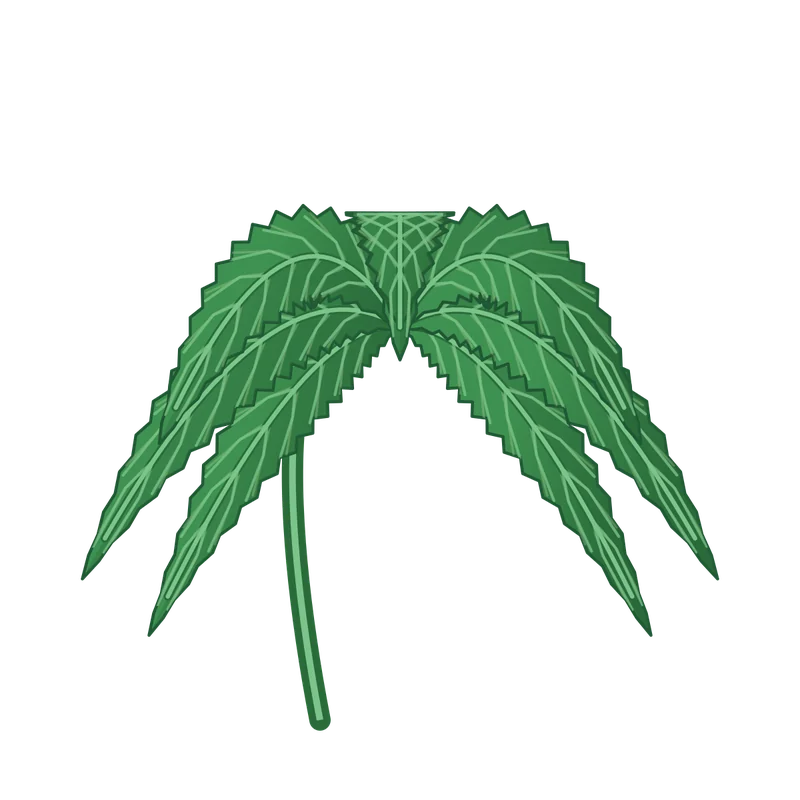
Underwatering: a light pot and a limp plant
A limp plant in a pot that feels very light probably just needs water. Water it slowly until the whole…
Browning / necrosis · Stunted growth · Wilting or drooping · Yellowing
-
 Nutrient toxicity
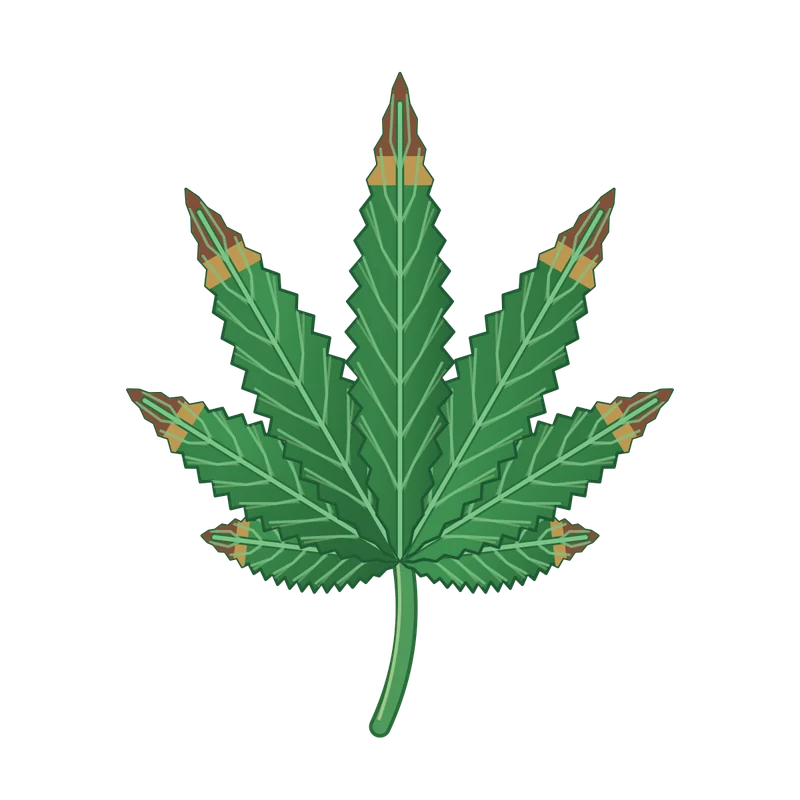
Nutrient burn: brown tips and edges from too much feed
Brown, crispy tips or edges after a stronger feed may be nutrient burn, but other problems look the same. Test…
Browning / necrosis · Curling or clawing · Wilting or drooping · Yellowing
-
 Pest
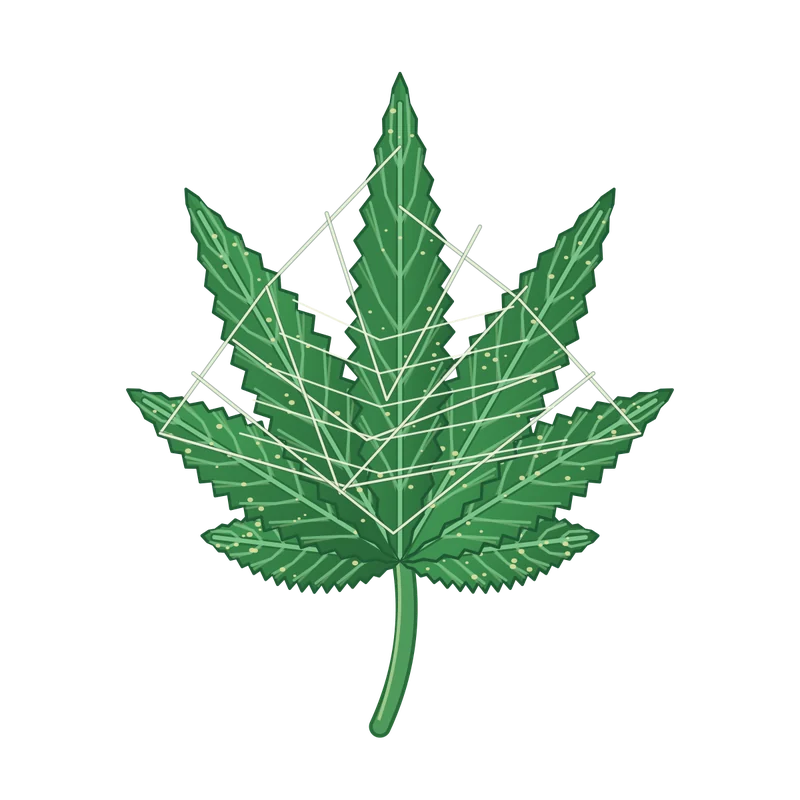
Spider mites: pale speckles, then webbing
Fine pale speckles on the leaves, with tiny moving dots or webbing underneath, point to spider mites. Check the underside…
Pale speckling · Visible bugs · Webbing · Yellowing
-
 Pest
Aphids: clusters and sticky leaves
Clusters of small soft insects on stems and under leaves, often with sticky or shiny residue, mean aphids. They can…
Sticky or shiny residue · Stunted growth · Visible bugs · Wilting or drooping
-
 Pest
Whiteflies: a white cloud when you shake the plant
Tiny white insects that fly up when you water or brush the plant are whiteflies. Keep a yellow sticky card…
Sticky or shiny residue · Visible bugs · Wilting or drooping · Yellowing
Sources (4)
- Llewellyn, D., Golem, S., Jones, A.M.P., & Zheng, Y. (2023). Foliar symptomology, nutrient content, yield, and secondary metabolite variability of cannabis grown hydroponically with different single-element nutrient deficiencies. Plants, 12(3), 422. https://doi.org/10.3390/plants12030422 — open access. Source for the week-6 control-plant observation, the nitrogen-deficiency progression and petiole colour, and the flushing note.
- Leaf senescence: progression, regulation, and application. Molecular Horticulture (2021). https://doi.org/10.1186/s43897-021-00006-9 — open access review. Source for the assimilation-to-remobilization transition and the regulatory factors.
- Senescence and death of plant organs: nutrient recycling and developmental regulation. Comptes Rendus Biologies. https://www.sciencedirect.com/science/article/pii/S163106911000017X — source for monocarpic reproductive-transition senescence.
- Nitrogen metabolism and remobilization during senescence. Journal of Experimental Botany, 53(370), 927. https://academic.oup.com/jxb/article/53/370/927/537244 — source for chloroplast breakdown and phloem export of amino acids.