

Pest
Whiteflies: a white cloud when you shake the plant
Tiny white insects that fly up when you water or brush the plant are whiteflies. Keep a yellow sticky card nearby and act early, because heavy infestations are hard to control.
On this page
Plants can look fine until numbers are high, which is why the sticky card matters.
What it looks like
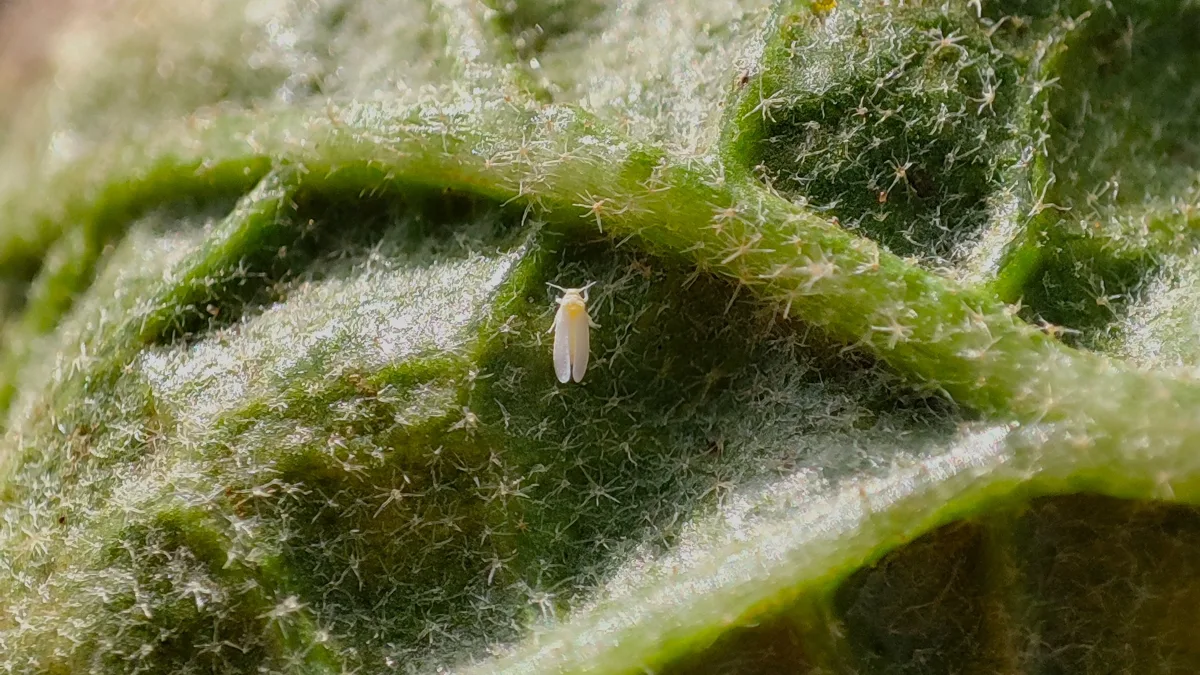
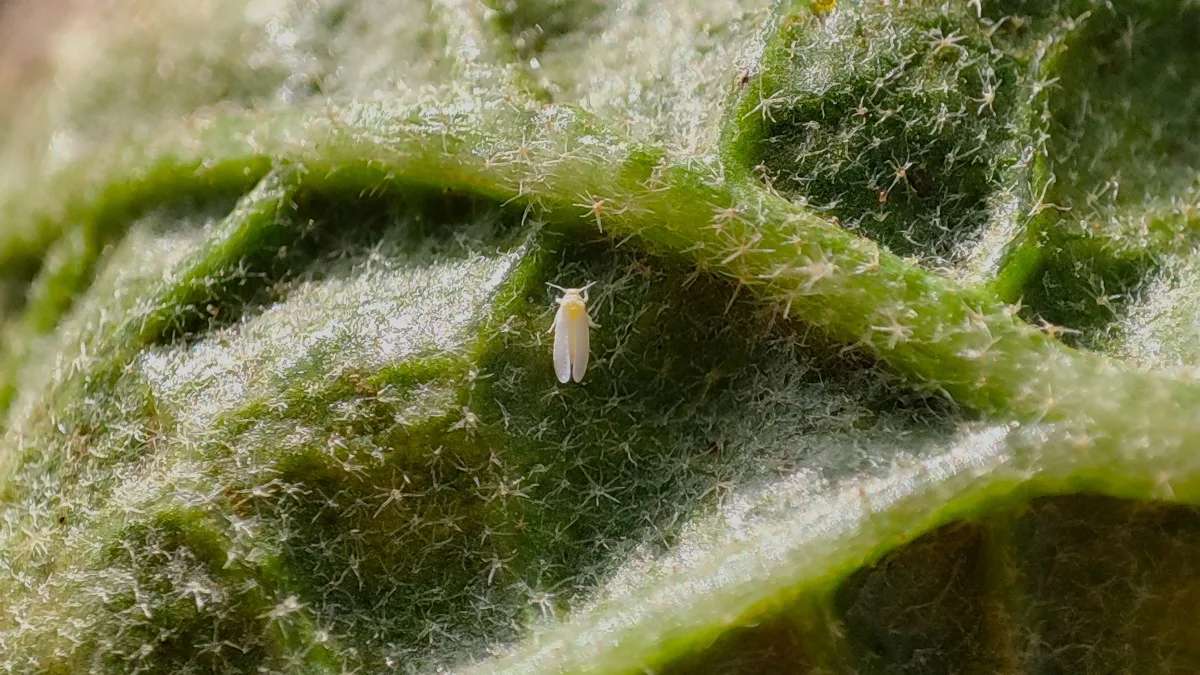
Adults are 1.5 to 2.5 mm long and moth-like, with powdery white wings. The young look completely different: flat, wingless, semi-transparent ovals that sit still on the undersides of leaves, and they’re easy to mistake for leaf spots, scale or eggs (Purdue Extension).
The most obvious sign is a burst of adults leaving the plant when you water or handle it. Heavily infested plants may show yellowing, drooping and wilting, along with sticky honeydew and black sooty mold on the leaves (Purdue Extension). Silvering leaves with young whiteflies on them are another sign (UC IPM).
Why it happens
Whiteflies come in on infested plants or from weeds near the grow. They survive and breed all year indoors. Egg to adult takes 14 to 28 days, faster when it’s warm, and a female lays 200 to 400 eggs (Purdue Extension). Generations overlap, so every life stage may be present at once.
Most of the damage comes from the young, not the adults flying around (UC IPM). Whiteflies are mainly an indoor problem on cannabis. Sweetpotato whitefly has been reported as a serious pest of indoor plants in the southeastern US, based on what the authors were told rather than a study, and no whiteflies were seen developing in hemp fields (Cranshaw et al. 2019).
How to confirm it
- Tap or gently shake the plant and watch for adults flying up.
- Use yellow sticky cards, the most reliable monitoring tool, and check them weekly so you can see numbers change (Purdue Extension). Hang them level with the plants, sticky side facing the foliage. Whiteflies don’t fly far, so you may need more than one (UC IPM).
- Turn over a few leaves and look for the flat young and for honeydew.
What else it could be: aphids also leave honeydew, but they stay put when disturbed. Fungus gnats also fly up, but they’re dark and hang around the soil.
What to do
- Isolate the plant, and quarantine new ones until you know they’re clean (Purdue Extension).
- Remove infested leaves and hose off what you can. Keeping up with this can slow them down early (UC IPM).
- Use sticky cards as more than a monitor if numbers are high. They can reduce whitefly numbers somewhat, but won’t solve the problem alone.
- Use soap or oil on leaves if you need to. Insecticidal soaps and oils such as neem can reduce numbers but won’t eliminate them, and they need thorough coverage of leaf undersides and repeat sprays (UC IPM).
- Use parasitic wasps early, not as a rescue. Encarsia formosa attacks the young and works best at low numbers. Parasitized young turn black (Purdue Extension).
- Clear weeds in and around the grow, and clean up between harvests (Purdue Extension).
Keep sprays off buds you plan to smoke. One study of contaminated flower found residues of four synthetic chemicals carried over into smoke, as much as 69.5% depending on the chemical and the device (Sullivan et al. 2013). We found no similar study for soaps, oils or biological products, so we can’t tell you those are safe to smoke. Few products are registered for cannabis at all (Lemay et al. 2022), and which ones are allowed differs by state, so check the label and your state’s rules first.
How much to trust this
We don’t know how much whiteflies cost on cannabis. Purdue says it’s unclear whether infestations cause economic losses on hemp, and no action threshold exists. Most treatment advice comes from whiteflies on other plants. Purdue’s life-cycle figures are for greenhouse whitefly, and other species may differ.
Photos
1 photo of whiteflies: a white cloud when you shake the plant

It could also be
These share symptoms with this one. Open each to see what tells them apart.
-
 Pest
Aphids: clusters and sticky leaves
Clusters of small soft insects on stems and under leaves, often with sticky or shiny residue, mean aphids. They can…
Sticky or shiny residue · Stunted growth · Visible bugs · Wilting or drooping
-
 Watering
Underwatering: a light pot and a limp plant
A limp plant in a pot that feels very light probably just needs water. Water it slowly until the whole…
Browning / necrosis · Stunted growth · Wilting or drooping · Yellowing
-
 Nutrient toxicity
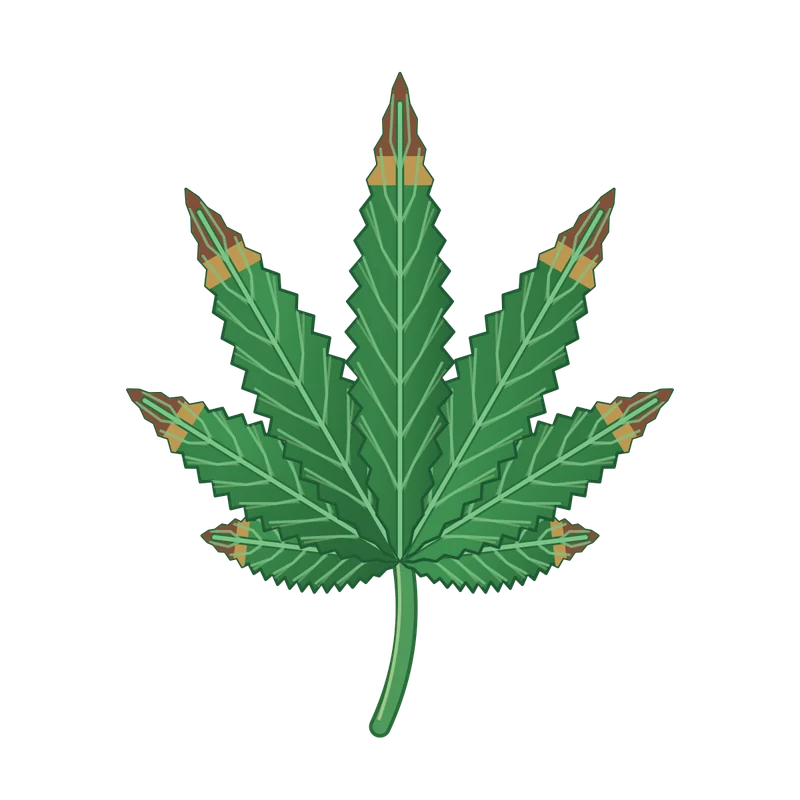
Nutrient burn: brown tips and edges from too much feed
Brown, crispy tips or edges after a stronger feed may be nutrient burn, but other problems look the same. Test…
Browning / necrosis · Curling or clawing · Wilting or drooping · Yellowing
-
 Pest
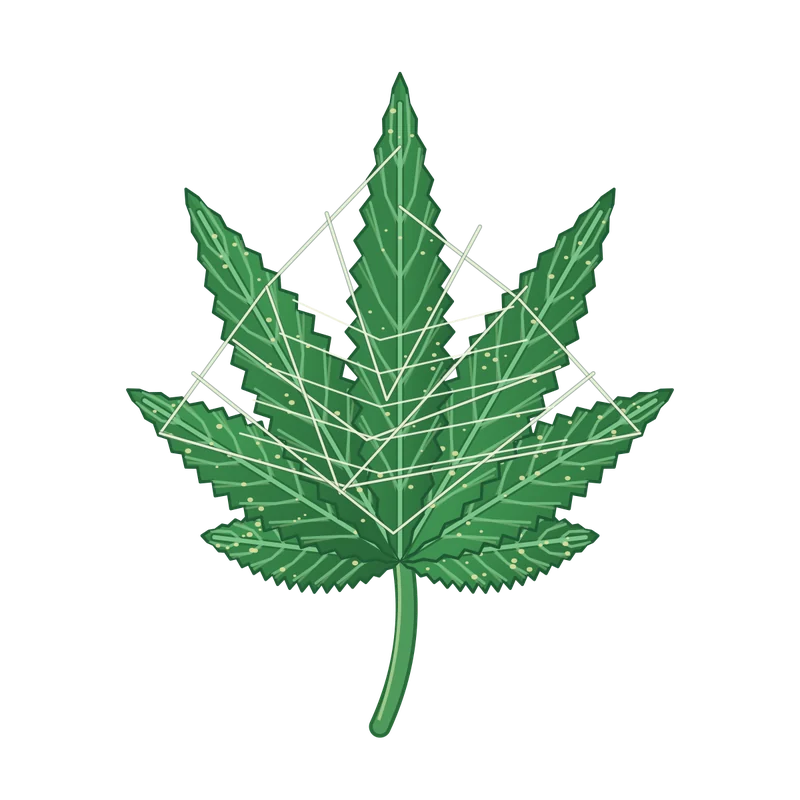
Spider mites: pale speckles, then webbing
Fine pale speckles on the leaves, with tiny moving dots or webbing underneath, point to spider mites. Check the underside…
Pale speckling · Visible bugs · Webbing · Yellowing
-
 Watering
Overwatering: wet roots that can’t get air
Drooping or yellowing leaves on a pot that still feels heavy usually mean the roots are too wet. Don't water…
Curling or clawing · Stunted growth · Wilting or drooping · Yellowing
-
 Pest
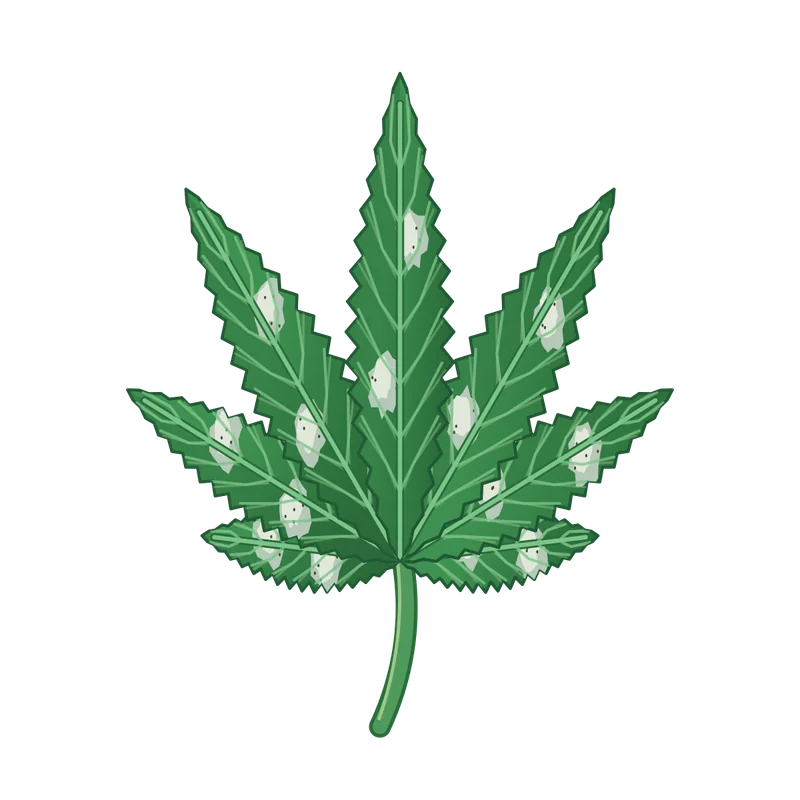
Thrips: silvery scrapes and black specks
Silvery or pale scraped patches with tiny black specks point to thrips. Look for the slender insects themselves before you…
Pale speckling · Silvery patches · Visible bugs · Buds
Sources (5)
- Serber, Z., & Long, E.Y. (2021). Management strategies for common arthropod pests of greenhouse hemp in Indiana. Purdue Extension, E-275-W. https://www.extension.entm.purdue.edu/publications/E-275/E-275.pdf
- Cranshaw, W., Schreiner, M., Britt, K., Kuhar, T.P., McPartland, J., & Grant, J. (2019). Developing insect pest management systems for hemp in the United States: a work in progress. Journal of Integrated Pest Management, 10(1), 26. https://doi.org/10.1093/jipm/pmz023
- UC Statewide IPM Program (2015). Pest Notes: Whiteflies. UC ANR Publication 7401. https://ipm.ucanr.edu/PMG/PESTNOTES/pn7401.html
- Lemay, J., Zheng, Y., & Scott-Dupree, C. (2022). Factors influencing the efficacy of biological control agents used to manage insect pests in indoor cannabis (Cannabis sativa) cultivation. Frontiers in Agronomy, 4, 795989. https://doi.org/10.3389/fagro.2022.795989
- Sullivan, N., Elzinga, S., & Raber, J.C. (2013). Determination of pesticide residues in cannabis smoke. Journal of Toxicology, 2013, 378168. https://doi.org/10.1155/2013/378168 [Evidence access: ABSTRACT VERIFIED; full text NOT VERIFIED.]