

Feeding and water Lifecycle Flowering Seedling Vegetative
Plant food basics: what N, P and K do and how much you need
Use a balanced nutrient program matched to your medium and water. Studies show both shortages and excess can hurt growth. The elemental concentrations they report aren't the same as fertilizer-label numbers or…
On this page
Plant food packages list three numbers: N, P and K. They aren’t three directly comparable elemental percentages. On typical U.S. fertilizer labels, they’re percent nitrogen, phosphate (P₂O₅ equivalent) and potash (K₂O equivalent). Research usually reports elemental N, P and K in mg/L. To convert the label figures, elemental P is about 0.44 × P₂O₅ and elemental K is about 0.83 × K₂O.
What each does, roughly
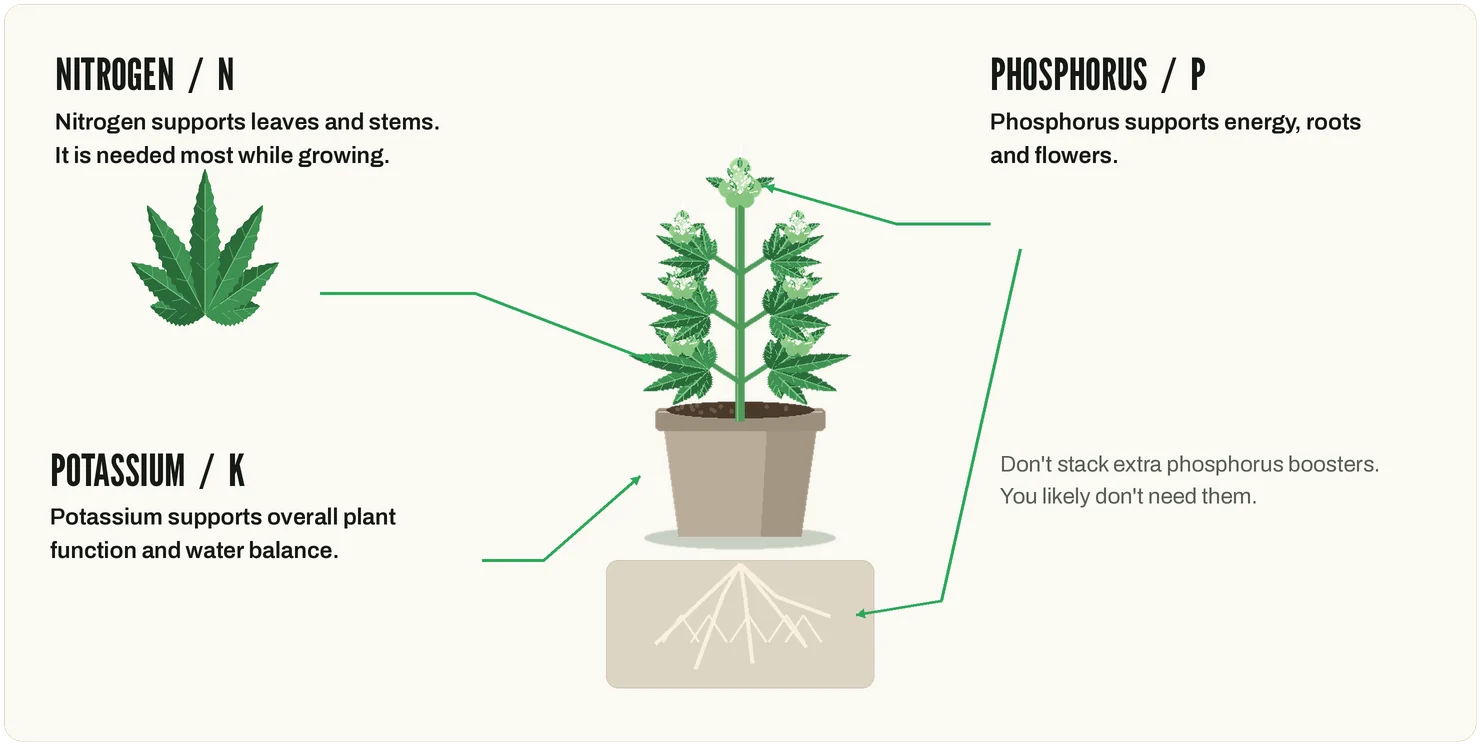
- Nitrogen (N): leaves and stems. Needed most while growing.
- Phosphorus (P): energy, roots and flowers.
- Potassium (K): overall plant function and water balance.
- Calcium and magnesium: cell walls and green color. See the Cal-Mag guide.
What studies found
| Question | Result |
|---|---|
| Best nitrogen while growing | About 160 mg/L gave the best growth; very low nitrogen cut biomass by about 75 percent |
| Best nitrogen and phosphorus in flowering | A model predicted a maximum near 194 mg/L elemental N and 59 mg/L elemental P for Gelato in DWC |
| Phosphorus range that works | 30 to 90 mg/L supported normal growth; very low supply hurt growth |
| Potassium in flowering | No significant yield response across 60–340 mg/L K in that Gelato trial; K remains essential |
| Organic liquid feed | Past the best rate, more fertilizer didn’t help |
These come from controlled studies with specific cultivars and setups, including perlite, water culture and coir-based mixes. Vegetative biomass, flower yield and cannabinoid concentration are different endpoints. The values aren’t interchangeable recipes, and organic fertilizer releases nutrients differently from mineral feed.
Practical takeaways
- Use a complete program that fits your medium, water and stage. If you change strength, make small changes based on growth and consistent EC and pH readings instead of automatically diluting every product.
- Don’t stack extra phosphorus boosters. You likely don’t need them.
- Where the first symptoms show up helps identify the cause. For example, calcium problems appear on new growth. See the troubleshooting guide.
Sources (6)
- Saloner, A., & Bernstein, N. (2020). Response of medical cannabis (Cannabis sativa L.) to nitrogen supply under long photoperiod. Frontiers in Plant Science, 11, 572293. https://www.frontiersin.org/journals/plant-science/articles/10.3389/fpls.2020.572293/full [Evidence access: FULL TEXT VERIFIED.]
- Bevan, L., Jones, M., & Zheng, Y. (2021). Optimisation of nitrogen, phosphorus, and potassium for soilless production of Cannabis sativa in the flowering stage using response surface analysis. Frontiers in Plant Science, 12, 764103. https://www.frontiersin.org/journals/plant-science/articles/10.3389/fpls.2021.764103/full [Evidence access: FULL TEXT VERIFIED.]
- Shiponi, S., & Bernstein, N. (2021). The highs and lows of P supply in medical cannabis: Effects on cannabinoids, the ionome, and morpho-physiology. Frontiers in Plant Science, 12, 657323. https://www.frontiersin.org/journals/plant-science/articles/10.3389/fpls.2021.657323/full [Evidence access: FULL TEXT VERIFIED.]
- Caplan, D., Dixon, M., & Zheng, Y. (2017). Optimal rate of organic fertilizer during the vegetative-stage for cannabis grown in two coir-based substrates. HortScience, 52(9), 1307–1312. https://doi.org/10.21273/HORTSCI11903-17 [Evidence access: ABSTRACT VERIFIED; full text NOT VERIFIED.]
- Cockson, P., Landis, H., Smith, T., Hicks, K., & Whipker, B. E. (2019). Characterization of nutrient disorders of Cannabis sativa. Applied Sciences, 9(20), 4432. https://www.mdpi.com/2076-3417/9/20/4432 [Evidence access: FULL TEXT VERIFIED.]
- Landschoot, P. Penn State Extension. How much phosphorus and potassium are really in your fertilizer? https://extension.psu.edu/how-much-phosphorus-and-potassium-are-really-in-your-fertilizer [Evidence access: EXTENSION TEXT VERIFIED.]