

Environment Lifecycle Flowering Late flower Seedling Vegetative
Temperature, humidity and VPD made simple
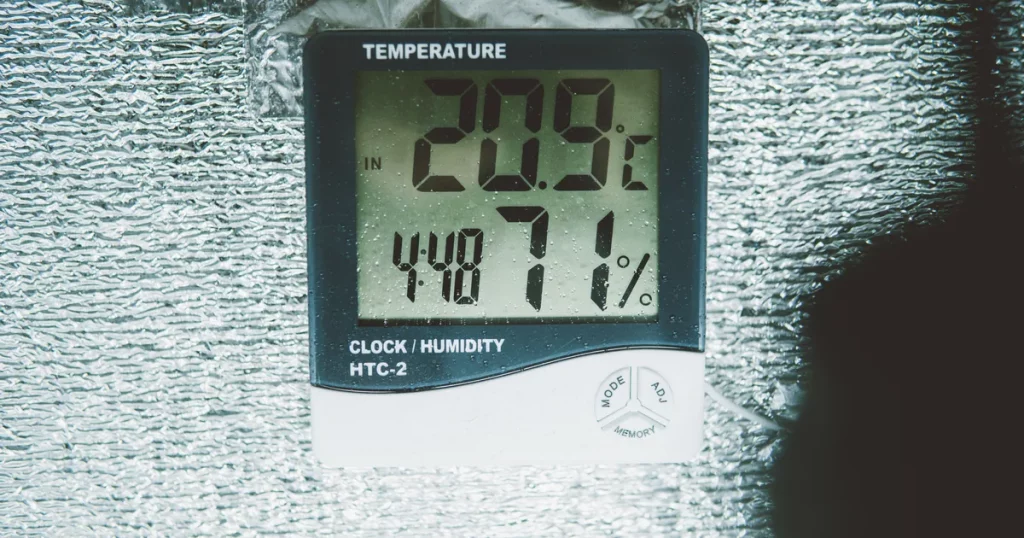
Aim for warm, steady temperatures, higher humidity for seedlings, and lower humidity as buds fill out. VPD combines temperature and humidity into one number, but a thermometer and hygrometer get you a…
On this page
Plants lose water through their leaves. Temperature and humidity control how fast that happens.
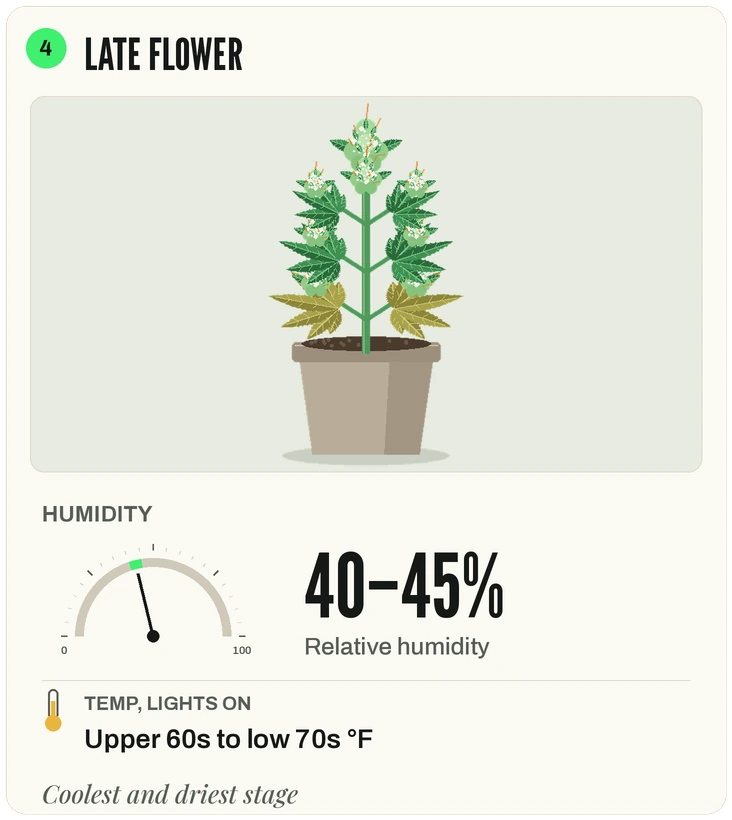
Practical targets
These are common grower ranges, not tested limits.
| Stage | Temperature (lights on) | Humidity |
|---|---|---|
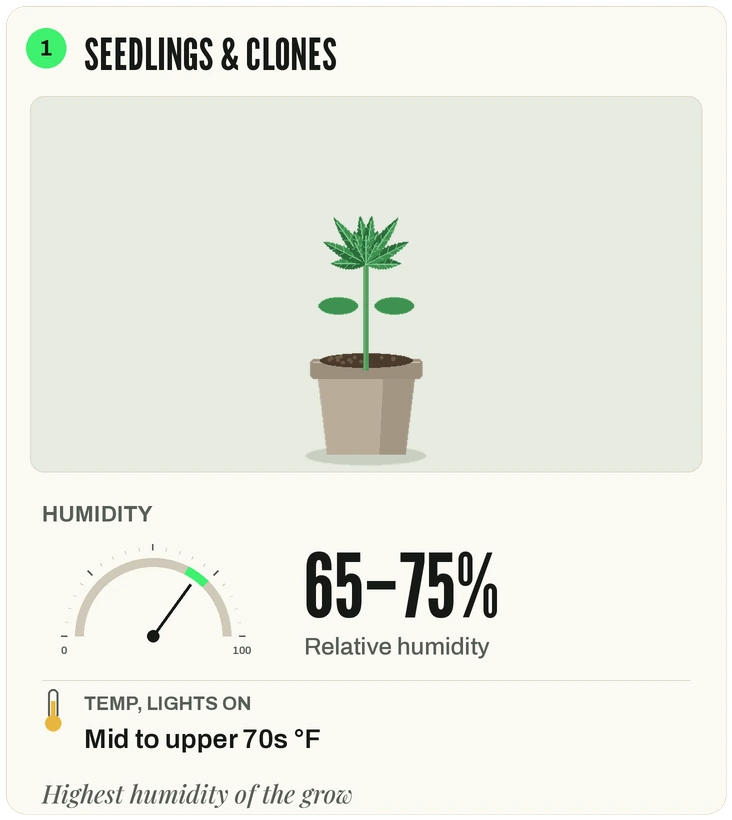
| Seedlings and clones | Mid to upper 70s °F | Higher, around 65 to 75 percent |
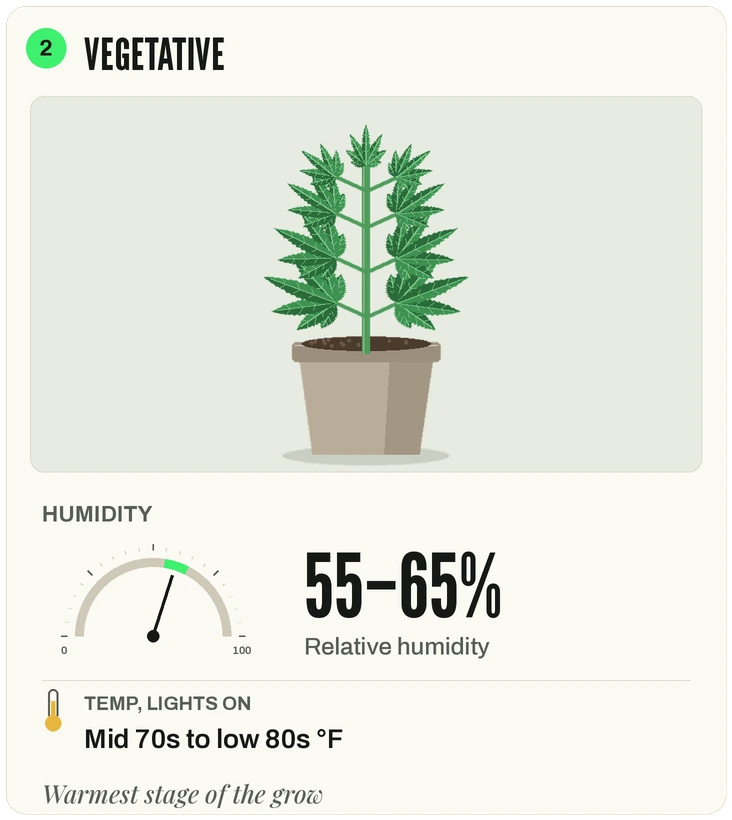
| Vegetative | Mid 70s to low 80s °F | Around 55 to 65 percent |
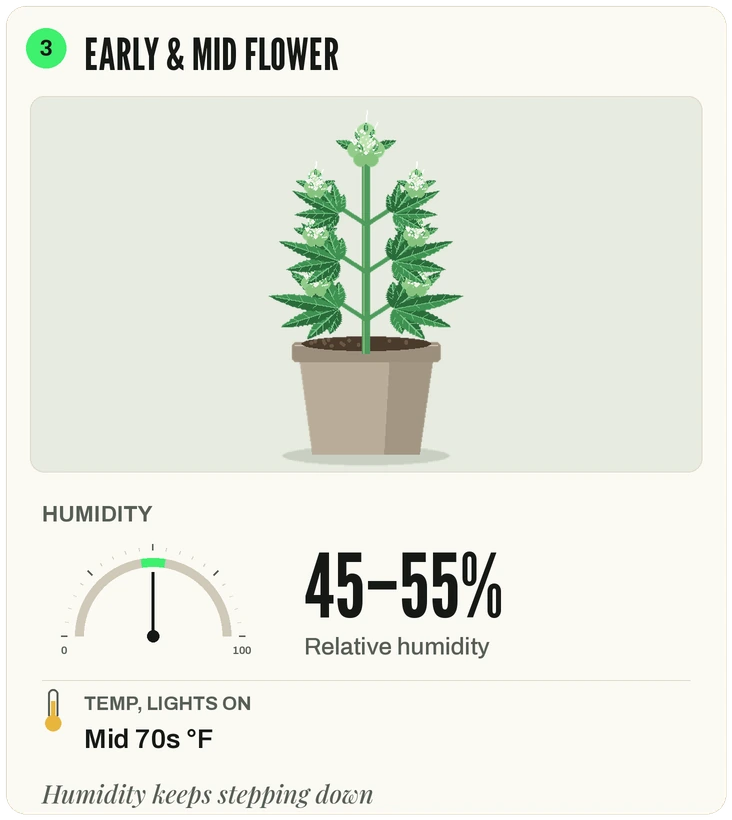
| Early and mid flower | Mid 70s °F | Around 45 to 55 percent |
| Late flower | Cooler, upper 60s to low 70s °F | Around 40 to 45 percent |
What research adds
- Chandra and colleagues measured leaf gas exchange at different temperatures, light levels and CO₂ concentrations. Photosynthesis was highest around 30°C under their particular measurement conditions. That didn’t establish the best room temperature for flower yield, terpenes or every cultivar.
- Bud rot thrives where humid air gets trapped in thick buds, so late-flower humidity and airflow matter most.
Check leaf temperature, not just the air
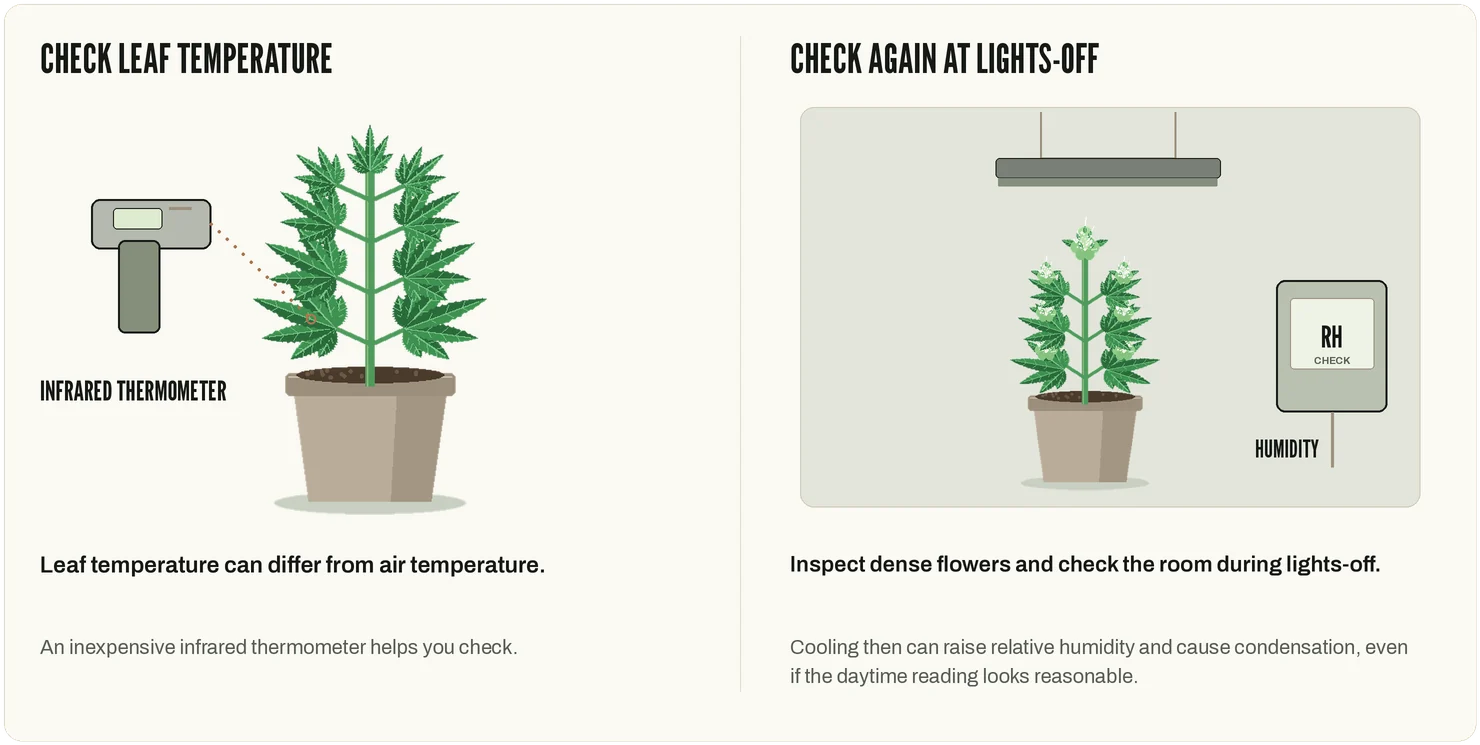
Leaf temperature can differ from air temperature. Fixture radiation, intensity, airflow and transpiration all matter, so don’t assume every LED-grown leaf is cooler than the room. An inexpensive infrared thermometer helps you check.
What is VPD?
Vapor pressure deficit (VPD) is a difference in water-vapor pressure. Leaf-to-air VPD uses leaf temperature as well as air temperature and humidity, so a chart based only on air temperature is an approximation. If you use a VPD chart, treat it as a guide. Too humid slows water movement and invites mold. Too hot and dry makes plants close their pores and stall.
The humidity table is a starting point, not a mold-safety boundary. Inspect dense flowers and check the room during lights-off. Cooling then can raise relative humidity and cause condensation, even if the daytime reading looks reasonable.
Sources (4)
- Chandra, S., Lata, H., Khan, I. A., & ElSohly, M. A. (2008). Photosynthetic response of Cannabis sativa L. to variations in photosynthetic photon flux densities, temperature and CO2 conditions. Physiology and Molecular Biology of Plants. https://pmc.ncbi.nlm.nih.gov/articles/PMC3550641/ [Evidence access: FULL TEXT VERIFIED.]
- Punja, Z. K., Collyer, D., Scott, C., Lung, S., Holmes, J., & Sutton, D. (2019). Pathogens and molds affecting production and quality of Cannabis sativa L. Frontiers in Plant Science, 10, 1120. https://www.frontiersin.org/journals/plant-science/articles/10.3389/fpls.2019.01120/full [Evidence access: FULL TEXT VERIFIED.]
- Punja, Z. K., & Ni, L. (2021). The bud rot pathogens infecting cannabis (Cannabis sativa L., marijuana) inflorescences: symptomology, species identification, pathogenicity and biological control. Canadian Journal of Plant Pathology. https://doi.org/10.1080/07060661.2021.1936650 [Evidence access: ABSTRACT VERIFIED; full text NOT VERIFIED.]
- University of Minnesota Extension. Small-scale hydroponics. https://extension.umn.edu/how/small-scale-hydroponics [Evidence access: EXTENSION TEXT VERIFIED.]