

Environment Feeding and water Flowering Seedling Vegetative
Troubleshooting: what’s wrong with my plant?
Start at the top of the list: check light, water, pH and temperature before adding supplements. Where on the plant symptoms start, and whether they're on new or old leaves, helps point…

On this page
Many different problems look alike, so don’t add several products at once.
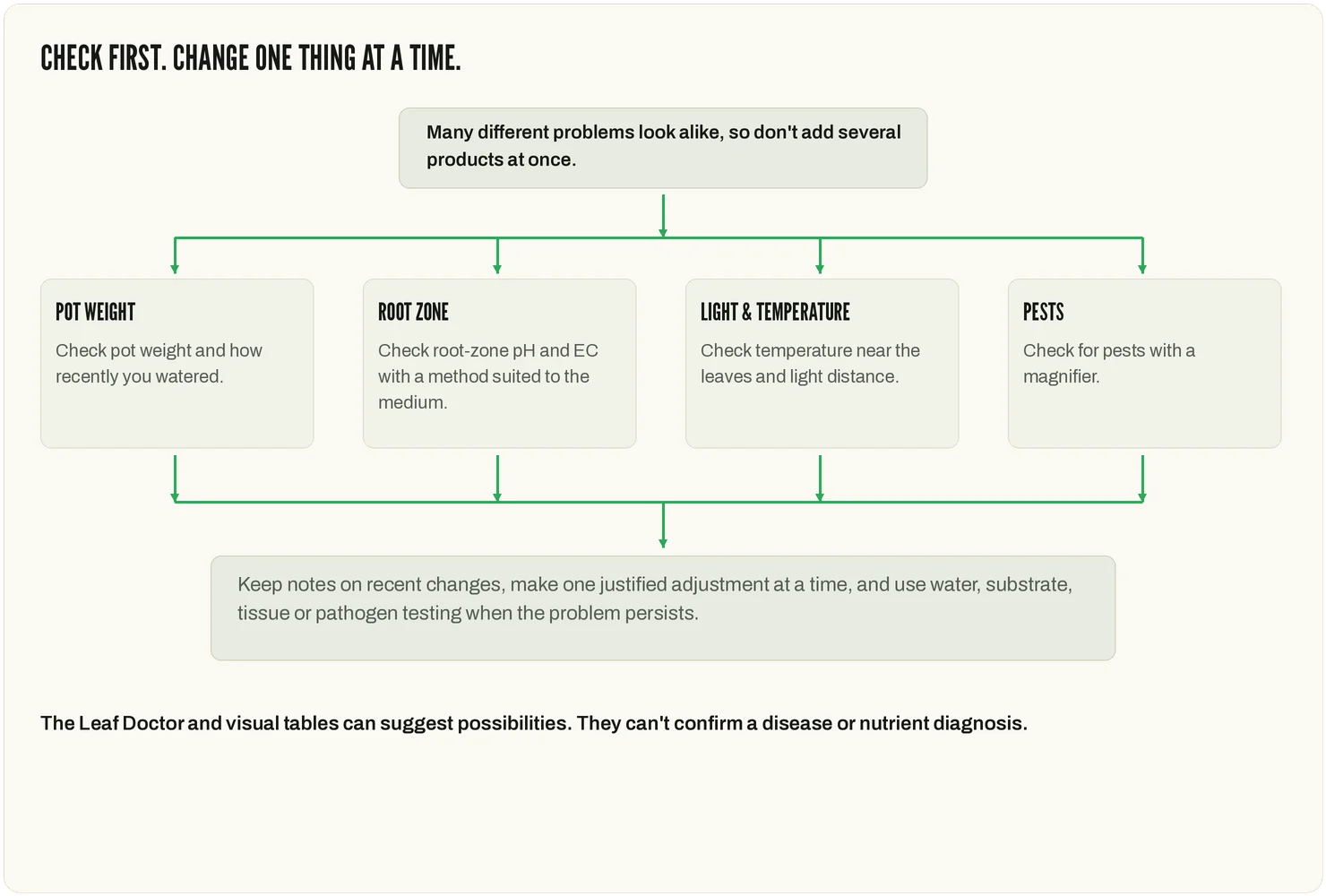
Check these first
- Pot weight and how recently you watered.
- Root-zone pH and EC, using a method that suits the medium. PourThru is one option for soilless containers.
- Temperature near the leaves and light distance.
- Pests, with a magnifier.
Common questions
- Yellow bottom leaves: often the plant moving nitrogen from old leaves to new growth, but also normal near harvest, shade at the bottom, or overwatering. See the late flower guide.
- Purple or red stems: can be genetics, strong light or cold. A deficiency is less likely if leaves are otherwise healthy.
- Dark green, clawing tips: commonly too much nitrogen or a hot, rich mix. Check EC, medium moisture and the feed program before adjusting nutrients. Repeated plain water can create shortages in unamended coco or water culture.
- Brown spots on mid leaves: can be a nutrient issue, but also pests or pH. Calcium problems are reported to show first on new growth.
- Twisted new growth: wind, dry air, pH swings or tiny mites.
- Airy, fluffy buds: in one trial, bud density rose as light intensity rose. Weak light, shaded lower buds and heat are common causes.
- Little smell: terpenes evaporate easily. Avoid overheating and poor storage, but don’t assume extra cold or a longer dry is always better. The cited storage study didn’t establish an optimum late-flower temperature.
- Wilting one branch with moist soil: possible root or vascular disease. See the mold and root rot guide.
A note on pH
Confirm the meter and sampling method before correcting a persistent drift. A 2025 hemp study found suppressed growth below about pH 5.0 in peat-based substrate, but it didn’t define a universal pH window for coco, soil and water culture. See the pH guide.
For more detail
The Leaf Doctor walks you through symptoms and suggests likely causes.
The Leaf Doctor and visual tables can suggest possibilities. They can’t confirm a disease or nutrient diagnosis. Keep notes on recent changes, make one justified adjustment at a time, and use water, substrate, tissue or pathogen testing when the problem persists. Don’t consume or process flower that may be moldy or contaminated.
Sources (6)
- Cockson, P., Landis, H., Smith, T., Hicks, K., & Whipker, B. E. (2019). Characterization of nutrient disorders of Cannabis sativa. Applied Sciences, 9(20), 4432. https://www.mdpi.com/2076-3417/9/20/4432 [Evidence access: FULL TEXT VERIFIED.]
- Veazie, P., Cockson, P., Smith, J. T., Schulker, B., Jackson, B., Hicks, K., & Whipker, B. (2025). Impact of substrate pH and micronutrient fertility rates on Cannabis sativa. Agrosystems, Geosciences & Environment, 8, e70044. https://doi.org/10.1002/agg2.70044 [Evidence access: ABSTRACT VERIFIED; full-text access limited.]
- Rodriguez-Morrison, V., Llewellyn, D., & Zheng, Y. (2021). Cannabis yield, potency, and leaf photosynthesis respond differently to increasing light levels in an indoor environment. Frontiers in Plant Science, 12, 646020. https://www.frontiersin.org/journals/plant-science/articles/10.3389/fpls.2021.646020/full [Evidence access: FULL TEXT VERIFIED.]
- Punja, Z. K., Collyer, D., Scott, C., Lung, S., Holmes, J., & Sutton, D. (2019). Pathogens and molds affecting production and quality of Cannabis sativa L. Frontiers in Plant Science, 10, 1120. https://www.frontiersin.org/journals/plant-science/articles/10.3389/fpls.2019.01120/full [Evidence access: FULL TEXT VERIFIED.]
- Purdue Extension. pH and electrical conductivity measurements in soilless substrates. HO-237-W. https://ag.purdue.edu/department/hla/extension/extension-publications-library/ext-pubs/ho-237-w.html [Evidence access: EXTENSION TEXT VERIFIED.]
- Milay, L., Berman, P., Shapira, A., Guberman, O., & Meiri, D. (2020). Metabolic profiling of cannabis secondary metabolites for evaluation of optimal postharvest storage conditions. Frontiers in Plant Science, 11, 583605. https://www.frontiersin.org/journals/plant-science/articles/10.3389/fpls.2020.583605/full [Evidence access: FULL TEXT VERIFIED.]