

Pest
Thrips: silvery scrapes and black specks
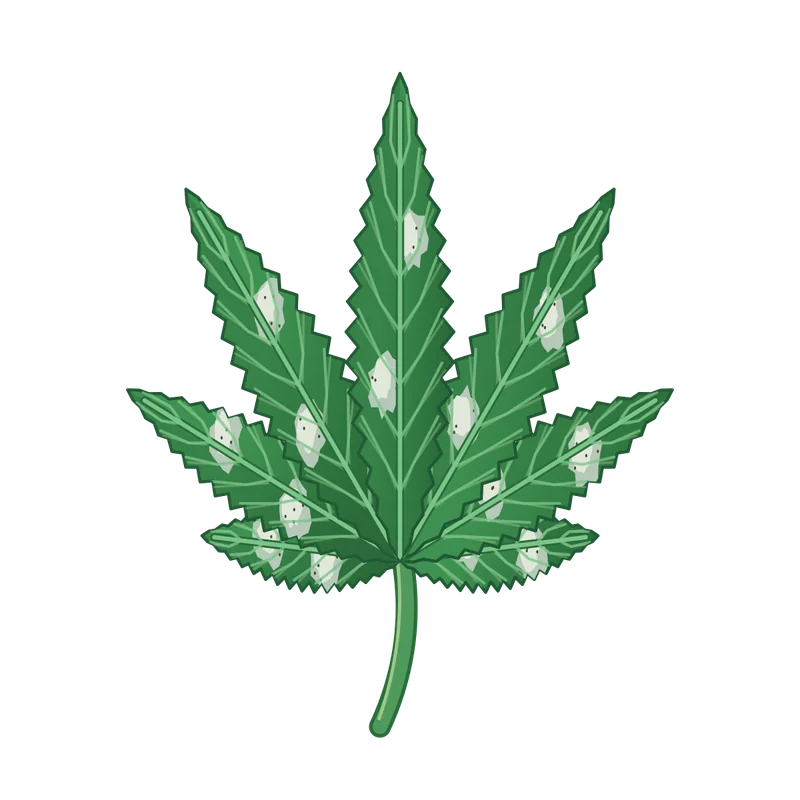
Silvery or pale scraped patches with tiny black specks point to thrips. Look for the slender insects themselves before you treat, because other pests leave similar marks.
On this page
Thrips are hard to clear, so catching them early matters.
What it looks like
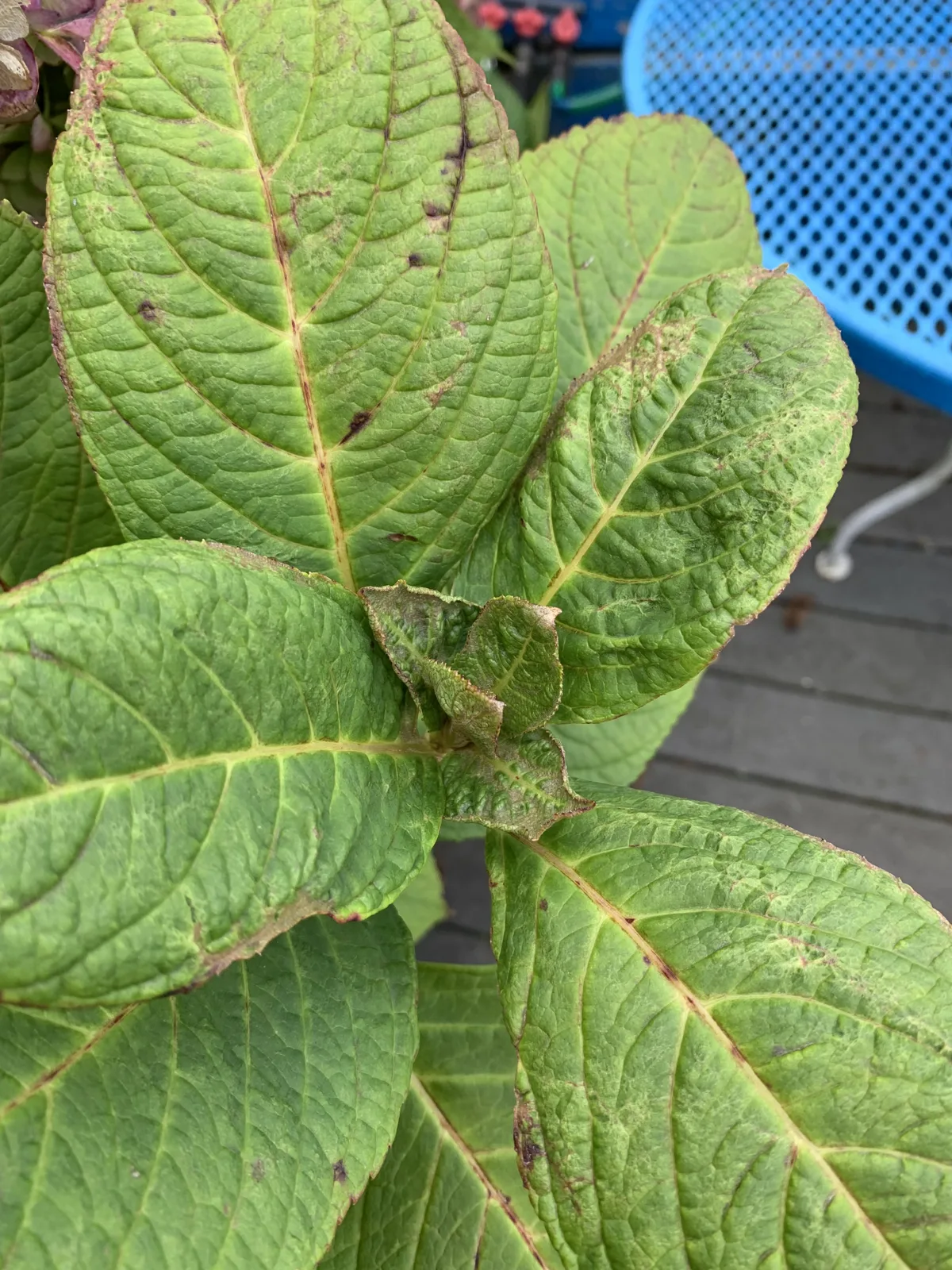
Thrips puncture the outer layer of a leaf and suck out what’s inside. That leaves stippling, discolored flecks or a silvery surface, usually with black, varnish-like specks of droppings. Damaged leaves can turn papery and distorted, drop early, and growth can be stunted (UC IPM).
The insects themselves are tiny and slender, less than 1/20 inch long. Their color runs from translucent white or yellowish to dark brown or black.
Why it happens
Thrips can drift long distances on the wind, and they also travel on infested plants (UC IPM). Two species come up most often on cannabis. Onion thrips can cause serious leaf damage indoors, while western flower thrips is mostly associated with flowers and pollen (Cranshaw et al. 2019).
Outdoors, onion thrips usually don’t reach damaging levels because plants grow so fast (Cranshaw et al. 2019). Indoors it’s a different story: in one controlled study on indoor cannabis, onion thrips multiplied on the plants, and plants that started with no thrips had higher fresh yields (McCune et al. 2021).
Part of why they’re hard to clear is that most plant-feeding species drop to the soil or leaf litter, or lodge in crevices, for the non-feeding stages (UC IPM). A spray on the leaves may not reach those. In warm weather, egg to adult can take as little as 2 weeks.
How to confirm it
- Shake foliage or flowers over light-colored paper and look for tiny slender insects moving.
- Hang bright yellow sticky traps to catch adults.
- Don’t treat on trap counts alone. Finding thrips doesn’t prove they’re causing the damage, and adults in flowers may just be feeding on pollen (UC IPM).
What else it could be: mites also stipple leaves, so check for round mites and webbing. And by the time you see the damage, the thrips that caused it may have moved on.
What to do
- Remove badly damaged growth on a small number of plants, and keep the plants well watered and not overfed with nitrogen, which may encourage thrips (UC IPM).
- Clean up. Clear plant debris and control weeds in and around the grow (Purdue Extension).
- Quarantine new plants until you know they’re clean (Purdue Extension).
- Be realistic about predators. Predatory mites, minute pirate bugs and lacewings all eat thrips. But there’s little research on releasing them in gardens and landscapes, and UC IPM says it’s unlikely to give satisfactory control in most situations there. Indoors, short days can also push some predators, including the minute pirate bug Orius insidiosus, into dormancy (Lemay et al. 2022).
- Use spinosad carefully, if at all. UC IPM lists it as an option but warns it harms some natural enemies and bees, and says not to apply it to flowering plants. Whether it’s allowed on cannabis depends on your state, so check first.
Keep sprays off buds you plan to smoke. One study of contaminated flower found residues of four synthetic chemicals carried over into smoke, as much as 69.5% depending on the chemical and the device (Sullivan et al. 2013). We found no similar study for soaps, oils or biological products, so we can’t tell you those are safe to smoke. Few products are registered for cannabis at all (Lemay et al. 2022), and which ones are allowed differs by state, so check the label and your state’s rules first.
How much to trust this
The yield study is the strongest evidence here, and it’s specific: one thrips species, indoors, with plants started at set infestation levels. We could read its abstract but not its full text, so we’re not quoting its figures. It shows thrips can cost yield, not how much a particular infestation will cost you.
The advice on identifying and managing thrips is mostly from general guidance for gardens and landscapes, not cannabis trials. We found no study comparing thrips treatments on smokable cannabis.
Photos
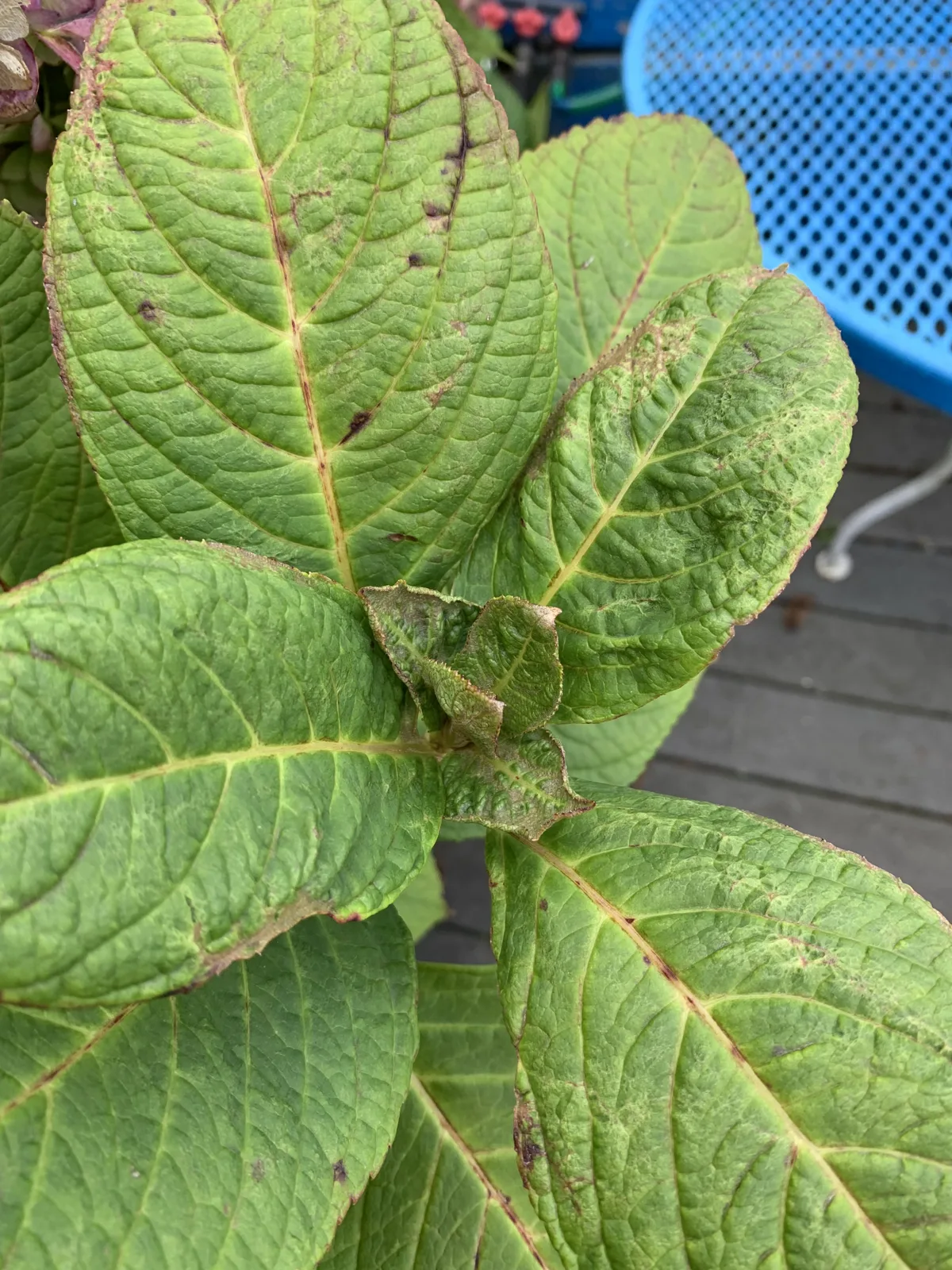
1 photo of thrips: silvery scrapes and black specks
It could also be
These share symptoms with this one. Open each to see what tells them apart.
-
 Pest
Spider mites: pale speckles, then webbing
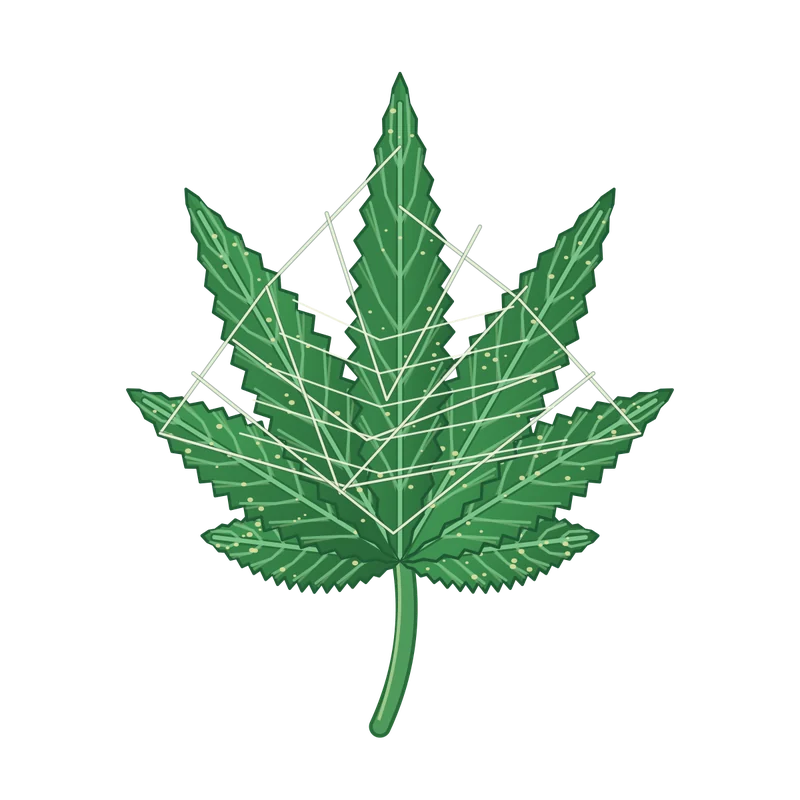
Fine pale speckles on the leaves, with tiny moving dots or webbing underneath, point to spider mites. Check the underside…
Pale speckling · Visible bugs · Webbing · Yellowing
-
 Pest
Hemp russet mites: the pest you can’t see
Upward-curling leaf edges and a dull, bronzed look, with no webbing and no bugs you can find, may mean russet…
Browning / necrosis · Curling or clawing · Other discolouration · Pale speckling
-
 Pest
Aphids: clusters and sticky leaves
Clusters of small soft insects on stems and under leaves, often with sticky or shiny residue, mean aphids. They can…
Sticky or shiny residue · Stunted growth · Visible bugs · Wilting or drooping
-
 Pest
Whiteflies: a white cloud when you shake the plant
Tiny white insects that fly up when you water or brush the plant are whiteflies. Keep a yellow sticky card…
Sticky or shiny residue · Visible bugs · Wilting or drooping · Yellowing
-
 Disease
Powdery mildew: white dusty patches on leaves
White, flour-like spots on the top of leaves are usually powdery mildew. Remove affected leaves early, because new spores can…
Spots · Surface coating or powder · Buds · Lower fan leaves
-
 Watering
Underwatering: a light pot and a limp plant
A limp plant in a pot that feels very light probably just needs water. Water it slowly until the whole…
Browning / necrosis · Stunted growth · Wilting or drooping · Yellowing
Sources (6)
- McCune, F., Morphy, C., Eaves, J., & Fournier, V. (2021). Onion thrips, Thrips tabaci (Thysanoptera: Thripidae), reduces yields in indoor-grown cannabis. Phytoprotection, 101(1). https://doi.org/10.7202/1076365ar [Evidence access: ABSTRACT VERIFIED; full text NOT VERIFIED.]
- Cranshaw, W., Schreiner, M., Britt, K., Kuhar, T.P., McPartland, J., & Grant, J. (2019). Developing insect pest management systems for hemp in the United States: a work in progress. Journal of Integrated Pest Management, 10(1), 26. https://doi.org/10.1093/jipm/pmz023
- Lemay, J., Zheng, Y., & Scott-Dupree, C. (2022). Factors influencing the efficacy of biological control agents used to manage insect pests in indoor cannabis (Cannabis sativa) cultivation. Frontiers in Agronomy, 4, 795989. https://doi.org/10.3389/fagro.2022.795989
- Bethke, J.A., Dreistadt, S.H., & Varela, L.G. (2014). Pest Notes: Thrips. UC ANR Publication 7429. https://ipm.ucanr.edu/legacy_assets/PDF/PESTNOTES/pnthrips.pdf
- Serber, Z., & Long, E.Y. (2021). Management strategies for common arthropod pests of greenhouse hemp in Indiana. Purdue Extension, E-275-W. https://www.extension.entm.purdue.edu/publications/E-275/E-275.pdf
- Sullivan, N., Elzinga, S., & Raber, J.C. (2013). Determination of pesticide residues in cannabis smoke. Journal of Toxicology, 2013, 378168. https://doi.org/10.1155/2013/378168 [Evidence access: ABSTRACT VERIFIED; full text NOT VERIFIED.]