

Pest
Aphids: clusters and sticky leaves
Clusters of small soft insects on stems and under leaves, often with sticky or shiny residue, mean aphids. They can be knocked back early, but they multiply quickly and can end up…
On this page
Once you’ve seen them, check your plants at least twice a week.
What it looks like
The cannabis aphid feeds only on cannabis. Adults are 1.8 to 2.7 mm long, visible to the naked eye, and may or may not have wings. They range from pale pink or green to brown. Other aphids can show up too, including green peach aphid, so not every aphid on your plant is this one (Purdue Extension).
Look for two tube-like structures sticking out from the rear, called cornicles. They’re what separate aphids from other small insects (UC IPM).
Other signs (Purdue Extension):
- Honeydew: a sugary waste that makes leaves and buds look shiny or wet
- Sooty mold: a dark growth on the honeydew, which can reduce yield and plant growth
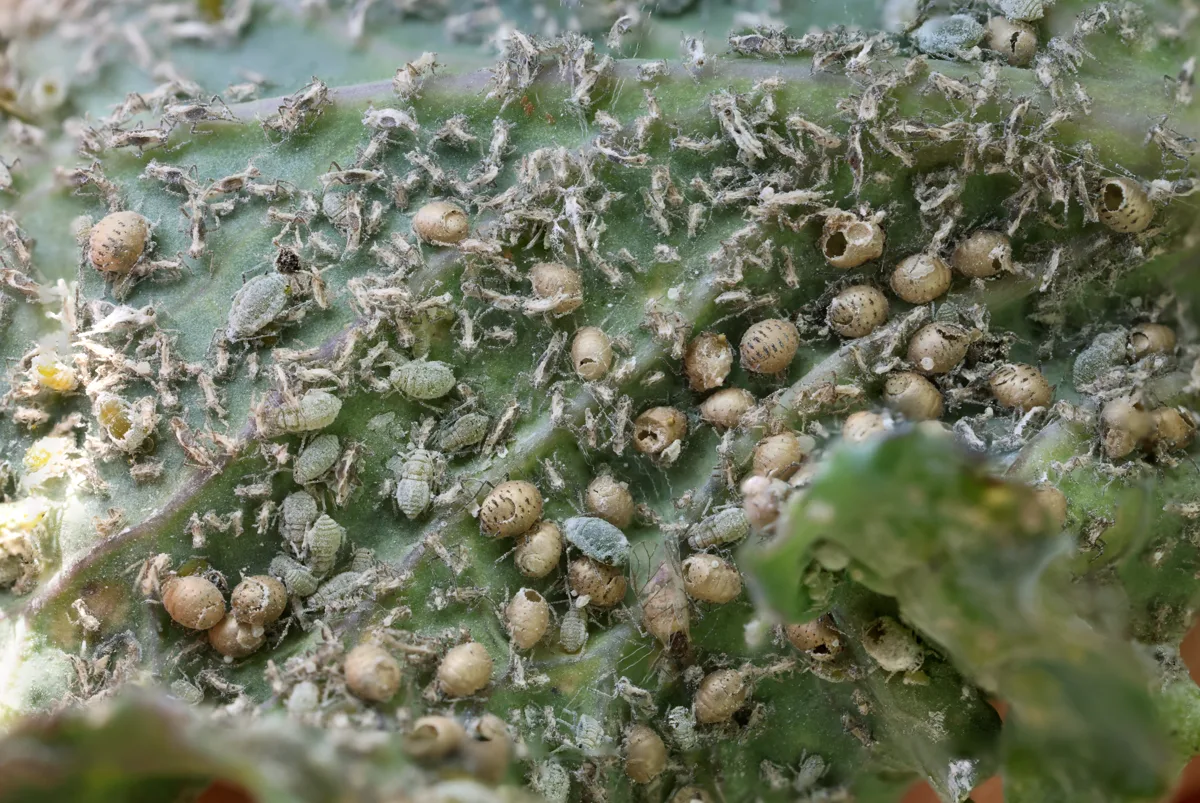
- White cast skins on leaves, stems or the soil
- Yellowing, wilting and stunted growth as they drain the plant
Cannabis aphids move onto maturing flowers late in the season, and their eggs can end up in harvested buds (Cranshaw et al. 2019).
Why it happens
The cannabis aphid’s life cycle isn’t well studied, but females likely reproduce without mating and give birth to live young, as other aphids do, so a few can quickly become many (Purdue Extension). In aphids generally, a young one can reach adulthood in seven to eight days in warm weather, and each adult can produce up to 80 offspring in a week (UC IPM). Indoors under adequate light, cannabis aphids can keep reproducing all year (Cranshaw et al. 2019).
They usually arrive on new plants or cuttings. Ants protect aphids from their natural enemies, so ants on your plants are worth noticing (UC IPM).
Root aphids
Rice root aphid lives almost entirely underground and can cause significant decline in indoor plants. Winged forms can turn up on the leaves, but most of their young migrate down to the roots (Cranshaw et al. 2019). If a plant is declining with no clear cause and you’re seeing winged aphids, check the roots.
How to confirm it
- Check buds, stems and the undersides of leaves at least twice a week, on several plants.
- Look for cast skins and honeydew, which you may spot before the insects.
- Use a lens to find the cornicles.
What else it could be: whiteflies also leave honeydew, but they fly up when you disturb the plant. Aphids don’t move quickly when disturbed.
What to do
- Isolate the plant, and quarantine new ones until you know they’re clean (Purdue Extension).
- Prune out infested leaves and stems, and knock aphids off with a strong stream of water if the plant is sturdy. Do it early in the day so leaves dry quickly (UC IPM).
- Use soap or oil on leaves if you need to. They only kill the aphids they touch, so cover the undersides and repeat. Don’t use them on water-stressed plants or above 90°F, and test a small area first (UC IPM).
- Use parasitic wasps early, not as a rescue. Aphidius species attack cannabis aphids and are sold commercially, but they work best at low numbers and can’t clear a heavy infestation (Purdue Extension). Brown or gold swollen aphids, called mummies, mean they’re working.
- Go easy on nitrogen. Excess nitrogen is linked to more aphids in general (UC IPM).
- Avoid broad-spectrum insecticides. They kill the insects that eat aphids.
Light can work against predators. Twelve-hour flowering days can push the aphid predator Aphidoletes aphidimyza into dormancy (Lemay et al. 2022), so it may be less useful once you’ve flipped.
Keep sprays off buds you plan to smoke. One study of contaminated flower found residues of four synthetic chemicals carried over into smoke, as much as 69.5% depending on the chemical and the device (Sullivan et al. 2013). We found no similar study for soaps, oils or biological products, so we can’t tell you those are safe to smoke. Few products are registered for cannabis at all (Lemay et al. 2022), and which ones are allowed differs by state, so check the label and your state’s rules first.
How much to trust this
The cannabis aphid’s biology isn’t well studied (Purdue Extension), and its effect on yield is unknown (Cranshaw et al. 2019). The breeding figures and most treatment advice come from aphids in general, not this species. We also found no controlled trial of these treatments on smokable cannabis.
Photos
1 photo of aphids: clusters and sticky leaves
It could also be
These share symptoms with this one. Open each to see what tells them apart.
-
 Pest
Whiteflies: a white cloud when you shake the plant
Tiny white insects that fly up when you water or brush the plant are whiteflies. Keep a yellow sticky card…
Sticky or shiny residue · Visible bugs · Wilting or drooping · Yellowing
-
 Watering
Overwatering: wet roots that can’t get air
Drooping or yellowing leaves on a pot that still feels heavy usually mean the roots are too wet. Don't water…
Curling or clawing · Stunted growth · Wilting or drooping · Yellowing
-
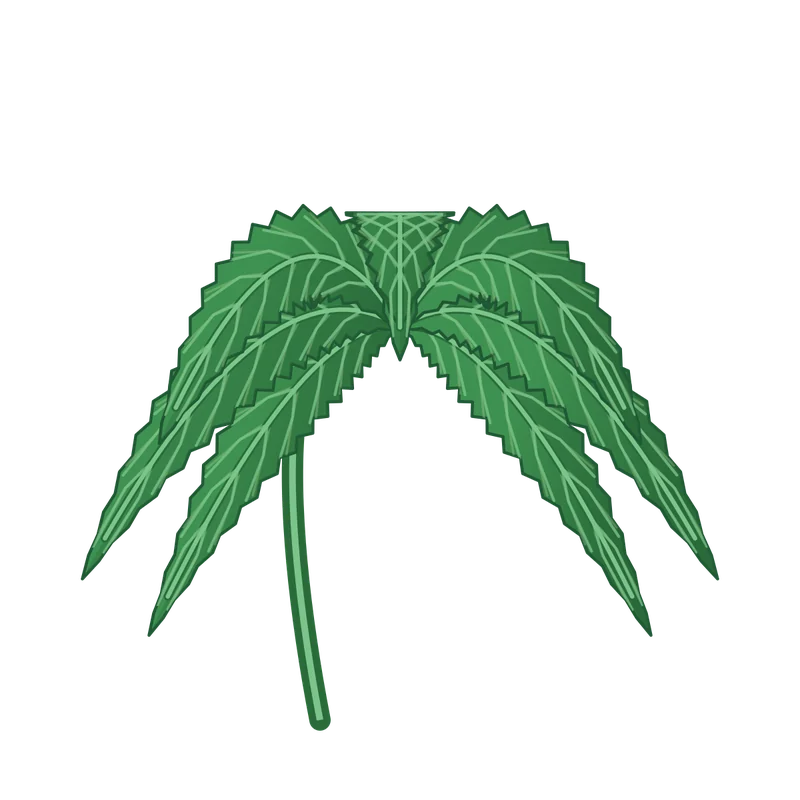 Watering
Underwatering: a light pot and a limp plant
A limp plant in a pot that feels very light probably just needs water. Water it slowly until the whole…
Browning / necrosis · Stunted growth · Wilting or drooping · Yellowing
-
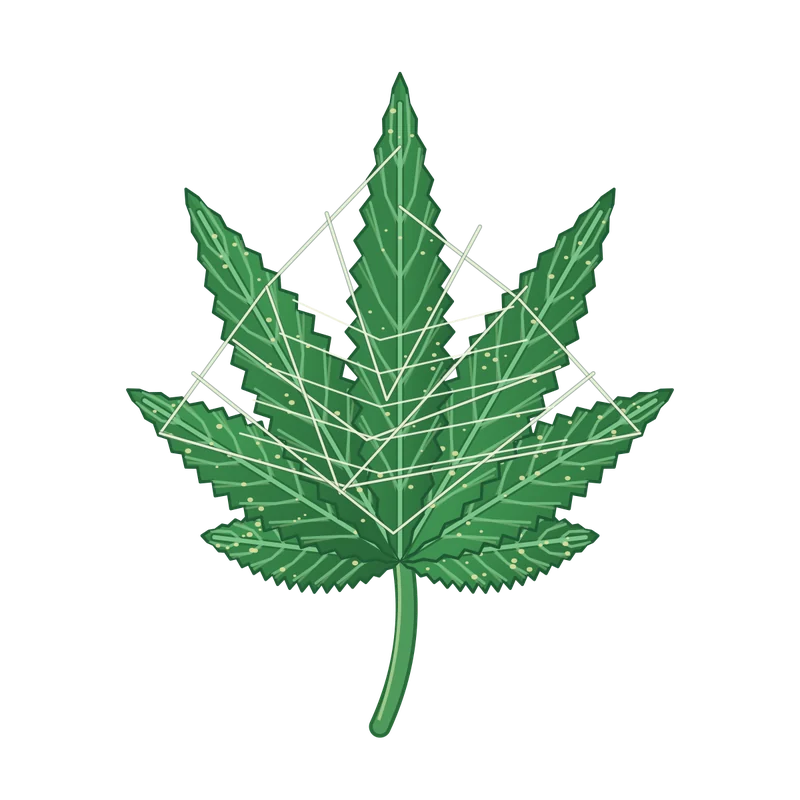 Pest
Spider mites: pale speckles, then webbing
Fine pale speckles on the leaves, with tiny moving dots or webbing underneath, point to spider mites. Check the underside…
Pale speckling · Visible bugs · Webbing · Yellowing
-
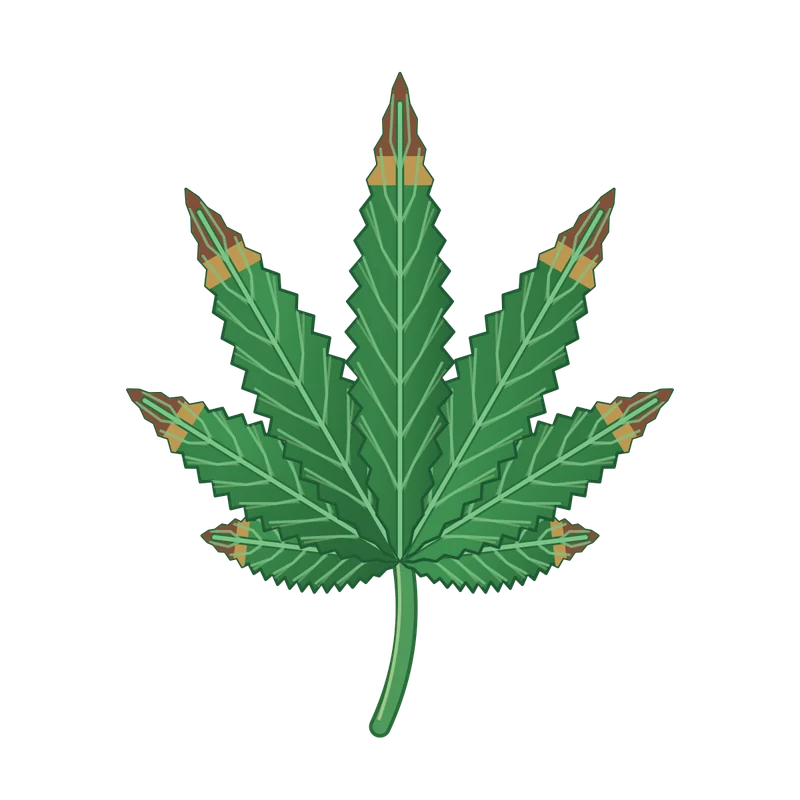 Nutrient toxicity
Nutrient burn: brown tips and edges from too much feed
Brown, crispy tips or edges after a stronger feed may be nutrient burn, but other problems look the same. Test…
Browning / necrosis · Curling or clawing · Wilting or drooping · Yellowing
-
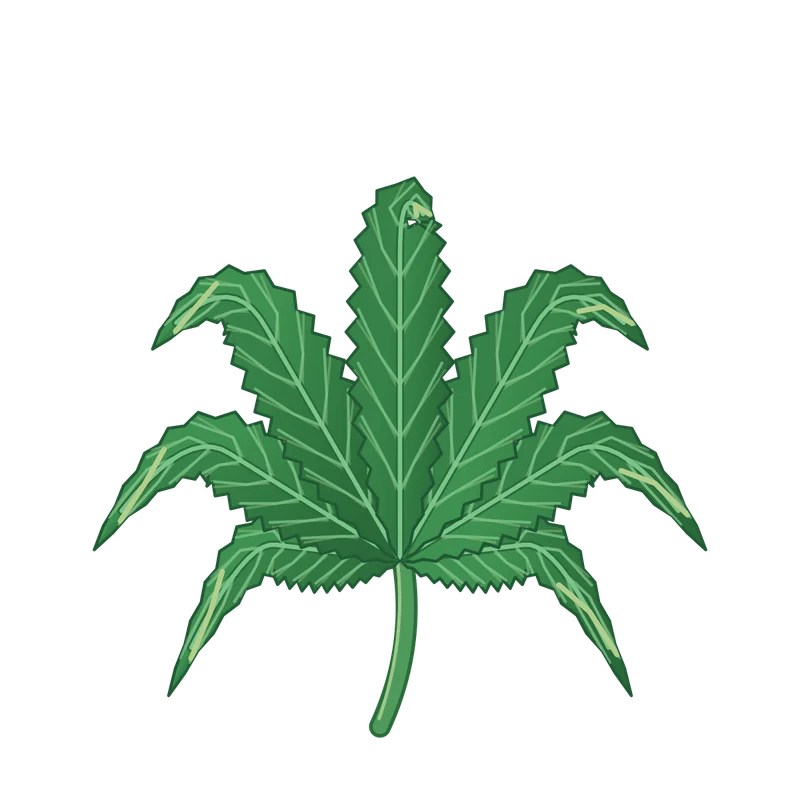 Pest
Hemp russet mites: the pest you can’t see
Upward-curling leaf edges and a dull, bronzed look, with no webbing and no bugs you can find, may mean russet…
Browning / necrosis · Curling or clawing · Other discolouration · Pale speckling
Sources (5)
- Serber, Z., & Long, E.Y. (2021). Management strategies for common arthropod pests of greenhouse hemp in Indiana. Purdue Extension, E-275-W. https://www.extension.entm.purdue.edu/publications/E-275/E-275.pdf
- Cranshaw, W., Schreiner, M., Britt, K., Kuhar, T.P., McPartland, J., & Grant, J. (2019). Developing insect pest management systems for hemp in the United States: a work in progress. Journal of Integrated Pest Management, 10(1), 26. https://doi.org/10.1093/jipm/pmz023
- Lemay, J., Zheng, Y., & Scott-Dupree, C. (2022). Factors influencing the efficacy of biological control agents used to manage insect pests in indoor cannabis (Cannabis sativa) cultivation. Frontiers in Agronomy, 4, 795989. https://doi.org/10.3389/fagro.2022.795989
- UC Statewide IPM Program (2013). Pest Notes: Aphids. UC ANR Publication 7404. https://ipm.ucanr.edu/PMG/PESTNOTES/pn7404.html
- Sullivan, N., Elzinga, S., & Raber, J.C. (2013). Determination of pesticide residues in cannabis smoke. Journal of Toxicology, 2013, 378168. https://doi.org/10.1155/2013/378168 [Evidence access: ABSTRACT VERIFIED; full text NOT VERIFIED.]