

Nutrient deficiency
Yellowing lower leaves: what it is, and when it’s nothing
Before anything else: if you're six or more weeks into flower and it's only the bottom leaves, this is probably normal.
On this page
Before anything else: if you’re six or more weeks into flower and it’s only the bottom leaves, this is probably normal. Fully-fed control plants in a 2023 controlled study began yellowing their lower leaves around week 6 with nothing wrong with them. The plant is pulling resources up into the flowers. That’s the job.
If that’s you, stop here. Don’t feed it anything.
If it’s earlier than that, or it’s spreading, keep reading.
Three things to rule out before diagnosing anything
Most “deficiency” questions aren’t deficiencies. Work through these in order — each one ends with don’t buy anything, which is why you won’t find them at the top of other guides.
1. Natural senescence
Weeks 6+ of flower, lower fan leaves, gradual, working bottom-up. In Llewellyn et al. (2023), control plants receiving complete nutrition started this around week 6 and it complicated the researchers’ own ability to read late-stage symptoms. If the researchers running the experiment had trouble telling it apart from deficiency, you’re not being careless by finding it confusing.
Tell-tale: it’s slow, it’s confined to the oldest growth, and the rest of the plant looks healthy.
2. You’re flushing
The same study notes that pre-harvest flushing “may amplify deficiency appearance or speed senescence.” If you’ve cut nutrients deliberately, the yellowing is the thing you asked for. Judge the plant after a flush, not during one.
3. pH lockout
This is the big one, and it’s the reason “add more nutrients” so often makes things worse.
Below about pH 5.0 the plant’s growth is inhibited regardless of what’s in the reservoir (Veazie et al. 2025). The nutrient can be sitting right there and the plant still can’t use it. Feeding more of something unavailable doesn’t help, and it drives EC up.
Check runoff pH before you change anything. Target 6.0–6.5 at the root zone. Details and the research on the pH page.
If none of those fit: the differential
Lower-leaf yellowing has several plausible causes and the symptom alone does not distinguish them. Here’s what the controlled research actually found, with what would tell them apart.
Most consistent: nitrogen deficiency
In Llewellyn, nitrogen deficiency showed exactly this pattern — lower fan leaves first, then most fan leaves, then sugar leaves. Yellowing began at the leaflet tips around week 3 and spread from base to tip. Petioles turned red-brown.
It’s also the most expensive thing on this list to get wrong: nitrogen-deficient plants yielded 72% less than controls, the largest reduction of any single-element deficiency tested.
Distinguishing feature: the red-brown petioles, and the fact that it keeps climbing the plant rather than staying at the bottom.
An important caveat: foliar nitrogen at symptom onset was not lower than the control in that study. So a tissue test taken when you first notice it may come back normal and still be nitrogen. Timing matters more than the test.
Also consistent: magnesium deficiency
Classic interveinal chlorosis — yellow between the veins while the veins stay green — appearing in lower fan leaves around week 4, progressing to interveinal necrosis.
Distinguishing feature: the pattern. Nitrogen yellows the whole leaf fairly uniformly; magnesium leaves a green skeleton of veins behind.
But: Llewellyn found the smaller, younger fan leaves most affected, with older fan leaves and inflorescence leaves less so — which is the opposite of the textbook mobile-nutrient pattern. Treat “it’s on the bottom, so it’s mobile, so it’s N or Mg” as a weak inference.
Also consistent: calcium deficiency
Yellow-ringed necrotic spots between the veins, starting on lower fan leaves around week 3, concentrated at margins and tips, then moving up the plant.
Distinguishing feature: discrete spots with yellow halos, rather than general yellowing.
Worth knowing: calcium is textbook-immobile, so symptoms are supposed to start in new growth. They didn’t. The authors flag this as differing from the vegetative-stage pattern found in earlier work. This is a real limit on how much the standard rules can be trusted in flower.
Less likely than you’d think: iron or manganese
Growers chase both constantly. In Llewellyn:
- Iron deficiency produced only pale young sugar leaves and some mottling near the apical inflorescence in week 5 — which then disappeared. Lower fan leaf margins browned by week 6. The authors describe no striking symptoms.
- Manganese deficiency produced no visible symptoms at all. The plants were indistinguishable from controls at the end of the trial.
Neither caused a significant yield reduction. If your lower leaves are yellowing, these are unlikely to be why.
How much to trust any of this
Two controlled studies exist on nutrient disorders in cannabis, and they disagree in places.
| Cockson et al. 2019 | Llewellyn et al. 2023 | |
|---|---|---|
| Cultivar | ‘T1’ (hemp) | ‘Gelato 29’ |
| System | Silica sand | Hydroponic |
| Stage | Vegetative | Flowering |
They disagree on where sulfur symptoms start (mid-plant vs upper canopy) and on calcium’s progression. Both are single-cultivar studies.
So: the descriptions above are the best evidence available, from one cultivar, in flower, in hydro. Your plant may differ. That uncertainty is real and the confident symptom charts elsewhere are papering over it.
What to actually do
- Check runoff pH first. Every time, before anything else.
- If it’s week 6+ and only the bottom leaves — do nothing. It’s supposed to happen.
- Look at the petioles. Red-brown alongside the yellowing points toward nitrogen.
- Look at the pattern. Uniform yellowing vs green veins vs discrete haloed spots separates the three main candidates better than location does.
- Photograph it daily. Progression is more diagnostic than any single moment, and it’s what both studies tracked.
- Don’t stack supplements. Adding cal-mag, then iron, then a bloom booster makes the next observation uninterpretable. Change one thing.
- If it’s climbing the plant quickly, act on nitrogen. It’s the costliest to get wrong by a wide margin.
Photos
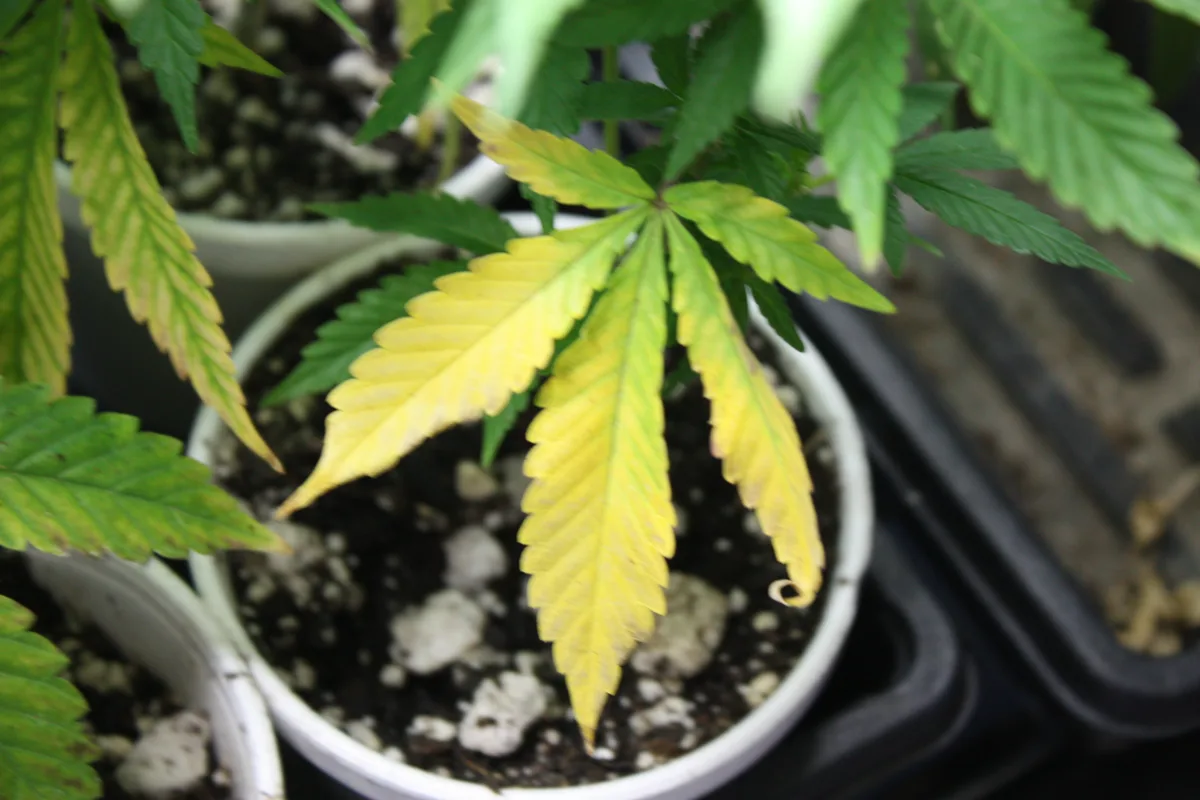
1 photo of yellowing lower leaves: what it is, and when it’s nothing
It could also be
These share symptoms with this one. Open each to see what tells them apart.
-
 Watering
Overwatering: wet roots that can’t get air
Drooping or yellowing leaves on a pot that still feels heavy usually mean the roots are too wet. Don't water…
Curling or clawing · Stunted growth · Wilting or drooping · Yellowing
-
 Watering
Underwatering: a light pot and a limp plant
A limp plant in a pot that feels very light probably just needs water. Water it slowly until the whole…
Browning / necrosis · Stunted growth · Wilting or drooping · Yellowing
-
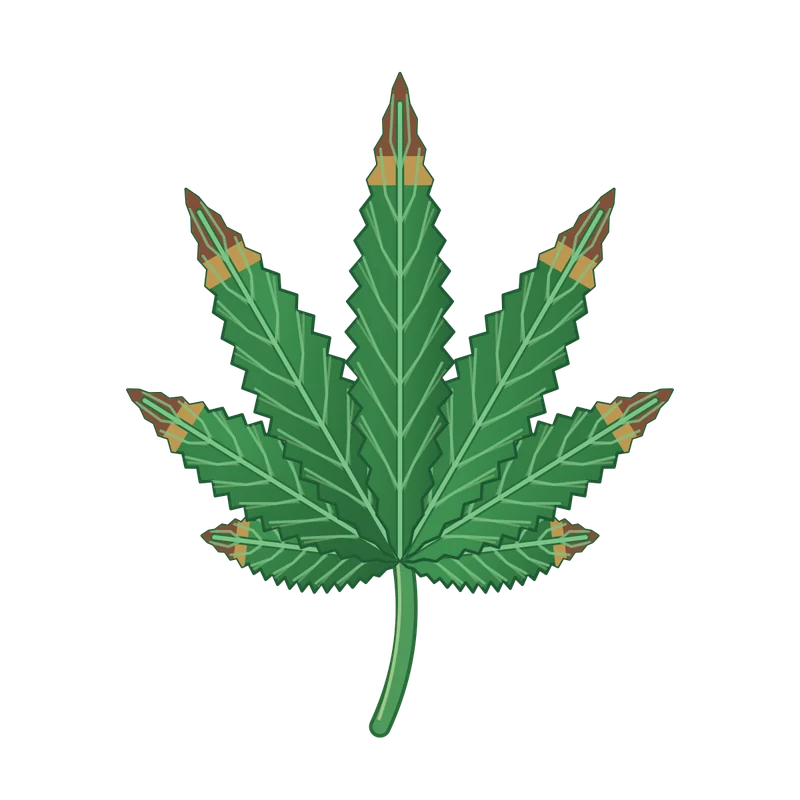 Nutrient toxicity
Nutrient burn: brown tips and edges from too much feed
Brown, crispy tips or edges after a stronger feed may be nutrient burn, but other problems look the same. Test…
Browning / necrosis · Curling or clawing · Wilting or drooping · Yellowing
-
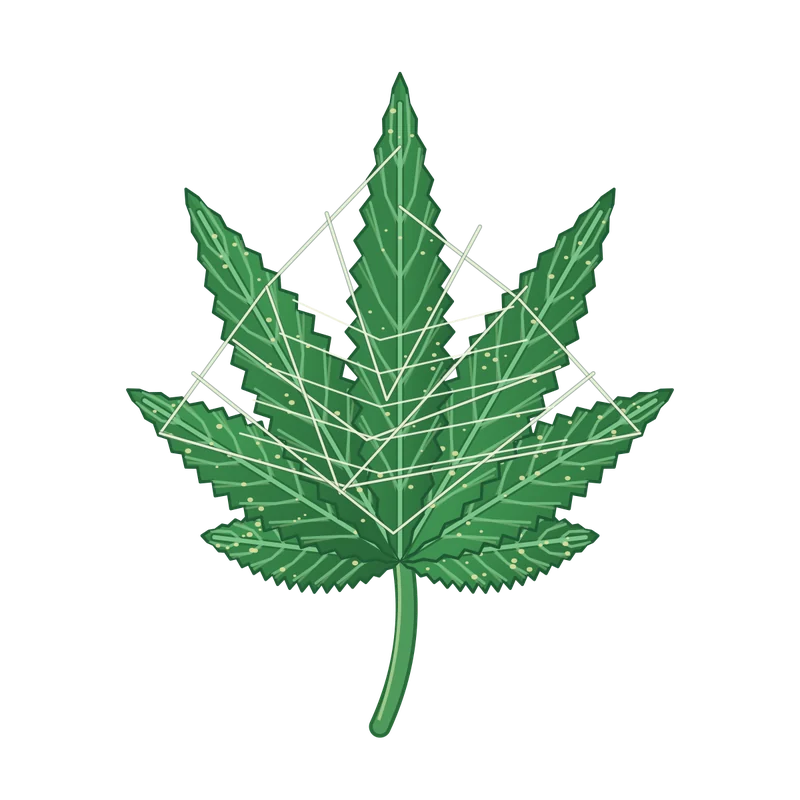 Pest
Spider mites: pale speckles, then webbing
Fine pale speckles on the leaves, with tiny moving dots or webbing underneath, point to spider mites. Check the underside…
Pale speckling · Visible bugs · Webbing · Yellowing
-
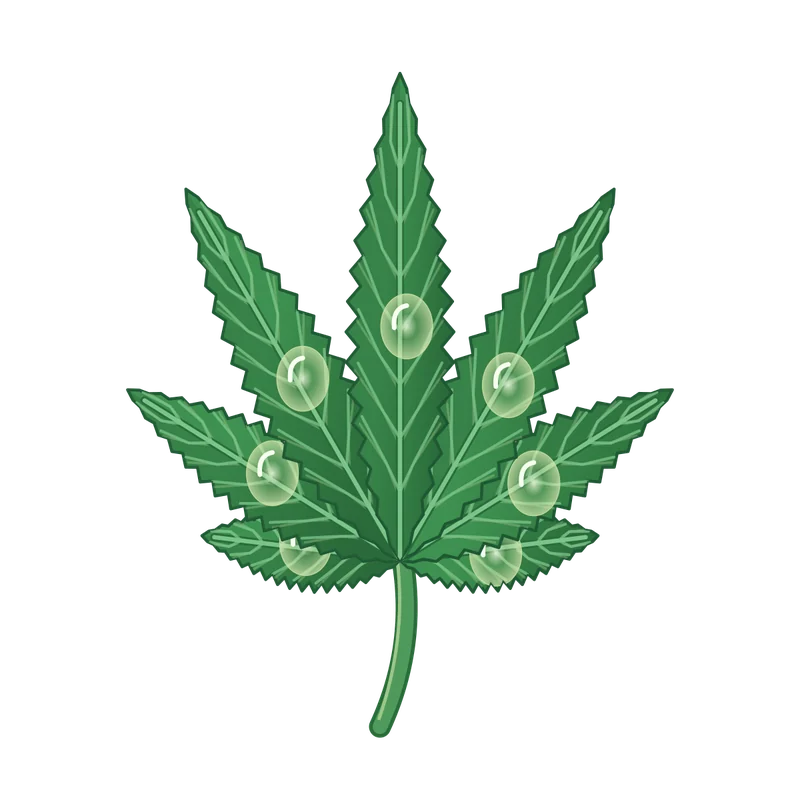 Pest
Aphids: clusters and sticky leaves
Clusters of small soft insects on stems and under leaves, often with sticky or shiny residue, mean aphids. They can…
Sticky or shiny residue · Stunted growth · Visible bugs · Wilting or drooping
-
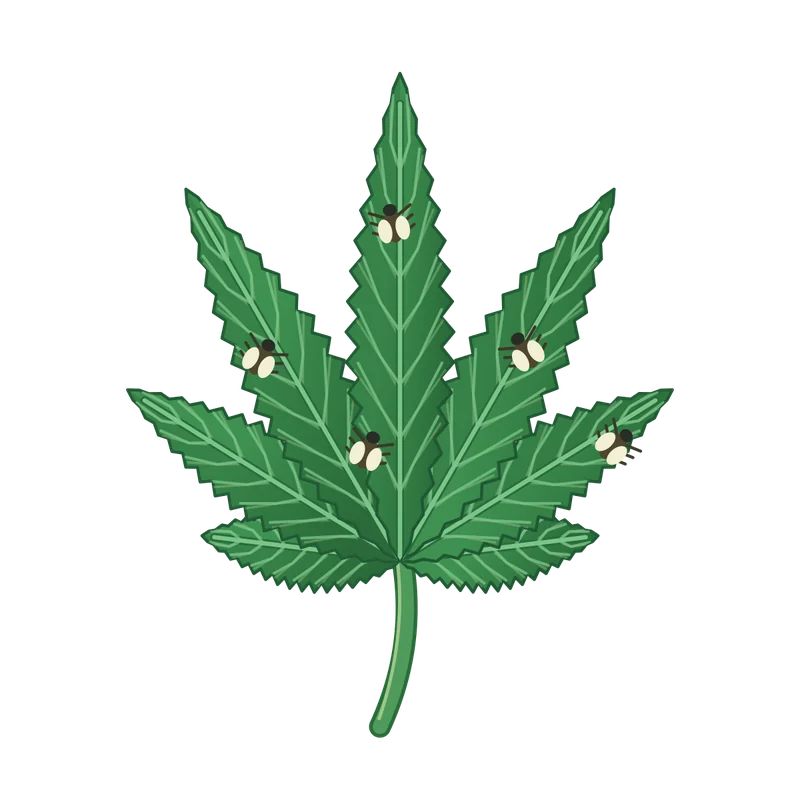 Pest
Whiteflies: a white cloud when you shake the plant
Tiny white insects that fly up when you water or brush the plant are whiteflies. Keep a yellow sticky card…
Sticky or shiny residue · Visible bugs · Wilting or drooping · Yellowing
Sources (3)
- Llewellyn, D., Golem, S., Jones, A.M.P., & Zheng, Y. (2023). Foliar symptomology, nutrient content, yield, and secondary metabolite variability of cannabis grown hydroponically with different single-element nutrient deficiencies. Plants, 12(3), 422. https://doi.org/10.3390/plants12030422
- Cockson, P., Landis, H., Smith, T., Hicks, K., & Whipker, B.E. (2019). Characterization of nutrient disorders of Cannabis sativa. Applied Sciences, 9(20), 4432. https://doi.org/10.3390/app9204432
- Veazie, P., Cockson, P., Smith, J.T., Schulker, B., Jackson, B., Hicks, K., & Whipker, B. (2025). Impact of substrate pH and micronutrient fertility rates on Cannabis sativa. Agrosystems, Geosciences & Environment, 8(1), e70044. https://doi.org/10.1002/agg2.70044